US reaches nuclear deal with Armenia during Vance visit

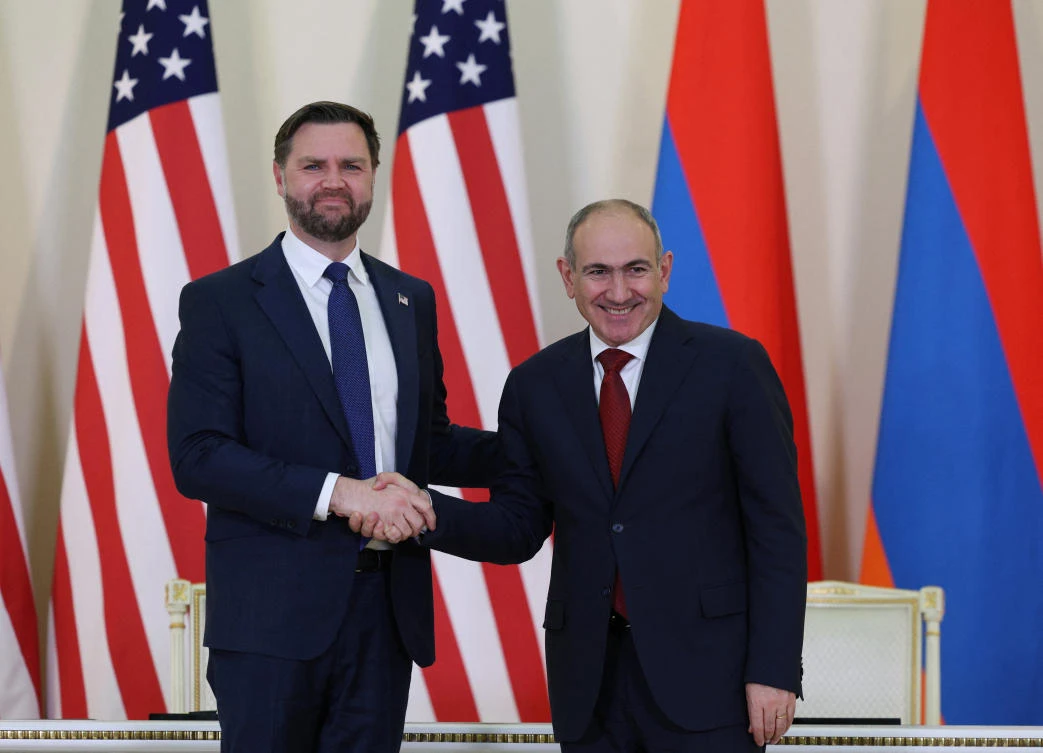
US Vice President JD Vance and Armenia's Prime Minister Nikol Pashinyan in Yerevan where they signed a civilian nuclear deal. (Reuters)
Short Url
Updated 09 February 2026
Follow

US reaches nuclear deal with Armenia during Vance visit

  • JD Vance’s visit to Armenia follows US-brokered peace accord with Azerbaijan mending relations after decades of war
  • Agreement will ‌allow ⁠up ​to $5bn in initial US exports to Armenia, plus an additional $4bn in longer-term fuel and maintenance contracts

TBILISI: Armenia and the United States agreed on Monday to cooperate in the civil nuclear sector as Washington sought to bolster ties with a former close ally of Russia, months after Washington brokered a peace agreement in the South Caucasus.
A statement on the nuclear sector deal was signed by Armenian Prime Minister Nikol Pashinyan and US Vice President JD Vance, who is on a two-day visit to the country.
The two said they had completed negotiations on what is known as a 123 Agreement, which allows the ‌US to legally license ‌nuclear technology and equipment to other countries.
The agreement will ‌allow ⁠up ​to $5 ‌billion in initial US exports to Armenia, plus an additional $4 billion in longer-term fuel and maintenance contracts, Vance said.
“This agreement will open a new chapter in the deepening energy partnership between Armenia and the United States,” Pashinyan said at a joint press conference with Vance.
Long heavily dependent on Russia and Iran for its energy supplies, Armenia is now reviewing proposals from US, Russian, Chinese, French and South Korean companies to construct a new nuclear reactor to replace its sole, aging ⁠Russian-built nuclear power plant, Metsamor.
No choice has yet been made, but Monday’s announcement paves the way for an American ‌project to be selected. That would deal a blow to ‍Russia, which traditionally has viewed the ‍South Caucasus as its sphere of influence but whose clout there has diminished as a ‍result of its invasion of Ukraine.

'Diversify partners’

“Considering Armenia’s multiplicity of dependencies on Russia, it is a political priority to diversify partners when it comes to nuclear cooperation,” said Narek Sukiasyan, a political scientist in Yerevan.
“The United States seems to be the preference now.”
Vance’s visit comes just six months after ​the Armenian and Azerbaijani leaders signed an agreement at the White House seen as the first step toward peace after nearly 40 years of war.
Vance ⁠was also seeking to advance the “Trump Route for International Peace and Prosperity (TRIPP),” a proposed 43-kilometer (27-mile) corridor that would run across southern Armenia and give Azerbaijan a direct route to its exclave of Nakhchivan and in turn to Turkiye, Baku’s close ally.
The route would better connect Asia to Europe while — crucially for Washington — bypassing Russia and Iran at a time when Western countries are keen on diversifying energy and trade routes away from Russia due to the Ukraine conflict.
The TRIPP corridor, which envisages new or updated rail infrastructure, oil and gas pipelines and fiber-optic cables, would transform the South Caucasus, a region riven by closed borders and longstanding ethnic conflicts.
“We’re not just making peace for Armenia,” Vance said. “We’re also creating real prosperity for Armenia and ‌the United States together.”
He is set to visit Azerbaijan on Wednesday and Thursday, according to the White House.

Europeans push back at US over claim they face ‘civilizational erasure’

Updated 16 February 2026
Follow

Europeans push back at US over claim they face ‘civilizational erasure’

  • “Contrary to what some may say, woke, decadent Europe is not facing civilizational erasure,” Kallas told the conference

MUNICH: A top European Union official on Sunday rejected the notion that Europe faces “civilizational erasure,” pushing back at criticism of the continent by the Trump administration.
EU foreign policy chief Kaja Kallas addressed the Munich Security Conference a day after US Secretary of State Marco Rubio offered a somewhat reassuring message to European allies. He struck a less aggressive tone than Vice President JD Vance did in lecturing them at the same gathering last year but maintained a firm tone on Washington’s intent to reshape the trans-Atlantic alliance and push its policy priorities.
Kallas alluded to criticism in the US national security strategy released in December, which asserted that economic stagnation in Europe “is eclipsed by the real and more stark prospect of civilizational erasure.” It suggested that Europe is being enfeebled by its immigration policies, declining birth rates, “censorship of free speech and suppression of political opposition” and a “loss of national identities and self-confidence.”
“Contrary to what some may say, woke, decadent Europe is not facing civilizational erasure,” Kallas told the conference. “In fact, people still want to join our club and not just fellow Europeans,” she added, saying she was told when visiting Canada last year that many people there have an interest in joining the EU.
Kallas rejected what she called “European-bashing.”
“We are, you know, pushing humanity forward, trying to defend human rights and all this, which is actually bringing also prosperity for people. So that’s why it’s very hard for me to believe these accusations.”
In his conference speech, Rubio said that an end to the trans-Atlantic era “is neither our goal nor our wish,” adding that “our home may be in the Western hemisphere, but we will always be a child of Europe.”
He made clear that the Trump administration is sticking to its guns on issues such as migration, trade and climate. And European officials who addressed the gathering made clear that they in turn will stand by their values, including their approach to free speech, climate change and free trade.
British Prime Minister Keir Starmer said Saturday that Europe must defend “the vibrant, free and diverse societies that we represent, showing that people who look different to each other can live peacefully together, that this isn’t against the tenor of our times.”
“Rather, it is what makes us strong,” he said.
Kallas said Rubio’s speech sent an important message that America and Europe are and will remain intertwined.
“It is also clear that we don’t see eye to eye on all the issues and this will remain the case as well, but I think we can work from there,” she said.