

Thousands protest over Herzog’s visit to Australia

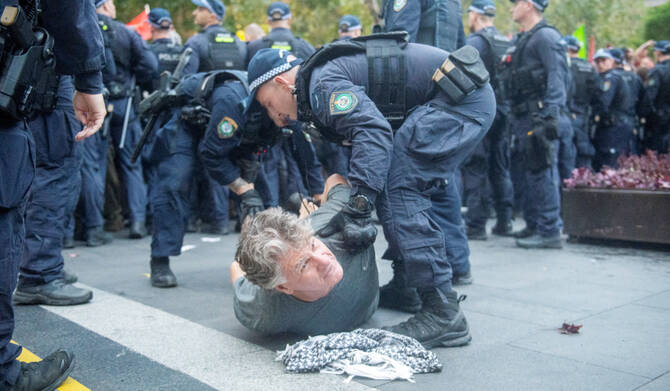
Police officers detain a protester as demonstrators gather at Town Hall Square to protest against Israeli President Isaac Herzog's state visit to Australia following a deadly mass shooting during a Jewish Hanukkah celebration at Bondi Beach on December 14, in Sydney, Australia, February 9, 2026. (REUTERS)
Short Url
Updated 09 February 2026
Follow

Thousands protest over Herzog’s visit to Australia

  • Palestine Action Group spokesman Josh Lees said on Instagram the police had “repeatedly charged us with horses and pepper spray”

SYDNEY: Sydney police used pepper spray on protesters on Monday as a rally against a visit to Australia by Israel’s President Isaac Herzog turned violent.
The head of state’s tightly secured, four-day visit was aimed at consoling Australia’s Jewish community in the wake of the December shooting at Sydney’s Bondi Beach that killed 15 people at a Hanukkah festival.
But he was met with protests in Australia’s two largest cities on Monday evening, with a Sydney rally turning violent as police hit protesters and members of the media, including AFP, with pepper spray.

BACKGROUND

Crowds also gathered in the center of Melbourne demanding an end to Israel’s occupation of Palestinian territories.

An AFP journalist said they saw at least 15 protesters being arrested as members of the rally scuffled with the police.
Palestine Action Group spokesman Josh Lees said on Instagram the police had “repeatedly charged us with horses and pepper spray.”
New South Wales police declined to comment when contacted by AFP.
Crowds also gathered in the center of Melbourne demanding an end to Israel’s “occupation” of Palestinian territories.
Prime Minister Anthony Albanese had urged people to be respectful of the reason for Herzog’s visit, saying he would join the president to meet with the families of those killed at Bondi Beach.
The New South Wales state government invoked new powers giving police greater powers to control demonstrations prior to the rally.
An attempt by protesters to overturn those powers in the state’s Supreme Court failed just before the rally began, local media reported.
Not far from the protests, Herzog took part in an event on Monday evening titled “An Evening of Light and Solidarity” for the victims of the Dec. 14 killings.
Earlier, the Israeli president paid homage to the victims under rain and grey skies as he laid a wreath outside the beachside Bondi Pavilion.
“The bonds between good people of all faiths and all nations will continue to hold strong in the face of terror, violence, and hatred,” he said.
“We shall overcome this evil together.”
Herzog said he laid two stones from Jerusalem at Bondi Beach “in sacred memory of the victims.”


Britain needs to step up defense spending faster, says Starmer

Britain's Prime Minister Keir Starmer takes part in a panel discussion in Munich, Germany. (AP file photo)
Updated 5 sec ago
Follow

Britain needs to step up defense spending faster, says Starmer

  • Britain’s budget watchdog, the Office for Budget Responsibility, said last year that raising defense spending to 3 percent of the GDP would cost an additional £17.3 billion a year ($24 billion) in 2029-30

LONDON: Britain should step up and accelerate its ​defense spending, Prime Minister Keir Starmer said on Monday, following a report that the government was considering bringing forward its target to spend 3 percent of economic output on defense.
Britain, which has warned of the risks posed by Russia, said in February 2025 that it would lift annual defense spending to 2.5 percent of the GDP by 2027 and aim for 3 percent in the next Parliament, which is expected to begin after an ‌election due in ‌2029.
The BBC reported that the government was ​now ‌exploring ways to ​reach the 3 percent target by 2029. It said no decision had been taken but the government recognized current plans would not cover rising defense costs.

HIGHLIGHT

The BBC reported that the government is ​now ‌exploring ways to ​reach the 3 percent target by 2029.

Asked whether he would bring the target forward to 2029, Starmer echoed comments he made at the Munich Security Conference, where he said Europe had united to support Ukraine with the supply of weapons and munitions and to strengthen military readiness.
“We need to step up. That means on ‌defense spending, we need to go faster,” ‌Starmer told reporters on Monday. “We’ve obviously made commitments ​already in relation to that, but ‌it goes beyond just how much you spend.”
Latest NATO estimates show ‌that Britain spent 2.3 percent of the GDP on defense in 2024, above the alliance’s 2 percent guideline. But like other European countries, it has faced US pressure to spend more to protect the continent. Struggling with high debt and spending commitments, the government last ‌year cut its international aid budget to fund the hike in defense spending to 2.5 percent of GDP but is yet to publish an investment plan with spending priorities, something that has frustrated the defense industry.
Britain’s budget watchdog, the Office for Budget Responsibility, said last year that raising defense spending to 3 percent of the GDP would cost an additional £17.3 billion a year ($24 billion) in 2029-30.
Finance Minister Rachel Reeves has struggled to stay on track with her plans to repair the public finances. The BBC said the Finance Ministry was believed to be cautious about the new defense spending proposals.
A government spokesperson said Britain was “delivering ​the largest sustained increase in defense ​spending since the Cold War.”