

Saudi-Turkiye ties in urban development to flourish as officials meet in Istanbul  

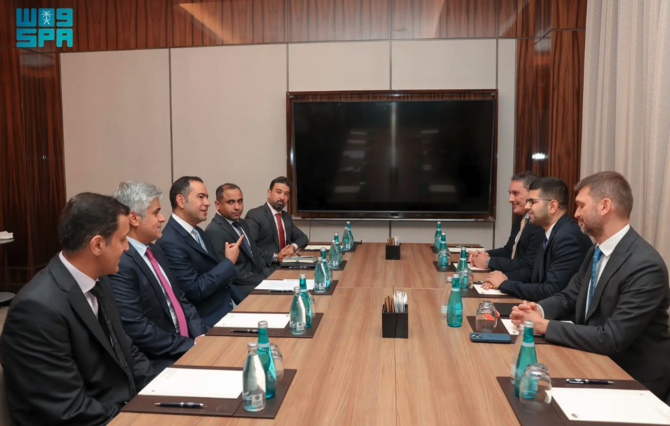
Saudi Arabia’s Minister of Municipal and Rural Affairs and Housing, Majid bin Abdullah Al-Hogail, meeting with the Head of the Investment Office of the Presidency of Turkiye, Burak Daglioglu. SPA
Short Url
Updated 03 July 2024
Follow

Saudi-Turkiye ties in urban development to flourish as officials meet in Istanbul  

RIYADH: Bilateral cooperation between Saudi Arabia and Turkiye is poised to expand in the fields of real estate, infrastructure, and waste management as ministers convene in Istanbul.   

During the three-day official tour running until July 4, Saudi Arabia’s Minister of Municipal, Rural Affairs, and Housing, Majid bin Abdullah Al-Hogail, is scheduled to meet with various officials and companies in Turkiye to explore opportunities for enhancing cooperation and investment in these sectors. 

This comes against the backdrop of active ministerial engagements aimed at boosting cooperation, with Saudi Arabia and Turkiye seeing their bilateral trade surpass SR26 billion ($6.93 billion) in 2023. 

The Saudi real estate market is rapidly advancing with ambitious urban development projects and substantial infrastructure investments, attracting global interest while emphasizing sustainability and innovation. 

On arrival in Istanbul, the minister met with the Turkiye Presidency’s Investment Office Chief, Burak Daglıoglu, to discuss fostering bilateral cooperation.  

Al-Hogail emphasized the deep and strong relations between Saudi Arabia and Turkiye, commending their robust commercial ties and joint investments.   

He underscored the Kingdom’s openness to all companies and expertise in diverse development sectors.   

Highlighting the experience and capabilities of Turkish investment companies in real estate, waste management, and recycling, Al-Hogail noted their suitability for the Saudi market and welcomed their interest in investing in these sectors.  

Furthermore, cooperation between the two countries goes beyond economy as the Saudi Minister of Defense, Prince Khalid bin Salman, met with Turkish President Recep Tayyip Erdogan at the Presidential Palace in Ankara on July 2.  

During the meeting, Prince Khalid and the president reviewed relations between the Kingdom and Turkiye and ways to enhance them. They also discussed regional and international developments and efforts made with regard to them.  

Later on the day, Prince Khalid was received by his Turkish counterpart Yasar Guler at the Ministry of National Defense in Ankara.  

During the meeting, aspects of Saudi-Turkish relations were discussed. Ways to continue strengthening and developing existing and future cooperation paths between the ministries of defense in the two countries were also reviewed.  

Defense cooperation between the two nations was also evident in high-level talks on military capabilities, technology transfer, and scientific research development in January.  

The bilateral committee involving the two countries convened its fourth meeting in Istanbul on Jan. 15, according to the Kingdom’s Ministry of Defense.   

The meeting was attended by Saudi Assistant Minister of Defense Talal bin Abdullah Al-Otaibi, Turkish Deputy Minister of Defense Celal Sami Tufekci, and President of Turkiye’s Defense Industry Agency Haluk Gorgun.    

Saudi Arabia’s Ambassador to Turkiye Fahd bin Asaad Abu Al-Nasr also joined the attendees, along with specialists from the Saudi Ministry of Defense, the General Authority for Military Industries, the General Authority for Defense Development, and Saudi Military Industries — an affiliate of the Public Investment Fund.    

Meanwhile, Al-Otaibi visited Turkiye’s leading drone manufacturer Baykar. He discussed the existing cooperation between his ministry and the Turkish company.    


Oman’s non-oil exports rise 7.5% as diversification gains traction 

Updated 7 sec ago
Follow

Oman’s non-oil exports rise 7.5% as diversification gains traction 

RIYADH: Oman’s non-oil exports rose 7.5 percent to 6.7 billion Omani rials ($17.4 billion) in 2025, highlighting diversification gains even as lower crude prices dragged overall export earnings lower. 

Data from the National Centre for Statistics and Information showed re-export activity grew faster, increasing 20.3 percent year on year to 2.05 billion rials, supported by stronger trade flows through the Sultanate’s ports and logistics hubs. 

The expansion reflects government efforts to boost industrial output and develop export-oriented sectors as Oman works to reduce reliance on hydrocarbons under its economic diversification strategy. 

The improvement in non-oil trade follows Fitch Ratings’ decision in December to upgrade Oman to investment-grade status, raising its long-term foreign-currency rating to BBB- from BB+. The agency cited stronger public finances, an improved external position, and continued fiscal discipline, noting government debt had declined to around 36 percent of gross domestic product in 2025 from about 68 percent in 2020. 

“The Sultanate of Oman has made notable advancements in diversifying its exports and enhancing its economy sustainably, particularly through non-oil sectors,” said Raymond Khoury, partner and public sector lead at Arthur D. Little Middle East.  

He added: “To build on this progress, it is crucial to increase investments in modern technologies like artificial intelligence, especially by establishing advanced data centers to support digital sovereignty and integrating AI into manufacturing and agriculture to boost productivity and further diversify the export portfolio.” 

The newly released data further showed that products from chemical and related industries, metal products, plastics, as well as machinery and electrical equipment were among the most prominent Omani non-oil exports last year. 

The figures also indicated a decline in the value of oil and gas exports, which fell to 14.5 billion rials, marking a 15.2 percent year-on-year decrease. 

Oil exports were affected by a drop in the average price of Omani crude to $71 per barrel last year, compared with $80.8 per barrel in 2024. 

Total oil exports last year reached 307.9 million barrels, compared with 308.4 million barrels in 2024, while average daily oil production increased from 992,600 barrels per day in 2024 to more than one million barrels per day in 2025. 

The data also showed that the value of Oman’s merchandise exports reached 23.2 billion rials last year, reflecting a 7.1 percent decline from 2024, mainly due to lower oil export revenues. Merchandise imports, meanwhile, rose by 2.7 percent during the same period to exceed 17.1 billion rials in 2025. 

Statistics further indicated that Oman’s total merchandise trade stood at 40.4 billion rials in 2025, compared with 41.7 billion rials in 2024, reflecting the decline in oil export values. 

Regarding trading partners for non-oil exports, the UAE topped the list with more than 1.31 billion rials in 2025, up 25.3 percent year on year. 

The value of Omani non-oil exports to Saudi Arabia rose from 849 million rials to 1.07 billion rials during the same period, while exports to India increased by 6 percent to approximately 700 million rials. Meanwhile, non-oil exports to South Korea and the US declined by 26.1 percent and 13.3 percent, respectively. 

The UAE also ranked as Oman’s largest partner in re-export activities last year, accounting for 35.2 percent of total re-export trade, which amounted to 2.05 billion rials. The value of goods re-exported to the UAE reached 724 million rials, marking annual growth of 27.2 percent. 

Iran ranked second with 365 million rials, registering a modest increase of 1.6 percent compared with the previous year. The UK came third with 207 million rials, followed by Saudi Arabia in fourth place with 191 million rials and India in fifth with 84 million rials. 

Merchandise imports from the UAE increased by 5.4 percent during the year, exceeding 4.1 billion rials. 

Imports from China rose by 5.7 percent to 1.93 billion rials, while imports from India declined by 3.8 percent to 1.44 billion rials. Imports from Kuwait fell from 1.69 billion rials to 1.31 billion rials, while imports from Saudi Arabia declined from 1.28 billion rials to 1.21 billion rials.