Nepal’s rapper turned mayor challenges ousted PM

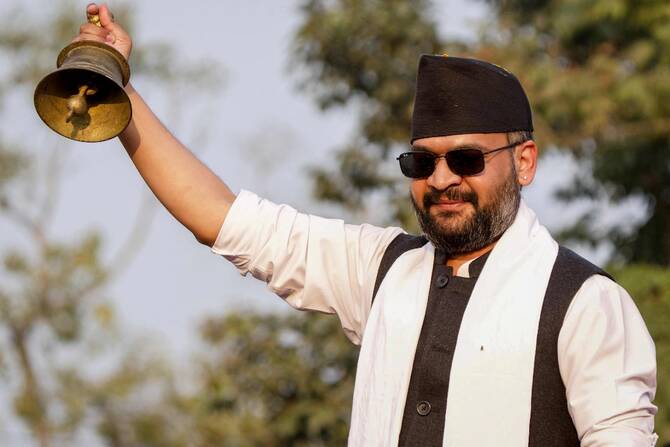
Rastriya Swatantra Party (RSP) election candidate and Kathmandu's former mayor Balendra Shah poses with a bell, the party electoral symbol, during a campaign rally in Janakpur, Nepal. (AFP)
Short Url
Updated 20 January 2026
Follow

Nepal’s rapper turned mayor challenges ousted PM

  • Nepal will hold general elections on March 5, the first since mass anti-corruption protests in September 2025 overthrew Oli, a 73-year-old Marxist leader and four-term prime minister

Katmandu: Nepal’s rapper-turned-politician Balendra Shah will go into a head-to-head election battle with the veteran prime minister he helped unseat, as he champions youth demands that toppled last year’s government.
The 35-year-old resigned last week as mayor of Katmandu to contest general elections, announcing Tuesday that he will directly challenge ousted prime minister KP Sharma Oli by running in the same constituency.
Nepal will hold general elections on March 5, the first since mass anti-corruption protests in September 2025 overthrew Oli, a 73-year-old Marxist leader and four-term prime minister.
“Contesting against a major figure... signals that I am not taking the easy way out,” Shah told AFP, ahead of his formal confirmation of candidacy.
“It demonstrates that, despite the problems or betrayals that have affected the country, we are moving toward addressing them,” he added.
Better known as Balen, the former mayor arrived for the interview at a Katmandu hotel dressed in black and wearing a traditional Nepali hat or “topi,” though he was without his trademark dark square sunglasses.
His hip-hop songs tackling corruption and inequality have drawn millions of views.
A civil engineer and rapper before joining politics, Shah stunned the political establishment in 2022 when he became the first independent candidate to be elected as Katmandu mayor.
He built a reputation as a sharp-tongued reformer, launching campaigns targeting tax evasion, traffic congestion, education and city waste.
Shah’s approach, however, drew criticism for heavy-handed enforcement and for communicating directly with his millions of social media followers rather than engaging with journalists.
“We made many processes that operated through informal arrangements transparent, through open procurement,” he said.

- ‘Ripple effect’ -

In December, Shah joined the centrist Rastriya Swatantra Party (RSP), led by television host Rabi Lamichhane, 50.
RSP, which became parliament’s fourth-largest force in the last elections in 2022, challenged parties that had dominated Nepal since the end of its civil war in 2006.
If the RSP secures a parliamentary majority, Shah would become prime minister.
“We share the same ideology,” Shah said, describing a vision of “a liberal economic system with social justice,” including free education and health care for the poor.
Rather than contesting from his Katmandu base, Shah will challenge Oli in his stronghold of Jhapa-5, a largely rural district 300 kilometers (185 miles) southeast of Katmandu.
“This should not be perceived as an egoistic decision,” Shah said. “The ripple effect would simply be greater if I contest from Jhapa.”
The September 8-9 demonstrations were initially triggered by anger over a brief government ban on major social media platforms, with protesters gathered under a loose “Gen Z” banner.
But deeper grievances — economic stagnation and entrenched corruption — fueled the unrest in the country of 30 million, in which at least 77 people were killed.

- ‘Grow our economy’ -

Shah backed the protests while urging restraint, emerging as a central figure in the movement.
“Gen Z’s number one demand is good governance, because there is a high level of corruption in the country,” he said, adding that his party had drawn on protesters for support.
“The Gen Z protest has opened a door — 40 percent of our central committee members and proportional representatives are new faces who emerged from the September protest,” he said.
Young Nepalis are looking for leaders promising economic reform. The World Bank estimates 82 percent of Nepal’s workforce is in informal employment, with GDP per capita at $1,447 in 2024.
“We need to grow our economy,” Shah said, citing tourism, trade and skilled jobs as ways to stem the mass outflow of workers.
Landlocked Nepal, wedged between regional giants India and China, faces geopolitical pressures, but Shah sees an opportunity to make Nepal a trade hub.
“My approach is to maintain a natural relationship with both neighboring nations,” he said.
And while focused on politics, he said that music remains central to his identity.
“Music is a medium to express oneself,” he said. “I will continue it, even if I am elected as prime minister.”


Trump, sharing leaked texts and AI mock-ups, vows ‘no going back’ on Greenland

Updated 2 sec ago
Follow

Trump, sharing leaked texts and AI mock-ups, vows ‘no going back’ on Greenland

DAVOS, Switzerland/COPENHAGEN: US President Donald Trump on Tuesday vowed there was “no going back” on his goal to control Greenland, refusing to rule out taking the Arctic island by force and rounding on allies as European leaders struggled to ​respond.
Trump’s ambition — spelled out in social media posts and mock-up AI images — to wrest sovereignty over Greenland from fellow NATO member Denmark has threatened to blow apart the alliance that has underpinned Western security for decades.
It has also threatened to reignite a trade war with Europe that rattled markets and companies for months last year, though Trump’s Treasury Secretary Scott Bessent pushed back against what he called “hysteria” over Greenland.
“As I expressed to everyone, very plainly, Greenland is imperative for National and World Security. There can be no going back — On that, everyone agrees!” Trump said after speaking to NATO Secretary General Mark Rutte.
To drive home the message, Trump posted an AI image of himself in Greenland, holding a US flag. Another showed him speaking to leaders next to a map showing Canada and ‌Greenland as part of ‌the United States.
Separately, he leaked messages including from French President Emmanuel Macron, who questioned ‌what ⁠Trump ​was “doing on Greenland.” ‌Trump, who has vowed to impose tariffs on countries who stood in his way, had earlier threatened to hammer French wines and champagnes with a 200 percent tariff.

BESSENT PUSHES BACK AGAINST ‘HYSTERIA’
The European Union has threatened to hit back with trade measures. One option is a package of tariffs on 93 billion euros ($109 billion) of US imports that could automatically kick in on February 6 after a six-month suspension.
Another option is the “Anti-Coercion Instrument” (ACI), which has never yet been used. It could limit access to public tenders, investments or banking activity, or restrict trade in services, the sector in which the US has a surplus with the bloc, including the lucrative digital services provided by US tech giants.
“This is not a ⁠question about the Kingdom of Denmark, it is about the entire transatlantic relationship,” Denmark’s Economy Minister Stephanie Lose told journalists ahead of an EU meeting of economy and finance ministers ‌in Brussels.
“At this point in time, we do not believe that anything should ‍be ruled out. This is a serious situation that, although we ‍would like to de-escalate, there are others who are contributing to escalating it right now, and therefore we will have to ‍keep all options on the table as we move forward.”
Bessent, on the sidelines of the World Economic Forum annual meeting in Davos, Switzerland, said a solution would be found that ensures national security for the United States and Europe.
“It’s been 48 hours. As I said, sit back, relax,” he said. “I am confident that the leaders will not escalate and that this will work out in a manner that ends up in ​a very good place for all.”
Asked about the prospect of a prolonged trade war between the United States and Europe, Bessent replied: “Why are we jumping there? Why are you taking it to the worst case?... Calm down the ⁠hysteria. Take a deep breath.”
However, in her own speech in Davos, European Commission President Ursula von der Leyen said the series of recent geopolitical shocks will force the EU to build a new independent Europe.
“We will only be able to capitalize on this opportunity if we recognize that this change is permanent,” she said.

RUSSIA QUESTIONS DANISH SOVEREIGNTY OVER GREENLAND
Trump will also this week attend the Davos gathering of the global political and business elite. Swiss newspaper NZZ reported that protesters marched in Zurich, Switzerland, late on Monday, carrying a giant banner saying: “TRUMP NOT WELCOME. NO WEF! NO OLIGARCHY! NO IMPERIALIST WARS!“
The foreign minister of Russia, which has been watching with glee as Trump’s drive to acquire Greenland widens splits with Europe, said on Tuesday that Greenland was not “a natural part” of Denmark.
Trump’s renewed tariff threats against European allies have revived talk of the ‘Sell America’ trade that emerged in the aftermath of his sweeping levies last April.
Stock markets bore the brunt on Monday of fears that the trade war could re-escalate, with European equities dropping over 1 percent and US stock futures taking a similar hit that points to weakness ‌following Monday’s US public holiday.
The dollar was on the back foot too, a sign that the world’s No.1 reserve currency was also in the crosshairs of Trump’s threat on Saturday to increase tariffs on Europe.