

UK approves China plan for its largest embassy in Europe despite espionage fears

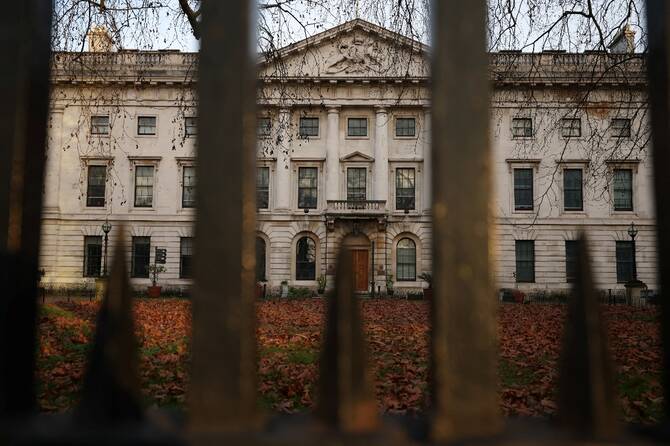
A view of the Royal Mint Court, the proposed site of a new Chinese mega embassy at Royal Mint Court, in London, Britain. (Reuters)
Short Url
Updated 20 January 2026
Follow

UK approves China plan for its largest embassy in Europe despite espionage fears

  • Beijing’s proposal for a new embassy on the historic site of the former Royal Mint has been dogged by delays since China bought it in 2018

LONDON: Britain's government gave approval on Tuesday for China to build its largest embassy in Europe in London, hoping to improve ties with Beijing despite British and U.S. politicians' warnings that it could be used as a base for spying.
The approval was subject to some conditions.
China's ​plans to build a new embassy on the site of the two-century-old Royal Mint Court near the Tower of London have stalled for three years over opposition from local residents, lawmakers and Hong Kong pro-democracy campaigners in Britain.
The decision was announced before an expected visit to China by Prime Minister Keir Starmer this month, the first by a British leader since 2018. Some British and Chinese officials said the trip was dependent on the embassy being approved.

EMBASSY APPROVAL HIGHLIGHTS UK'S CHINA DILEMMA
The Chinese government purchased Royal Mint Court in 2018 but its requests for planning permission to build a new embassy on the site ‌were rejected by ‌the local council in 2022. Chinese President Xi Jinping asked Starmer ‌last ⁠year ​to intervene.
The ‌government took control of the planning decision last year and an inquiry was held last February to hear arguments about whether the embassy should be approved.
Some politicians in Britain and the United States have said China should be barred from building on the site near London's historic financial district because it might enable Beijing to eavesdrop on fibre-optic cables that are used by finance firms and travel underneath the area.
British security officials have also warned that allowing China to build a much larger embassy would mean more Chinese spies in Britain as well as ⁠more diplomats, an assertion dismissed by the Chinese embassy in London.
The head of Britain's MI5 domestic spy agency said in October his spy ‌agency had more than a century of experience dealing with foreign ‍embassies, suggesting any security risks could be managed.
But MI5 ‍has also warned of a threat posed by attempts by China to recruit and cultivate people ‍with access to the British government.
The agency issued a warning to lawmakers in November about Beijing trying to interfere in British politics, and the collapse of a trial of two British men charged with spying on members of parliament for China led to criticism the government was prioritising better relations over national security.
The government has approved the new embassy - ​after years of diplomatic pressure from China - as Starmer tries to reset relations with Beijing, which is one of his foreign policy priorities.
Britain has in the past decade moved from ⁠saying it wanted to be China's biggest supporter in Europe to being one of its fiercest critics, and is now trying to improve relations again. Starmer said last month closer business ties were in the national interest.
DIPLOMATIC TENSIONS
Some local residents who oppose China building a large embassy in the area are considering whether to ask for a judicial review against the decision.
The new embassy would be one of the largest diplomatic outposts in the world with a footprint of about 55,000 square metres (600,000 square feet), according to the planning application.
That is almost 10 times the size of China's current embassy in central London and considerably bigger than its embassy in the United States.
Before Tuesday's decision, China had blocked plans by Britain to expand its embassy in Beijing, officials involved in the talks said.
Chinese officials say that when Beijing purchased the site for 255 million pounds ($343.54 million), it received assurances from ‌the then Conservative government that it could build its embassy.
Royal Mint Court was from the early 19th century until 1967 the site of the Royal Mint, where coins are produced.


WHO chief says reasons US gave for withdrawing ‘untrue’

Updated 5 sec ago
Follow

WHO chief says reasons US gave for withdrawing ‘untrue’

  • US Secretary of State Marco Rubio and US Health Secretary Robert F. Kennedy Jr. announced in a joint statement Thursday that Washington had formally withdrawn from the WHO
  • And in a post on X, Tedros added: “Unfortunately, the reasons cited for the US decision to withdraw from WHO are untrue”

GENEVA: The head of the UN’s health agency on Saturday pushed back against Washington’s stated reasons for withdrawing from the World Health Organization, dismissing US criticism of the WHO as “untrue.”
Tedros Adhanom Ghebreyesus warned that US announcement this week that it had formally withdrawn from the WHO “makes both the US and the world less safe.”
And in a post on X, he added: “Unfortunately, the reasons cited for the US decision to withdraw from WHO are untrue.”
He insisted: “WHO has always engaged with the US, and all Member States, with full respect for their sovereignty.”
US Secretary of State Marco Rubio and US Health Secretary Robert F. Kennedy Jr. announced in a joint statement Thursday that Washington had formally withdrawn from the WHO.
They accused the agency, of numerous “failures during the Covid-19 pandemic” and of acting “repeatedly against the interests of the United States.”
The WHO has not yet confirmed that the US withdrawal has taken effect.

- ‘Trashed and tarnished’ -

The two US officials said the WHO had “trashed and tarnished” the United States, and had compromised its independence.
“The reverse is true,” the WHO said in a statement.
“As we do with every Member State, WHO has always sought to engage with the United States in good faith.”
The agency strenuously rejected the accusation from Rubio and Kennedy that its Covid response had “obstructed the timely and accurate sharing of critical information that could have saved American lives and then concealed those failures.”
Kennedy also suggested in a video posted to X Friday that the WHO was responsible for “the Americans who died alone in nursing homes (and) the small businesses that were destroyed by reckless mandates” to wear masks and get vaccinated.
The US withdrawal, he insisted, was about “protecting American sovereignty, and putting US public health back in the hands of the American people.”
Tedros warned on X that the statement “contains inaccurate information.”
“Throughout the pandemic, WHO acted quickly, shared all information it had rapidly and transparently with the world, and advised Member States on the basis of the best available evidence,” the agency said.
“WHO recommended the use of masks, vaccines and physical distancing, but at no stage recommended mask mandates, vaccine mandates or lockdowns,” it added.
“We supported sovereign governments to make decisions they believed were in the best interests of their people, but the decisions were theirs.”

- Withdrawal ‘raises issues’ -

The row came as Washington struggled to dislodge itself from the WHO, a year after US President Donald Trump signed an executive order to that effect.
The one-year withdrawal process reached completion on Thursday, but Kennedy and Rubio regretted in their statement that the UN health agency had “not approved our withdrawal and, in fact, claims that we owe it compensation.”
WHO has highlighted that when Washington joined the organization in 1948, it reserved the right to withdraw, as long as it gave one year’s notice and had met “its financial obligations to the organization in full for the current fiscal year.”
But Washington has not paid its 2024 or 2025 dues, and is behind around $260 million.
“The notification of withdrawal raises issues,” WHO said Saturday, adding that the topic would be examined during WHO’s Executive Board meeting next month and by the annual World Health Assembly meeting in May.
“We hope the US will return to active participation in WHO in the future,” Tedros said Saturday.
“Meanwhile, WHO remains steadfastly committed to working with all countries in pursuit of its core mission and constitutional mandate: the highest attainable standard of health as a fundamental right for all people.”