

Pakistan says PM Sharif has received invitation to join Gaza peace board

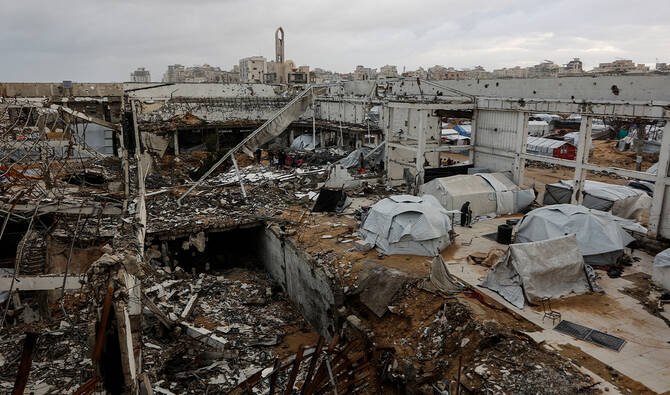
A photograph shows makeshift shelters inside a war-damaged building, parts of which collapsed on a windy winter day in Gaza City on January 13, 2026. (AFP/ file)
Short Url
Updated 18 January 2026
Follow

Pakistan says PM Sharif has received invitation to join Gaza peace board

  • Board is set to supervise temporary governance of Gaza
  • Gaza has been under a shaky ceasefire since October

ISLAMABAD: Pakistan’s foreign ministry said on Sunday Prime Minister Shehbaz Sharif had received an invitation from US President Donald Trump to join the so-called “Board of Peace” for Gaza.

The White House on Friday announced some members of this board, which would outlive its role supervising the temporary governance of Gaza, under a fragile ceasefire since October. 

The names include US Secretary of State Marco Rubio, President Donald Trump’s special envoy Steve Witkoff, former British prime minister Tony Blair and Trump’s son-in-law, Jared Kushner. Trump is the chair of the board, according to a plan the White House unveiled in October.

Israel and the Palestinian group Hamas signed off on Trump’s plan, which says a Palestinian technocratic administration will be overseen by an international board, which will supervise Gaza’s governance for a transitional period.

“The Prime Minister of Pakistan has received the invitation from the President of the United States to join the Board of Peace on Gaza,” the Foreign Office said in a statement. 

“Pakistan will remain engaged with international efforts for peace and security in Gaza, leading to a lasting solution to the Palestine issue in accordance with United Nations resolutions.”

Many rights experts and advocates have said Trump overseeing a board to supervise a foreign territory’s governance resembles a colonial structure, while Blair’s involvement was criticized last year due to his role in the Iraq war and the history of British imperialism in the Middle East.

The White House did not detail the responsibilities of each member of the board. The names do not include any Palestinians. The White House said more members will be announced over the coming weeks.

It also named a separate, 11-member “Gaza Executive Board” to support the technocratic body, including Turkish Foreign Minister Hakan Fidan, UN Middle East peace coordinator Sigrid Kaag, United Arab Emirates International Cooperation Minister Reem Al-Hashimy, and Israeli-Cypriot billionaire Yakir Gabay.

But Israeli Prime Minister Benjamin Netanyahu’s office has said the composition of this board had not been coordinated with Israel and contradicted its policy — possibly a reference to Fidan’s presence, as Israel objects to Turkish involvement. 

With inputs from Reuters


Pakistan, Afghanistan trade heavy casualty claims, battlefield losses as cross-border fighting escalates

Updated 4 sec ago
Follow

Pakistan, Afghanistan trade heavy casualty claims, battlefield losses as cross-border fighting escalates

  • Pakistan says 133 Afghan Taliban killed in counter-strikes, Kabul says 55 Pakistani soldiers dead
  • Both sides report destruction, capture of military posts as escalation deepens, signaling widening conflict

Islamabad/Karachi: Pakistan and Afghanistan traded claims of heavy battlefield losses early Friday as cross-border fighting intensified along their shared frontier, marking the most serious escalation in hostilities between the bitter neighbors in recent months.

The fighting follows Pakistani airstrikes earlier this week targeting what Islamabad said were Tehreek-e-Taliban Pakistan (TTP) and Daesh militant camps inside Afghanistan. Pakistan said those strikes killed more than 100 militants, while Kabul said women and children were killed and condemned the attacks as violations of Afghan sovereignty.

With both governments now announcing retaliatory operations and publishing sharply conflicting casualty figures, the confrontation signals a rapid deterioration in relations between the two countries.

Pakistani officials said the latest strikes were in response to what they described as unprovoked firing by Afghan forces along multiple sectors of the border late Thursday. The Pakistani prime minister’s spokesman Mosharraf Zaidi said at 0345 hours Friday counter-strikes were continuing.

“A total of 133 Afghan Taliban are confirmed killed, more than 200 wounded,” Zaidi said in an X update. “Twenty seven (27) Afghan Taliban posts have been destroyed, and nine (9) have been captured.”

He added that strikes had targeted military positions in Kabul, Paktia and Kandahar, and that corps headquarters, brigade headquarters, ammunition depots, logistics bases and other installations had been destroyed.

Pakistan’s Information Minister Attaullah Tarar described the military action as “Operation Wrath for the Sake of Truth,” saying Pakistan’s “effective counter operations are ongoing.”

Defense Minister Khawaja Asif adopted sharply escalatory language on X, declaring: “Now it is open war between us and you.”

On the Afghan side, Taliban government spokesperson Zabihullah Mujahid accused Pakistan of bombing major cities. 

“The cowardly Pakistani army has bombed some places in Kabul, Kandahar, and Paktia. Praise be to God, no one was harmed,” Mujahid said on X.

In a separate statement, Afghanistan’s Ministry of National Defense said its forces had conducted retaliatory operations along the shared border. 

The ministry claimed 55 Pakistani soldiers were killed, two garrisons and 19 posts captured and military equipment seized. It said eight Afghan fighters were killed and 11 wounded in the clashes, and alleged that 13 civilians were injured in Nangarhar.

Pakistani officials said no Pakistani posts had been damaged or captured. 

None of the casualty figures or battlefield claims from either side could be independently verified.

Cross-border violence has intensified in recent weeks, with Pakistan blaming a surge in suicide bombings and militant attacks on insurgents it says are based in Afghanistan. Kabul denies providing safe havens to anti-Pakistan militant groups.

The latest clashes mark the third major escalation between the neighbors in less than a year. Similar Pakistani strikes last year triggered weeklong fighting before Qatar, Türkiye and other regional actors mediated a ceasefire in October.

The 2,600-kilometer (1,600-mile) frontier, a key trade and transit corridor linking Pakistan to landlocked Afghanistan and onward to Central Asia, has faced repeated closures amid tensions, disrupting commerce and humanitarian movement. Trade and movement of people between the two nations has remained closed since October 2025.

The confrontation also unfolds against a backdrop of growing friction over Afghanistan’s regional alignments. Pakistan has repeatedly accused the Taliban authorities of allowing Indian influence to expand in Afghanistan, an allegation Kabul has rejected.

Pakistan’s defense minister Asif renewed that accusation on Friday, saying the Taliban government had turned Afghanistan into “a colony of India.”

Islamabad has long accused India of using Afghan territory to support anti-Pakistan militant groups, a charge New Delhi denies.
