

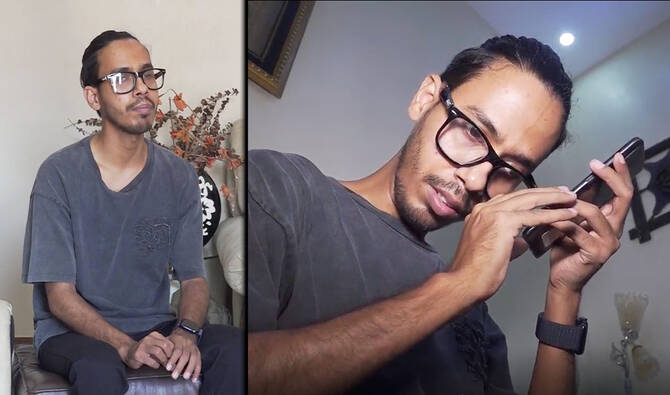

KARACHI: With a ponytail tied high and a chain around his neck, Khalid Anwar snaps his fingers and nods to the beat as his latest track “Khawab Dekh” — or “dream” — plays in the background, a song that reflects both his sound and his outlook on life.
The 31-year-old rapper, who performs as MK Anwar, is emerging in Pakistan’s music scene with songs that blend personal struggle with social commentary, using his work to challenge perceptions around disability and inclusion.
In a country where disability remains widespread yet often misunderstood, Anwar’s journey stands out, not only as an artist but as someone navigating life with a degenerative eye condition that has gradually taken away his sight.
Anwar’s introduction to rap came during a school farewell, where he was asked by a teacher to perform something of his own.
“My teacher told me to prepare something, so I wrote ‘School Ki Kahani’ and performed it,” he recalls.
Inspired by artists like Ali Gul Pir and worldwide hip-hop sensation Snoop Dogg, he began writing music early, though he delayed recording for years, hoping his eyesight might improve.
“When I realized my eyesight would never recover, I recorded my first song,” he says.
His condition began in early childhood. What started as limited light perception gradually worsened.
“At first, I could read books. Then slowly, the text stopped being visible. Even the lines on paper disappeared,” he says. “Eventually, I couldn’t write with a pen or pencil at all.”
Years later, he was diagnosed with Retinitis Pigmentosa, a degenerative condition that leads to progressive vision loss.
“We realized it couldn’t be reversed,” Anwar says. “My eye cells are degenerating, and my sight is gradually fading.”
Despite the diagnosis, Anwar continued to pursue music, even when told he would not be able to perform in videos.
“If someone tells me I can’t do something, I feel compelled to prove them wrong,” he says.
His first music video, “School Ki Kahani,” was produced with the help of friends and classmates and featured a visually impaired girl, reinforcing his message that disability does not limit capability.
Alongside music, Anwar works as a creative manager at an advertising agency, writing jingles and producing commercials, while using his platform to advocate for inclusion.
“I don’t just want to be an artist,” he says. “I want to promote inclusivity.”
His songs address issues ranging from disability to gender inequality and harassment. In “Nabina,” one of his tracks meaning “blind” in Urdu, he critiques how society labels people with disabilities as “inspiring” without creating real opportunities.
“People don’t know how to talk to a blind person,” he says. “So I try to normalize that through my work.”
He believes the biggest barriers are social attitudes rather than physical limitations.
“People think blind individuals are helpless or limited in what they can do,” he says. “They don’t imagine they can be artists, musicians or creators.”
His appearance on Pakistan’s rap reality show Star Rappers, where he reached the semifinals, helped shift perceptions, he says.
“People used to think blind people can’t do these things,” he says. “Now they see it differently.”
Through his vlog “Life of a Blind Guy,” Anwar shares his daily life and engages with audiences, often answering questions about navigating everyday tasks.
“People offer money, but what we need is awareness and inclusion,” he says. “We need people to be more sensitized.”
He also points to the lack of representation in media and education as a key challenge.
“If children grow up in inclusive environments, they won’t question someone’s abilities later in life,” he says.
Looking ahead, Anwar hopes to collaborate with artists such as Asim Azhar and Ali Sethi while continuing to use music as a tool for change.
“People used to laugh when I said I wanted to be a star,” he says. “But dreaming is not a bad thing. It’s my dreams that brought me here.”


