

Pakistan PM calls privatization top priority, discusses selling power firms after PIA stake sale

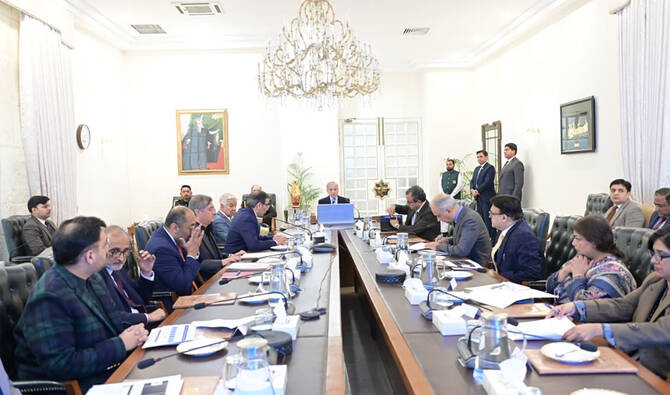
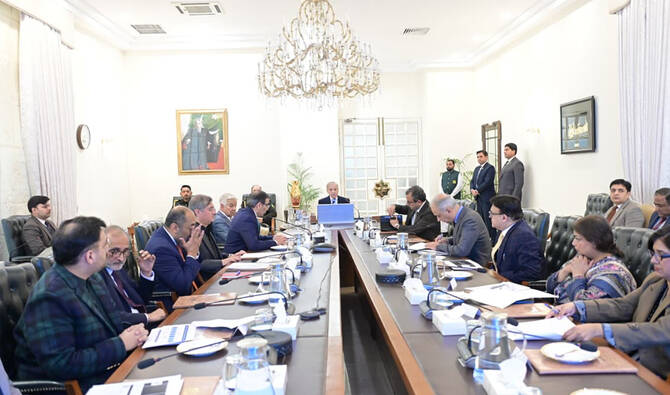
Prime Minister Muhammad Shehbaz Sharif chairs a meeting on the matters related to Privatisation Commission in Islamabad, on January 6, 2026).
Short Url
Updated 07 January 2026
Follow

Pakistan PM calls privatization top priority, discusses selling power firms after PIA stake sale

  • Government plans to privatize five electricity distributors as part of IMF-backed economic reforms
  • Last year, a consortium led by Arif Habib Group won the bid for a 75 percent controlling stake in PIA

ISLAMABAD: Prime Minister Shehbaz Sharif described the privatization of state-owned enterprises (SOEs) as his administration's top priority on Tuesday, as he discussed the sale of loss-making power distribution companies after the government successfully divested a 75 percent stake in Pakistan International Airlines (PIA) in December.

The push to privatize power utilities follows the government’s efforts to restructure and offload state firms under broader economic reforms recommended by the International Monetary Fund (IMF) under a $7 billion loan program with Pakistan.

The IMF has repeatedly urged Islamabad to reduce fiscal losses by privatizing or restructuring chronically loss-making SOEs.

“Privatization of loss-making state-owned enterprises is among the government’s top priorities,” the prime minister said, according to a statement released by his office after a meeting on privatization. “The successful privatization of 75 percent shares of PIA is the first drop of rain.”

Last month, a consortium led by the Arif Habib Group won the bid for a 75 percent controlling stake in the national flag carrier, offering Rs 135 billion ($482 million) in a transaction the government described as a milestone in its privatization drive.

Building on that momentum, officials said the Privatization Commission plans to divest electricity distribution companies in two batches. The first phase will include Islamabad Electric Supply Company, Gujranwala Electric Power Company and Faisalabad Electric Supply Company, followed by Hyderabad Electric Supply Company and Sukkur Electric Power Company in the second batch.

Prime Minister Shehbaz Sharif also directed the commission to accelerate digitalization and strengthen its public relations and marketing functions to improve transparency, governance and engagement with investors, according to the statement.

The power sector has long been a drain on public finances due to high losses, inefficiencies and mounting subsidies, making it a central focus of Pakistan’s reform agenda under the IMF program.

Prior to the PIA sale, the United Arab Emirates-based International Holding Company acquired a majority stake in First Women Bank Limited under a government-to-government privatization deal.

That transaction was finalized in October 2025, with Pakistani and UAE officials attending the signing ceremony.


UN Security Council calls on states to help Pakistan bring Balochistan attackers to justice

Updated 7 sec ago
Follow

UN Security Council calls on states to help Pakistan bring Balochistan attackers to justice

  • Security officials say counterterrorism operations have killed 197 separatist militants over three days
  • Security Council calls such acts of militant violence criminal and unjustifiable, regardless of motivation

ISLAMABAD: The United Nations Security Council on Tuesday condemned coordinated attacks in Pakistan’s southwestern province of Balochistan, urging all countries to actively cooperate with Islamabad in bringing the perpetrators to justice, as security officials said 197 separatist militants had been killed in counterterrorism operations over the past three days.

The attacks, claimed by the Balochistan Liberation Army (BLA), targeted security installations and government facilities across multiple districts in the province, killing more than 50 people, including 22 members of the security forces, Pakistani authorities said.

Pakistan has repeatedly accused BLA militants of acting as “Indian proxies” and receiving logistical support from Afghanistan, allegations that both New Delhi and Kabul deny.

“The members of the Security Council condemned in the strongest terms the heinous and cowardly terrorist attacks across multiple locations in Balochistan province, Pakistan, on 31st January 2026,” the Council said in a statement circulated by its president, James Kariuki.

“The members of the Security Council underlined the need to hold perpetrators, organizers, financiers and sponsors of these reprehensible acts of terrorism accountable and bring them to justice,” it said. “They urged all States, in accordance with their obligations under international law and relevant Security Council resolutions, to cooperate actively with the Government of Pakistan in this regard.”

The statement said the attacks resulted in the deaths of Pakistani nationals, among them five women and three children.

“The members of the Security Council expressed their deepest sympathy and condolences to the families of the victims and to the Government and the people of Pakistan, and wished a speedy and full recovery to those who were injured,” it added.

A Pakistani security official, speaking on condition of anonymity, said “follow-up and sanitization operations against these terrorists are still ongoing,” adding that 36 Baloch civilians had also “fallen victim to the barbarity of these terrorists.”

He also confirmed the exact death toll on both sides, saying 36 “Baloch citizens who have fallen victim to the barbarity of these terrorists.”

The Council reiterated that such acts of militant violence are criminal and unjustifiable regardless of motivation.

Pakistan is currently serving as a non-permanent Security Council member for the 2025-26 term.