

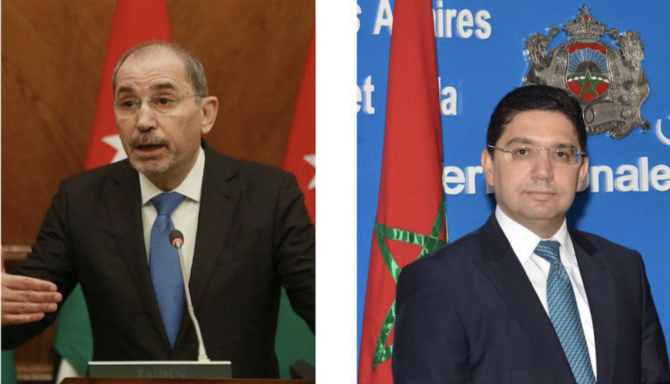
Safadi, Bourita discuss strengthening Jordan–Morocco ties and regional developments

Jordan’s Minister of Foreign and Expatriate Affairs Ayman Safadi held a telephone call on Monday with his Moroccan counterpart Nasser Bourita to discuss ways to enhance the longstanding relations between the two kingdoms. (Jordan News Agency)
Short Url
Updated 29 December 2025
Follow

Safadi, Bourita discuss strengthening Jordan–Morocco ties and regional developments

AMMAN: Jordan’s Minister of Foreign and Expatriate Affairs Ayman Safadi held a telephone call on Monday with his Moroccan counterpart Nasser Bourita to discuss ways to enhance the longstanding relations between the two kingdoms, the Jordan News Agency reported.

During the call, the two ministers reaffirmed their commitment to expanding cooperation across a range of sectors in a manner that serves the mutual interests of Jordan and Morocco, JNA added.

Safadi and Bourita also reviewed key regional developments, with a particular focus on the war in Gaza and the situation in the occupied West Bank.

They stressed the importance of maintaining the ceasefire in Gaza, fully implementing its provisions and ensuring the uninterrupted and sustained delivery of humanitarian aid, while advancing towards the second phase of the truce agreement.

The ministers linked regional stability to the need for a clear political horizon that guarantees the legitimate rights of the Palestinian people. They also underscored the need to halt escalating tensions and unilateral, illegal Israeli measures in the West Bank.

Both sides said coordination would continue on bilateral relations, as well as on regional and international issues of shared concern.


Syrian government, Kurds to extend truce: sources to AFP

Updated 10 sec ago
Follow

Syrian government, Kurds to extend truce: sources to AFP

  • No official announcement has yet come from Damascus or SDF, but two sources said truce is to be extended by one month

DAMASCUS: The Syrian government and Kurdish forces have agreed to extend a ceasefire set to expire Saturday, as part of a broader deal on the future of Kurd-majority areas, several sources told AFP.

No official announcement has yet come from Damascus or the Kurdish-led Syrian Democratic Forces (SDF), but two sources said the truce is to be extended by one month.

On Tuesday, Damascus and the SDF agreed to a four-day ceasefire after Kurdish forces relinquished swathes of territory to government forces, which also sent reinforcements to a Kurdish stronghold in the northeast.

A diplomatic source in Damascus told AFP the ceasefire, due to expire on Saturday evening, will be extended “for a period of up to one month at most.”

A Kurdish source close to the negotiations confirmed “the ceasefire has been extended until a mutually acceptable political solution is reached.”

A Syrian official in Damascus said the “agreement is likely to be extended for one month,” adding that one reason is the need to complete the transfer of Daesh group militant detainees from Syria to Iraq.

All sources requested anonymity because they are not allowed to speak to the media.

After the SDF lost large areas to government forces, Washington said it would transfer 7,000 Daesh detainees to prisons in Iraq.

Europeans were among 150 senior IS detainees who were the first to be transferred on Wednesday, two Iraqi security officials told AFP.

The transfer is expected to last several days.

Daesh swept across Syria and Iraq in 2014, but backed by a US-led coalition, the SDF ultimately defeated the group and went on to jail thousands of suspected militants and detain tens of thousands of their relatives.

The truce between Damascus and the Kurds is part of a new understanding over Kurdish-majority areas in Hasakah province, and of a broader deal to integrate the Kurds’ de facto autonomous administration into the state.

Syrian President Ahmed Al-Sharaa’s Islamist forces toppled longtime ruler Bashar Assad in 2024.

The new authorities are seeking to extend state control across Syria, resetting international ties including with the United States, now a key ally.

The Kurdish source said the SDF submitted a proposal to Damascus through US envoy Tom Barrack that would have the government managing border crossings — a key Damascus demand.

It also proposes that Damascus would “allocate part of the economic resources — particularly revenue from border crossings and oil — to the Kurdish-majority areas,” the source added.

Earlier this month, the Syrian army recaptured oil fields, including the country’s largest, while advancing against Kurdish forces.