

For Filipinos in Gulf countries, technology fills Christmas celebration gaps

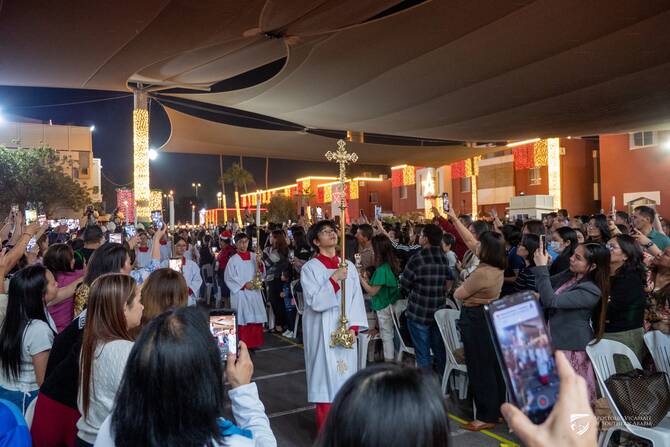
Filipinos attend a mass St. Joseph’s Church in Abu Dhabi, UAE in this photo shared on Dec. 18, 2025. (Apostolic Vicariate of Southern Arabia)
Short Url
Updated 22 December 2025
Follow

For Filipinos in Gulf countries, technology fills Christmas celebration gaps

  • There are more than 1.7m overseas Filipino workers across GCC states
  • Many celebrate Christmas with loved ones back home by way of video calls

MANILA: Coming from the Catholic-majority Philippines, where annual Christmas celebrations begin as early as September, Genevie Epana often finds herself reminiscing about the festivities back home during the holiday season.

Since she started working in Qatar in 2015, homesickness always hits a little harder this time of the year.

“Because Qatar is mainly a Muslim country … Christmas is not a public holiday. And you won’t see a lot of Christmas decorations outside or on the streets,” she told Arab News.

“But we Filipinos, we find ways, right? We find ways to celebrate Christmas away from home.”

The 32-year-old sticks to Philippine traditions even far from home, such as setting up a Christmas tree and lights in September, when Filipinos embark on their four-month-long preparations to commemorate the birth of Jesus.

“You really have to come up with your own ways just to be able to feel that it’s already Christmas, including playing Christmas songs on YouTube,” Epana said.

With over 1.7 million overseas Filipino workers across Gulf Cooperation Council states, many use video calls and social media to connect with their loved ones during the holidays.

“For an OFW here, Christmas feels almost normal, like any other day. You go to work,” said Mario Balboa, a Filipino engineer working in Saudi Arabia.

But advances in technology have helped Filipinos cope with the distance.

“That’s actually a big improvement in terms of technology and social media. Because social media plays a big role, it becomes a bridge that helps you reconnect with old classmates and friends you are no longer in touch with. And you can now still celebrate Christmas with your family up close, even if it’s through video call,” Balboa told Arab News.

For Michelle Grita Villaluna, who has been working in Qatar for four years, Christmas carolers and lanterns across Philippine neighborhoods are what she misses the most during the holiday season.

She plays Christmas songs and makes holiday plans with friends to make up for the missing festivities, while looking forward to attending the midnight mass at the local church in Doha.

“There are those who sell food, native snacks from the Philippines like rice cake and ginger tea. So, you really just have to go to church if you want to feel the Christmas spirit, and especially if you miss the Philippines,” she told Arab News.

Every year on Christmas Eve, Villaluna will make a video call to the Philippines, just as her family gets together for Noche Buena, the dinner that follows the last evening mass of the season.

“That way you can still be part of the celebration even though you’re not physically present,” she said.

The same is true for Mark Bryan Dadivas, who will be away in the UAE during Christmas this year.

“I miss my son and daughter the most. Being away from them is the hardest part for me. I stay connected with my family through Messenger, video calls, especially on Christmas, so I can still see and talk to them despite the distance,” the 35-year-old told Arab News.

Like many other Filipinos across the Gulf, he will be spending Christmas with friends.

“We pool our money with friends, kababayans (fellow Filipinos), to buy food and fruits so we can have a simple but meaningful Christmas celebration together.”

Though these efforts help navigate the reality of being far from home, Christmas is when Filipinos miss home the most.

“I really miss everything. The fun of celebrating with your family and relatives, then there’s karaoke and games,” Jenny Segalowitz, a Filipino restaurant owner who runs her business in the UAE, told Arab News.

“But that’s life. It’s part of our sacrifice and pain because it’s the most important holiday for us Filipinos but … it’s really not the same as when you’re home in the Philippines.”


Filipinos celebrate Christmas on a budget amid soaring costs

Children spend the afternoon at Quezon Memorial Circle in Quezon City, Philippines on Dec. 23, 2025. (PNA)
Updated 55 min 52 sec ago
Follow

Filipinos celebrate Christmas on a budget amid soaring costs

  • Filipinos are choosing modest Christmas gifts, scaling down year-end festivities
  • Millions look to content creators for tips on how to spend less for Christmas dinner

MANILA: As the predominantly Catholic Philippines celebrates one of its most important annual holidays on Thursday, many Filipinos have been forced to rethink their traditional Christmas celebrations amid soaring prices. 

This year, street food vendor Gemma Gracia is among those who will keep her business open during the holidays. 

“As a vendor, I’ve felt the prices go up since I also still buy at the market for our needs and for our selling needs,” she told Arab News. 

But as celebrating Christmas was important for her family, the 39-year-old has allocated 1,000 Philippine pesos ($17) for a family meal out at Jollibee, the Philippines’ biggest fast-food chain restaurant. 

“When you don’t have food to share on the table on this holiday, it’s a sad day. That’s why we make sure that we always have something on the table each year,” she said. 

For many Filipinos, the time-honored traditions of Noche Buena, or Christmas Eve, is the most awaited part of this holiday season, when dinner tables across the country are filled with a hearty selection of traditional dishes. 

Noche Buena, which is Spanish for “the good night,” is the dinner that follows the last evening mass of the season, known as misa de gallo or simbang gabi.

In the Philippines, such festive staples include meaty Filipino-style spaghetti and hamonado, the local version of a Christmas ham that usually serves as the centerpiece of Christmas dinner tables.

But the pinch from rising prices has affected Filipino shoppers in recent years, forcing them to adjust according to their budget. 

Although the country’s central bank said inflation had eased to 1.5 percent in November, many say the statistics do not reflect on-the-ground realities, where people reel from rising retail prices, shrinking portions and diminishing purchasing power of the peso. 

Allan Manansala, a 48-year-old construction worker in Manila, told Arab News that he is expecting to spend 5,000 pesos for his family of five in 2025, nearly a third of his monthly wage and about a fifth higher than what he spent in previous years. 

“I might have to skip giving my children gifts this year because of the costs,” he said. 

To get around the high costs, Manansala is skipping the Noche Buena festivities altogether and has instead decided to splurge on New Year’s Eve dinner, which is also a significant occasion in the Philippines. 

Others, like Allan Melenio, look for different ways to save up. 

“Our relative owns a meat shop, so we’re able to save on that since the prices are quite low,” he told Arab News. “But everywhere else, a piece of meat can cost so much.” 

While the economy has forced Filipinos to make smarter choices and get creative, content creators are among those offering ideas to address consumers’ woes, teaching people how to stretch their meager budgets for the holidays. 

One such tip came from Ninong Ry, a food content creator who challenged himself to prepare an eight-dish Noche Buena dinner with a budget of 1,500 pesos. Posted about two weeks before Christmas, his one-hour YouTube video has since garnered more than 1.4 million views. 

The video was also a response to comments from Philippine Trade Secretary Cristina Aldeguer-Roque, who suggested last month that 500 pesos was enough for a family of four to host a modest Christmas Eve dinner, sparking anger among Filipinos who said she was out of touch with reality. 

Jelmark Toqueb, who works as a plumber in Manila, said that the 500-peso budget was unrealistic. 

“It is clearly not enough. (Five hundred pesos) is not even enough for you to cook spaghetti with meat. Maybe just the noodles and the sauce,” he told Arab News.

For 32-year-old Toqueb and his wife, who works as a public school teacher, the holiday season remains a cherished occasion to spend quality time with the family. As their Christmas tradition involves gift-giving, he chose more modest presents this year to circumvent the high costs. 

“The prices now are different even from last year, (when they were) already high,” Toqueb said. “Even if the gift is simple, it’s fine. It’s the thought that counts.”