

Pakistan PM orders port reforms to cut cargo delays, boost trade and growth

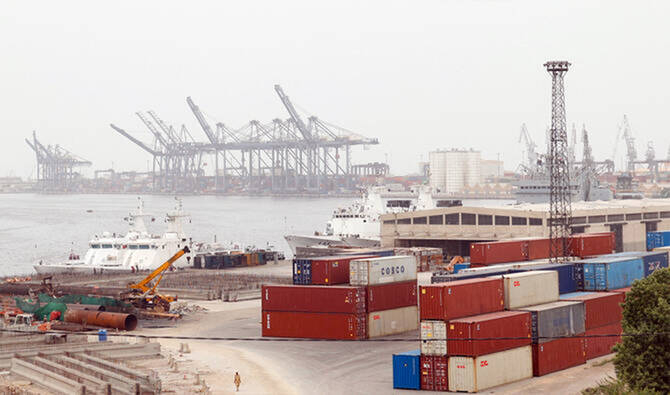
Shipping containers are stacked at the Karachi port area in Karachi, Pakistan, on July 31, 2025. (Reuters/File)
Short Url
Updated 24 December 2025
Follow

Pakistan PM orders port reforms to cut cargo delays, boost trade and growth

  • Shehbaz Sharif orders transparent auctions of abandoned cargo and separate yards to clear port backlogs
  • Government to fast-track dredging, port expansion and rail links to handle larger vessels and inland cargo

ISLAMABAD: Prime Minister Shehbaz Sharif on Wednesday ordered wide-ranging reforms at Pakistan’s ports to reduce cargo delays, cut costs for businesses and support economic growth, directing authorities to improve coordination, infrastructure and transparency across the sector.

The instructions were issued during a meeting of a private-sector working group formed to recommend port-related reforms, as the government seeks to ease bottlenecks in trade logistics and improve competitiveness.

“Our ports play an extremely important role in expanding business and driving economic growth in the country,” Sharif said, according to a statement from his office, as he directed port-linked agencies to strengthen coordination to reduce cargo dwell time and ordered a further reduction in port charges to ease the burden on the business community.

Sharif also instructed officials to introduce a transparent system for auctioning abandoned cargo, including the creation of separate yards at ports and the use of internationally reputed firms to manage the process.

He called for faster work on dredging and expanding ports to allow larger vessels to berth and ordered improvements in rail connectivity from ports to facilitate inland cargo movement.

A briefing given to the participants of the meeting highlighted work on a National Ports Master Plan was progressing, adding that a port community system had recently become operational, and fees at several ports were being reduced, including a cut of more than 50 percent in bulk cargo charges at Port Qasim.

Officials also said an electronic bidding system for auctioning abandoned cargo would be launched soon and that tenders for expansion and dredging at Karachi’s ports had already been issued.


US, Pakistan launch joint counterterrorism exercise to boost interoperability, share expertise

Updated 5 sec ago
Follow

US, Pakistan launch joint counterterrorism exercise to boost interoperability, share expertise

  • Pakistan, US have maintained multifaceted relations for decades, encompassing security, economic engagement and people-to-people ties
  • Both sides have sought to stabilize ties by focusing on areas of mutual interest such as regional stability, trade and counterterrorism

ISLAMABAD: Pakistan and the United States (US) launched the 13th edition of their bilateral joint counterterrorism exercise, Inspired Gambit 2026, to boost interoperability and share counterterrorism expertise, the Pakistani military said on Saturday.

The two-week-long exercise involves contingents from Pakistani and US armies. Officials from both sides attended the opening ceremony at the National Counter Terrorism Centre in Pabbi in northwest Pakistan, according to the Inter-Services Public Relations (ISPR), the Pakistani military's media wing.

It is aimed at enhancing mutual understanding and interoperability through the sharing of counter-terrorism experiences, while further refining tactics, techniques, and procedures essential for effective CT operations.

"Emphasis is being laid on marksmanship skills during urban warfare, as well as on understanding each other’s operational doctrines and best practices," the ISPR said in a statement.

"Such joint training exercises are of vital importance in addressing evolving security challenges, improving professional military standards, and strengthening the capacity of both forces to operate in complex counter-terrorism environments."

Pakistan and the US have maintained multifaceted relations for decades, encompassing security cooperation, economic engagement and people-to-people ties. While the partnership has experienced periods of strain, particularly over regional security dynamics in South Asia and Afghanistan, both sides have continued to engage through institutional mechanisms, including military-to-military contacts, counterterrorism cooperation and high-level diplomatic dialogues.

In recent years, Islamabad and Washington have sought to stabilize ties by focusing on areas of mutual interest such as regional stability, trade, counterterrorism and climate resilience. Defense collaboration, including joint exercises and training programs, remains a key component of their relationship.

"Inspired Gambit–2026 reflects the continued commitment of Pakistan and the United States towards collaborative efforts for peace and stability," the ISPR added.