

Filipinos celebrate Christmas on a budget amid soaring costs

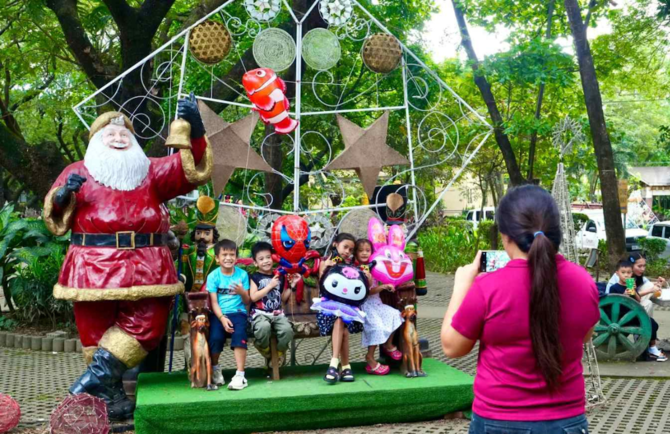
Children spend the afternoon at Quezon Memorial Circle in Quezon City, Philippines on Dec. 23, 2025. (PNA)
Short Url
Updated 24 December 2025
Follow

Filipinos celebrate Christmas on a budget amid soaring costs

  • Filipinos are choosing modest Christmas gifts, scaling down year-end festivities
  • Millions look to content creators for tips on how to spend less for Christmas dinner

MANILA: As the predominantly Catholic Philippines celebrates one of its most important annual holidays on Thursday, many Filipinos have been forced to rethink their traditional Christmas celebrations amid soaring prices. 

This year, street food vendor Gemma Gracia is among those who will keep her business open during the holidays. 

“As a vendor, I’ve felt the prices go up since I also still buy at the market for our needs and for our selling needs,” she told Arab News. 

But as celebrating Christmas was important for her family, the 39-year-old has allocated 1,000 Philippine pesos ($17) for a family meal out at Jollibee, the Philippines’ biggest fast-food chain restaurant. 

“When you don’t have food to share on the table on this holiday, it’s a sad day. That’s why we make sure that we always have something on the table each year,” she said. 

For many Filipinos, the time-honored traditions of Noche Buena, or Christmas Eve, is the most awaited part of this holiday season, when dinner tables across the country are filled with a hearty selection of traditional dishes. 

Noche Buena, which is Spanish for “the good night,” is the dinner that follows the last evening mass of the season, known as misa de gallo or simbang gabi.

In the Philippines, such festive staples include meaty Filipino-style spaghetti and hamonado, the local version of a Christmas ham that usually serves as the centerpiece of Christmas dinner tables.

But the pinch from rising prices has affected Filipino shoppers in recent years, forcing them to adjust according to their budget. 

Although the country’s central bank said inflation had eased to 1.5 percent in November, many say the statistics do not reflect on-the-ground realities, where people reel from rising retail prices, shrinking portions and diminishing purchasing power of the peso. 

Allan Manansala, a 48-year-old construction worker in Manila, told Arab News that he is expecting to spend 5,000 pesos for his family of five in 2025, nearly a third of his monthly wage and about a fifth higher than what he spent in previous years. 

“I might have to skip giving my children gifts this year because of the costs,” he said. 

To get around the high costs, Manansala is skipping the Noche Buena festivities altogether and has instead decided to splurge on New Year’s Eve dinner, which is also a significant occasion in the Philippines. 

Others, like Allan Melenio, look for different ways to save up. 

“Our relative owns a meat shop, so we’re able to save on that since the prices are quite low,” he told Arab News. “But everywhere else, a piece of meat can cost so much.” 

While the economy has forced Filipinos to make smarter choices and get creative, content creators are among those offering ideas to address consumers’ woes, teaching people how to stretch their meager budgets for the holidays. 

One such tip came from Ninong Ry, a food content creator who challenged himself to prepare an eight-dish Noche Buena dinner with a budget of 1,500 pesos. Posted about two weeks before Christmas, his one-hour YouTube video has since garnered more than 1.4 million views. 

The video was also a response to comments from Philippine Trade Secretary Cristina Aldeguer-Roque, who suggested last month that 500 pesos was enough for a family of four to host a modest Christmas Eve dinner, sparking anger among Filipinos who said she was out of touch with reality. 

Jelmark Toqueb, who works as a plumber in Manila, said that the 500-peso budget was unrealistic. 

“It is clearly not enough. (Five hundred pesos) is not even enough for you to cook spaghetti with meat. Maybe just the noodles and the sauce,” he told Arab News.

For 32-year-old Toqueb and his wife, who works as a public school teacher, the holiday season remains a cherished occasion to spend quality time with the family. As their Christmas tradition involves gift-giving, he chose more modest presents this year to circumvent the high costs. 

“The prices now are different even from last year, (when they were) already high,” Toqueb said. “Even if the gift is simple, it’s fine. It’s the thought that counts.”


Moscow made an offer to France regarding a French citizen imprisoned in Russia, says Kremlin

Updated 26 December 2025
Follow

Moscow made an offer to France regarding a French citizen imprisoned in Russia, says Kremlin

  • Laurent Vinatier, an adviser for Swiss-based adviser Center for Humanitarian Dialogue, Vinatier was arrested in Moscow in June 2024
  • He is accused of failing to register as a “foreign agent” while collecting information about Russia’s “military and military-technical activities” 

The Kremlin on Thursday said it was in contact with the French authorities over the fate of a French political scholar serving a three-year sentence in Russia and reportedly facing new charges of espionage.
Kremlin spokesman Dmitry Peskov told reporters that Russia has made “an offer to the French” regarding Laurent Vinatier, arrested in Moscow last year and convicted of collecting military information, and that “the ball is now in France’s court.” He refused to provide details, citing the sensitivity of the matter.
French President Emmanuel Macron is following Vinatier’s situation closely, his office said in a statement. French Foreign Ministry spokesperson Pascal Confavreux said Thursday that all government services are fully mobilized to pay provide consular support to Vinatier and push for his liberation as soon as possible.
Peskov’s remarks come after journalist Jérôme Garro of the French TF1 TV channel asked President Vladimir Putin during his annual news conference on Dec. 19 whether Vinatier’s family could hope for a presidential pardon or his release in a prisoner exchange. Putin said he knew “nothing” about the case, but promised to look into it.
Vinatier was arrested in Moscow in June 2024. Russian authorities accused him of failing to register as a “foreign agent” while collecting information about Russia’s “military and military-technical activities” that could be used to the detriment of national security. The charges carry a maximum penalty of five years in prison.
The arrest came as tensions flared between Moscow and Paris following French President Emmanuel Macron’s comments about the possibility of deploying French troops in Ukraine.
Vinatier’s lawyers asked the court to sentence him to a fine, but the judge in October 2024 handed him a three-year prison term — a sentence described as “extremely severe” by France’s Foreign Ministry, which called for the scholar’s immediate release.
Detentions on charges of spying and collecting sensitive data have become increasingly frequent in Russia and its heavily politicized legal system since Moscow invaded Ukraine in February 2022.
In addition to criticizing his sentence, the French Foreign Ministry urged the abolition of Russia’s laws on foreign agents, which subject those carrying the label to additional government scrutiny and numerous restrictions. Violations can result in criminal prosecution. The ministry said the legislation “contributes to a systematic violation of fundamental freedoms in Russia, like the freedom of association, the freedom of opinion and the freedom of expression.”
Vinatier is an adviser for the Center for Humanitarian Dialogue, a Switzerland-based nongovernmental organization, which said in June 2024 that it was doing “everything possible to assist” him.
While asking the judge for clemency ahead of the verdict, Vinatier pointed to his two children and his elderly parents he has to take care of.
The charges against Vinatier relate to a law that requires anyone collecting information on military issues to register with authorities as a foreign agent.
Human rights activists have criticized the law and other recent legislation as part of a Kremlin crackdown on independent media and political activists intended to stifle criticism of the war in Ukraine.
In August 2025, Russian state news agency Tass reported that Vinatier was also charged with espionage, citing court records but giving no details. Those convicted of espionage in Russia face between 10 and 20 years in prison.
Russia in recent years has arrested a number of foreigners — mainly US citizens — on various criminal charges and then released them in prisoner swaps with the United States and other Western nations. The largest exchange since the Cold War took place in August 2024, when Moscow freed journalists Evan Gershkovich and Alsu Kurmasheva, fellow American Paul Whelan, and Russian dissidents in a multinational deal that set two dozen people free.