

Filipinos celebrate Christmas on a budget amid soaring costs

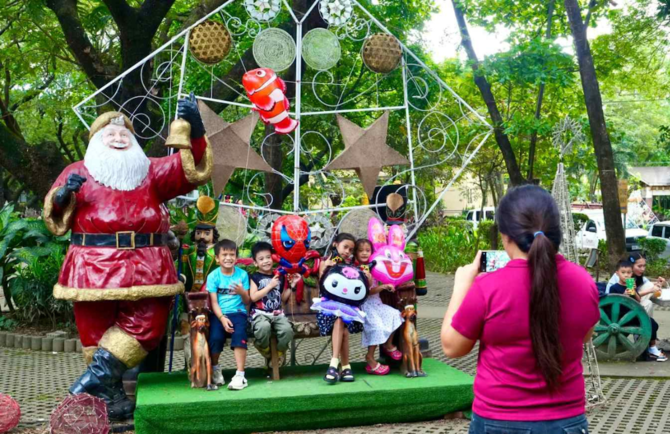
Children spend the afternoon at Quezon Memorial Circle in Quezon City, Philippines on Dec. 23, 2025. (PNA)
Short Url
Updated 24 December 2025
Follow

Filipinos celebrate Christmas on a budget amid soaring costs

  • Filipinos are choosing modest Christmas gifts, scaling down year-end festivities
  • Millions look to content creators for tips on how to spend less for Christmas dinner

MANILA: As the predominantly Catholic Philippines celebrates one of its most important annual holidays on Thursday, many Filipinos have been forced to rethink their traditional Christmas celebrations amid soaring prices. 

This year, street food vendor Gemma Gracia is among those who will keep her business open during the holidays. 

“As a vendor, I’ve felt the prices go up since I also still buy at the market for our needs and for our selling needs,” she told Arab News. 

But as celebrating Christmas was important for her family, the 39-year-old has allocated 1,000 Philippine pesos ($17) for a family meal out at Jollibee, the Philippines’ biggest fast-food chain restaurant. 

“When you don’t have food to share on the table on this holiday, it’s a sad day. That’s why we make sure that we always have something on the table each year,” she said. 

For many Filipinos, the time-honored traditions of Noche Buena, or Christmas Eve, is the most awaited part of this holiday season, when dinner tables across the country are filled with a hearty selection of traditional dishes. 

Noche Buena, which is Spanish for “the good night,” is the dinner that follows the last evening mass of the season, known as misa de gallo or simbang gabi.

In the Philippines, such festive staples include meaty Filipino-style spaghetti and hamonado, the local version of a Christmas ham that usually serves as the centerpiece of Christmas dinner tables.

But the pinch from rising prices has affected Filipino shoppers in recent years, forcing them to adjust according to their budget. 

Although the country’s central bank said inflation had eased to 1.5 percent in November, many say the statistics do not reflect on-the-ground realities, where people reel from rising retail prices, shrinking portions and diminishing purchasing power of the peso. 

Allan Manansala, a 48-year-old construction worker in Manila, told Arab News that he is expecting to spend 5,000 pesos for his family of five in 2025, nearly a third of his monthly wage and about a fifth higher than what he spent in previous years. 

“I might have to skip giving my children gifts this year because of the costs,” he said. 

To get around the high costs, Manansala is skipping the Noche Buena festivities altogether and has instead decided to splurge on New Year’s Eve dinner, which is also a significant occasion in the Philippines. 

Others, like Allan Melenio, look for different ways to save up. 

“Our relative owns a meat shop, so we’re able to save on that since the prices are quite low,” he told Arab News. “But everywhere else, a piece of meat can cost so much.” 

While the economy has forced Filipinos to make smarter choices and get creative, content creators are among those offering ideas to address consumers’ woes, teaching people how to stretch their meager budgets for the holidays. 

One such tip came from Ninong Ry, a food content creator who challenged himself to prepare an eight-dish Noche Buena dinner with a budget of 1,500 pesos. Posted about two weeks before Christmas, his one-hour YouTube video has since garnered more than 1.4 million views. 

The video was also a response to comments from Philippine Trade Secretary Cristina Aldeguer-Roque, who suggested last month that 500 pesos was enough for a family of four to host a modest Christmas Eve dinner, sparking anger among Filipinos who said she was out of touch with reality. 

Jelmark Toqueb, who works as a plumber in Manila, said that the 500-peso budget was unrealistic. 

“It is clearly not enough. (Five hundred pesos) is not even enough for you to cook spaghetti with meat. Maybe just the noodles and the sauce,” he told Arab News.

For 32-year-old Toqueb and his wife, who works as a public school teacher, the holiday season remains a cherished occasion to spend quality time with the family. As their Christmas tradition involves gift-giving, he chose more modest presents this year to circumvent the high costs. 

“The prices now are different even from last year, (when they were) already high,” Toqueb said. “Even if the gift is simple, it’s fine. It’s the thought that counts.”


Bangladesh halts controversial relocation of Rohingya refugees to remote island

Updated 13 sec ago
Follow

Bangladesh halts controversial relocation of Rohingya refugees to remote island

  • Administration of ousted PM Sheikh Hasina spent about $350m on the project
  • Rohingya refuse to move to island and 10,000 have fled, top refugee official says

DHAKA: When Bangladesh launched a multi-million-dollar project to relocate Rohingya refugees to a remote island, it promised a better life. Five years on, the controversial plan has stalled, as authorities find it is unsustainable and refugees flee back to overcrowded mainland camps.

The Bhasan Char island emerged naturally from river sediments some 20 years ago. It lies in the Bay of Bengal, over 60 km from Bangladesh’s mainland.

Never inhabited, the 40 sq. km area was developed to accommodate 100,000 Rohingya refugees from the cramped camps of the coastal Cox’s Bazar district.

Relocation to the island started in early December 2020, despite protests from the UN and humanitarian organizations, which warned that it was vulnerable to cyclones and flooding, and that its isolation restricted access to emergency services.

Over 1,600 people were then moved to Bhasan Char by the Bangladesh Navy, followed by another 1,800 the same month. During 25 such transfers, more than 38,000 refugees were resettled on the island by October 2024.

The relocation project was spearheaded by the government of former Prime Minister Sheikh Hasina, who was ousted last year. The new administration has since suspended it indefinitely.

“The Bangladesh government will not conduct any further relocation of the Rohingya to Bhasan Char island. The main reason is that the country’s present government considers the project not viable,” Mizanur Rahman, refugee relief and repatriation commissioner in Cox’s Bazar, told Arab News on Sunday.

The government’s decision was prompted by data from UN agencies, which showed that operations on Bhasan Char involved 30 percent higher costs compared with the mainland camps in Cox’s Bazar, Rahman said.

“On the other hand, the Rohingya are not voluntarily coming forward for relocation to the island. Many of those previously relocated have fled ... Around 29,000 are currently living on the island, while about 10,000 have returned to Cox’s Bazar on their own.”

A mostly Muslim ethnic minority, the Rohingya have lived for centuries in Myanmar’s western Rakhine state but were stripped of their citizenship in the 1980s and have faced systemic persecution ever since.

In 2017 alone, some 750,000 of them crossed to neighboring Bangladesh, fleeing a deadly crackdown by Myanmar’s military. Today, about 1.3 million of them shelter in 33 camps in the coastal Cox’s Bazar district, making it the world’s largest refugee settlement.

Bhasan Char, where the Bangladeshi government spent an estimated $350 million to construct concrete residential buildings, cyclone shelters, roads, freshwater systems, and other infrastructure, offered better living conditions than the squalid camps.

But there was no regular transport service to the island, its inhabitants were not allowed to travel freely, and livelihood opportunities were few and dependent on aid coming from the mainland.

Rahman said: “Considering all aspects, we can say that Rohingya relocation to Bhasan Char is currently halted. Following the fall of Sheikh Hasina’s regime, only one batch of Rohingya was relocated to the island.

“The relocation was conducted with government funding, but the government is no longer allowing any funds for this purpose.”

“The Bangladeshi government has spent around $350 million on it from its own funds ... It seems the project has not turned out to be successful.”