MANILA: Millions of Filipinos thronged cemeteries across the country on Saturday to mark Undas — the All Saints’ Day and All Souls’ Day celebrations — and take part in traditional serenades and bonfires.
The events are part of the observance for some Filipinos, as they continue ancient practices to honor their dead loved ones.
For most people in the Catholic-majority nation, the holiday involves offering prayers, lighting candles and placing flower bouquets on tomb markers.
But in the mountain town of Sagada in Northern Luzon, the day is a chance for its indigenous Kankanaey residents to practice a centuries-old tradition of pinag-aapoy, which means “light a fire.”
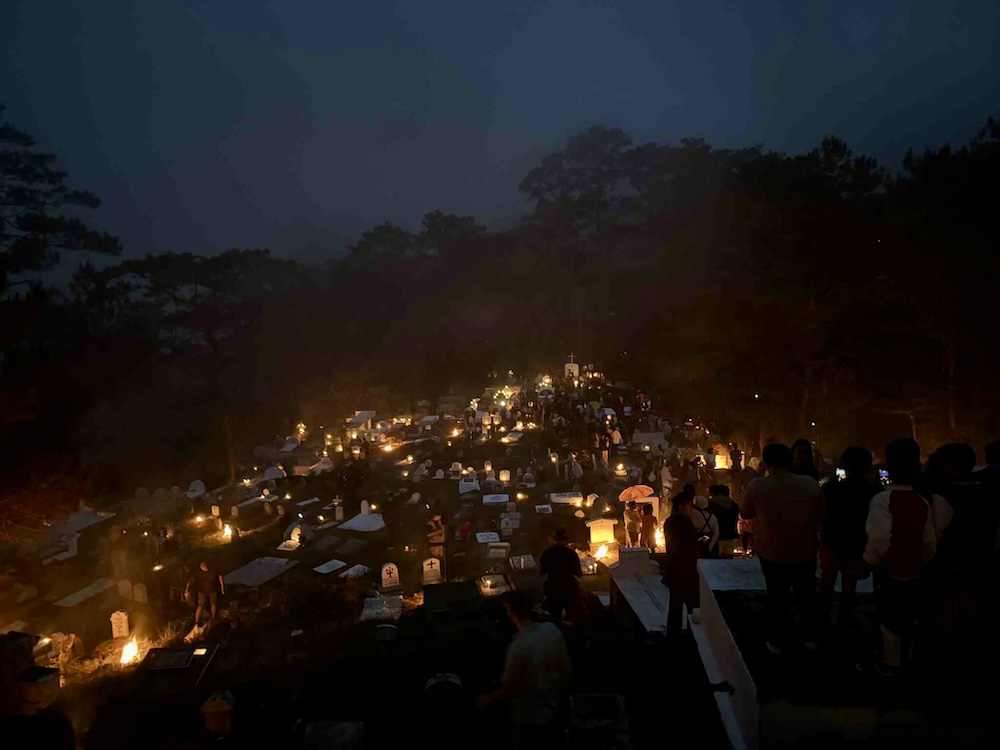
Filipinos take part in centuries-old tradition of pinag-aapoy, which involves lighting bonfires by the tomb to keep the spirits warm, on Nov. 1, 2025 in Sagada town of Mountain Province, Philippines. (Kharyle Aben)
It begins with an afternoon mass, when bundles of pinewood, locally known as saleng, are blessed before they are taken to the cemetery, where a priest would then walk around to bless the tombs. As families gather around the graves, their elders lead a short prayer for the deceased, after which they light the wood to create a bonfire.
A version of this tradition has been practiced since before Catholicism came to the Philippines, said Conrad Aben, a native of Sagada.
“The fire is to keep the spirits warm, that’s what people believe, and it’s a very old practice. Even before the Church came, people already lit fires. But when the Church arrived, the two traditions were combined, the Church and the culture integrated. That makes it unique,” the 57-year-old told Arab News.
As kutlong usually falls around or on Nov. 1, coinciding with All Saints’ Day, over time it merged with Catholic traditions, forming Sagada’s unique celebration of the annual holiday.
“Church leaders embraced the culture; it became a give-and-take relationship between faith and (cultural) tradition,” he added.
“When we come home from the cemetery, the celebration continues because the day is really for them. In our prayers, we say: ‘As we celebrate your special day…,’ and we invite our ancestors to join us for the food and some drinks … even when I’m busy in (another city), I have to come because we see Nov. 1 as a very special day.”
Down in Central Luzon, another tradition known as pangangaluluwa, or “souling,” also lives on.
An oral tradition that can be traced back to the 1900s, pangangaluluwa involves a group of adults and children dressed in white pretending to be souls, visiting houses and soliciting gifts through singing.
It has been cited by the National Commission for Culture and the Arts as evidence of Filipino belief in the afterlife and the continuing relationship between the living and the souls of the dead.
For some, a variation of this practice involves going around the cemetery to sing a song for the dead, said Jonas Reyes, who is from Olongapo City.
“They go from tomb to tomb, sing, and people give them alms. It’s like serenading the dead, or similar to caroling during Christmas,” he told Arab News.
Its annual observance varies, as some take part in souling on the eve on Undas, while others do it from Nov. 1-2, following their cemetery visit. Pangangaluluwa is practiced in the Philippine island of Mindoro and by the rural communities of Laguna, Nueva Ecija, Quezon and Rizal.
The Filipino custom has grown less popular over the years, however, as American-style “trick-or-treating” becomes more common among the younger generations.
For many Filipinos, Undas is an opportunity not just for traditions, but also family reunions, as people travel hours to “go home” and visit graves in far-flung parts of the country.
Such practices reflect a uniquely Filipino mix of spirituality and culture, said Rev. Ted Tuvera of the Archdiocese of Capiz.
“Filipinos are generally family-oriented. Add to it, Filipinos are quite religious. While the mind of the Church’s tradition honors its many saints and prays for the souls of the departed, Filipinos embrace these intentions in a unique manner,” he told Arab News.
“Unique, because apart from living up to these intentions, Filipinos take this opportunity to gather as families to pray and to remember fond memories of those who went ahead of us.”