Instability is the sign of an emerging nonpolar world

https://arab.news/vu2z9
There has been a tendency to look at international relations through the prism of polarity. For hundreds of years, polarity has provided observers of international affairs with a valuable tool for understanding the interactions among states and other international actors by mapping the distribution of power within the system relative to the most powerful. A polar-based world is one that, objectively or subjectively, provides foreign policy decision-makers with a sense of direction on whether to collaborate with it or oppose it.
Scholars have identified three main types of polar-based systems that have existed in history: unipolarity, bipolarity, and multipolarity. All these systems emerged at different points in the past two centuries. However, despite their differences, they all assume that the basic building block of international relations is the nation-state, one of whose main characteristics is sovereignty complemented by that of independence.
Sovereignty meant that the source of power within the state to govern and legislate originates from within the country, and that no external force has the legitimate right to interfere. Yet, throughout the centuries, the world has “shrunk” in terms of accessibility, the intensity and speed of interactions, and the rise of crucial issues that transcend political borders, such as global trade, cyberspace, global climate change, crime, and human trafficking. Increasingly, countries have become interconnected to ensure both their security and prosperity, securing, for instance, energy security and other natural resources, as well as access to markets, technology, and knowledge.
The tension between maintaining sovereignty and independence in a world of interdependency has increased, as much of what affects us does not necessarily occur within the political borders of where we reside and must therefore be regulated through diplomacy and international law.
In this web of interactions, the notion of polarity focuses on the main sources of international power at any given historical period, with most states either gravitating toward or opposing them. The underlying assumption of viewing international politics in terms of polarity is that each system is distinguished by the number of major powers that dominate international politics at the time, which affects stability and discord.
To begin with, it was the 19th century’s “balance of power” system, which was a precursor to the later multipolar system, where major European powers dominated international affairs through canceling out each other and thus preventing a single power or a combination of powers from achieving hegemony. When this system collapsed, the result was the First World War, which, until the second instalment of collective madness that ended with the Second World War, the world was more characterized by disorder and anarchy than by any clear sources of power able to establish and maintain stability. Consequently, the breakout of the worst, to date, world war between 1939 and 1945 was inevitable.
In the aftermath of the Second World War, an international system emerged that paradoxically aimed to suggest an alternative to the one that had led to that cataclysm, prevent future such occurrences through cooperation, and by establishing the UN and its agencies, and by codifying the conduct of international behaviour that enshrines adhering to values of finding peaceful solutions. But diametrically opposite to this very much welcomed evolution also emerged an adversarial bipolar system which was characterized by two rigid blocs, one led by the US and the other by the Soviet Union, with the threat of nuclear annihilation.
It looks as though the post-Second World War system is breaking down institutionally.
Yossi Mekelberg
The divide was typified by two diametrically opposing ideologies, capitalism and communism, to which members of the bloc had to sympathize with, if not completely adhere to. It was surprisingly stable, where the main protagonists, the US and the Soviet Union, never confronted each other directly. When this system came to an end with the collapse of the Soviet Union, it was replaced by a unipolar system dominated by the US, backed up by its military and economic might, that cultivated the idea that the world had entered an era dominated by the liberal-democratic model with war confined either to history, or to the periphery of world affairs.
This false assumption did not last for long, and major powers remained very much involved in conflict, such as the first Gulf War in 1991, the conflict in Bosnia in the following year and the genocide in Rwanda in 1994. Moreover, other centers of power were quickly on the rise, such as China, the EU, the BRICS, along with Russia’s attempts to reassert itself. Moreover, in a world in which economically sustainable development requires the free movement of people, goods, and finance, and in which the internet revolution is transforming the idea of physical borders, the attitude toward them needs to be redefined entirely, with the traditional concept of polarity challenged as well.
In an increasingly anarchic, and arguably chaotic state of global international affairs in which oneupmanship has taken over cooperation, where trade wars are becoming prevalent, where the UN is failing to fulfil its task of preventing wars or at least bringing them to a quick halt, and the major powers advance their interests first without taking into account how it might affect their allies, does polarity mean anything anymore?
It increasingly looks as though the post-Second World War system is breaking down institutionally, and its liberal peace and rights values and principles are under severe strain. A major cause is that many interactions within the current international system are ad hoc. This takes the notion of realpolitik to the extreme, ignoring ideological and moral considerations, while modern economies and militaries rely heavily on technology sharing and sustaining alliances that subscribe to a similar worldview and objectives; in other words, sharing a “polar” position is crucial.
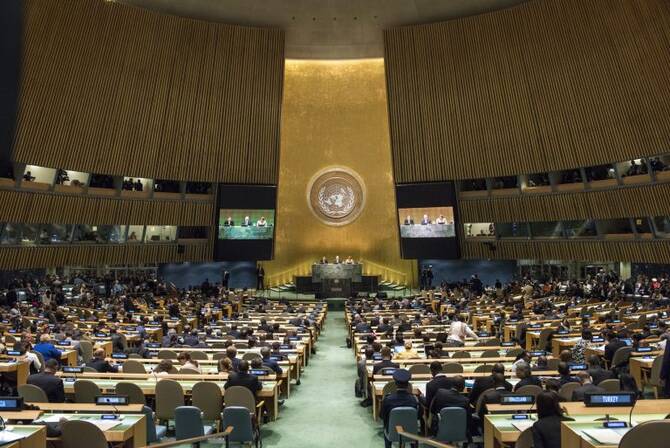
In the idealistic vision of the founders of the UN, it was this encompassing organization that would be the pole that the entire web of international affairs should gravitate toward, subscribing to a universal code of behaviour that eliminated wars and other forms of political violence, and thereby ensuring the sovereignty of all countries and the rights of individuals within them. But now this vision lies in tatters.
Instead, a world with no clear poles has emerged, the outcome of which is not necessarily more equitable power for medium and small countries, but one in which alliances and enmities are based mainly on utility and hence tend to be limited in time and scope. This, in turn, produces more uncertainty, insecurity, and instability. This emerging nonpolar world heralds a period in which the danger of conflict is heightened, and domestic upheaval is also on the rise, which is where the current international system finds itself.
- Yossi Mekelberg is professor of international relations and an associate fellow of the MENA Program at Chatham House. X: @YMekelberg