

Trump says Putin wants to end war, US to hold new talks with Ukraine

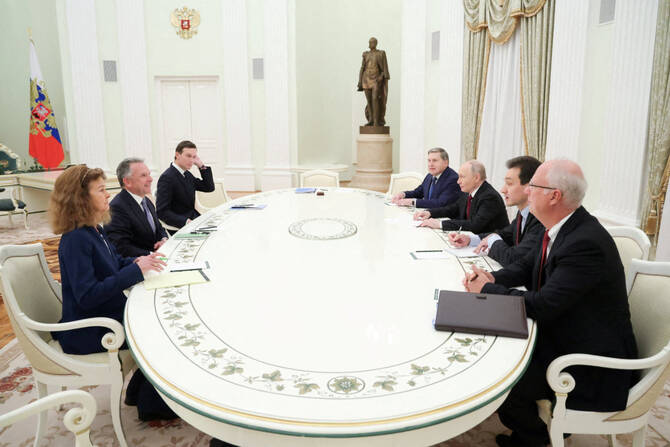
Russian President Vladimir Putin, presidential envoy Kirill Dmitriev and foreign policy aide Yuri Ushakov attend a meeting with US President Donald Trump's special envoy Steve Witkoff and son-in-law Jared Kushner at the Kremlin in Moscow on December 2, 2025. (Sputnik/Alexander Kazakov/Pool via REUTERS)
Short Url
Updated 04 December 2025
Follow

Trump says Putin wants to end war, US to hold new talks with Ukraine

  • “I can tell you that they had a reasonably good meeting with President Putin,” Trump said
  • Moscow insisted it was incorrect to say Putin rejected the plan in its entirety

WASHINGTON: President Donald Trump said Wednesday he believes Russia’s Vladimir Putin wants to end the Ukraine war despite inconclusive talks in Moscow, as US officials prepared for a follow-up meeting with Kyiv’s top negotiator.
Trump’s envoy Steve Witkoff and son-in-law Jared Kushner huddled into the early hours with Putin in the Kremlin but reached no breakthrough on halting Europe’s worst conflict since World War II.
The Kremlin said afterward it found parts of the US plan to end the war unacceptable, even though the proposal includes Ukraine ceding parts of the eastern Donbas region it still holds nearly four years after Russia’s invasion.
“I can tell you that they had a reasonably good meeting with President Putin,” Trump said when an AFP reporter asked him about the talks, adding afterwards that the talks were “very good.”
Trump said it was too soon to tell what would happen “because it does take two to tango.”
Pressed on whether Witkoff and Kushner got any sense that Putin genuinely wanted to halt Russia’s nearly four-year-old invasion, Trump replied: “He would like to end the war. That was their impression.”
Trump added that Ukraine “pretty well” backed the US proposal, although he added that Kyiv should have done so earlier when he had a notoriously heated meeting with President Volodymyr Zelensky in the Oval office in February.
Witkoff and Kushner were now due to meet top Ukrainian negotiator Rustem Umerov in Florida on Thursday, two US officials told AFP, to follow up on the Kremlin talks.


‘Successes of the Russian army’

But while the White House had voiced optimism ahead of the Kremlin talks, Moscow said that the two sides had failed to reach a compromise and that more work was needed.
The Kremlin added Wednesday that its army’s recent battlefield successes in Ukraine had bolstered its position and that Kyiv’s ties to NATO remained a key question.
Russia’s advance in eastern Ukraine gathered pace last month and Putin has said in recent days that Moscow is ready to fight on to seize the rest of the land it claims if Kyiv does not surrender it.
“The progress and nature of the negotiations were influenced by the successes of the Russian army on the battlefield in recent weeks,” Kremlin aide Yuri Ushakov, who took part in the US-Russia talks, told reporters, including AFP.
Moscow insisted it was incorrect to say Putin rejected the plan in its entirety.
It also said Russia was still committed to diplomacy, despite Putin’s stark warning earlier this week that Moscow was prepared to fight Europe if it wanted war.
“We are still ready to meet as many times as is needed to reach a peace settlement,” Kremlin spokesman Dmitry Peskov said.

‘Opportunity to end the war’

In Kyiv, Zelensky said that though a window of opportunity for peace has opened, it must be accompanied by pressure on Moscow.
“The world now clearly feels that there is an opportunity to end the war, and the current activity in negotiations must be supported by pressure on Russia,” he said in a regular evening address.
The fresh talks come as NATO pledges to buy hundreds of millions of dollars worth of US arms for Kyiv.
NATO chief Mark Rutte said it was positive that peace talks were ongoing, but that the alliance should make sure that “Ukraine is in the strongest possible position to keep the fight going.”
Russian troops have been grinding forward across the front line against outgunned and outnumbered Ukrainian forces.
Earlier this week, Moscow claimed to have captured the important stronghold of Pokrovsk, but a Ukrainian army unit fighting in the city said urban combat was still ongoing.
European countries have expressed fears Washington and Moscow will reach agreements without them and have spent the last weeks trying to amend the US plan so that it does not force Kyiv to capitulate.


Volcanic eruptions may have brought Black Death to Europe, say new study

Updated 6 sec ago
Follow

Volcanic eruptions may have brought Black Death to Europe, say new study

  • Study says volcanic eruptions in 1345 caused temperatures to drop, leading to crop failure and causing famine
  • This led Italy to have ships bring grain from central Asia, where the bubonic plague is thought to have first emerged
  • The plague killed tens of millions of people and wiped out up to 60 percent of the population in parts of Europe 

PARIS: Previously unknown volcanic eruptions may have kicked off an unlikely series of events that brought the Black Death — the most devastating pandemic in human history — to the shores of medieval Europe, new research has revealed.
The outbreak of bubonic plague known as the Black Death killed tens of millions and wiped out up to 60 percent of the population in parts of Europe during the mid-14th century.
How it came to Europe — and why it spread so quickly on such a massive scale — have long been debated by historians and scientists.
Now two researchers studying tree rings have suggested that a volcanic eruption may have been the first domino to fall.
By analizing the tree rings from the Pyrenees mountain range in Spain, the pair established that southern Europe had unusually cold and wet summers from 1345 to 1347.
Comparing climate data with written accounts from the time, the researchers demonstrated that temperatures likely dropped because there was less sunlight following one or more volcanic eruptions in 1345.
The change in climate ruined harvests, leading to failed crops and the beginnings of famine.
Fortunately — or so it seemed — “powerful Italian city states had established long-distance trade routes across the Mediterranean and the Black Sea, allowing them to activate a highly efficient system to prevent starvation,” said Martin Bauch, a historian at Germany’s Leibniz Institute for the History and Culture of Eastern Europe.
“But ultimately, these would inadvertently lead to a far bigger catastrophe,” he said in a statement.
Deadly stowaways

The city states of Venice, Genoa and Pisa had ships bring grain from the Mongols of the Golden Horde in central Asia, which is where the plague is thought to have first emerged.
Previous research has suggested that these grain ships brought along unwelcome passengers: rats carrying fleas infected with Yersinia pestis, the bacterium that causes plague.
Between 25 and 50 million people are estimated to have died over the next six years.
While the story encompasses natural, demographic, economic and political events in the area, it was ultimately the previously unidentified volcanic eruption that paved the way for one of history’s greatest disasters, the researchers argued.
“Although the coincidence of factors that contributed to the Black Death seems rare, the probability of zoonotic diseases emerging under climate change and translating into pandemics is likely to increase in a globalized world,” study co-author Ulf Buentgen of Cambridge University in the UK said in a statement.
“This is especially relevant given our recent experiences with Covid-19.”
The study was published in the journal Communications Earth & Environment on Thursday.