

Migrants in Lebanon hope Pope’s peace message lingers amid fears of new war

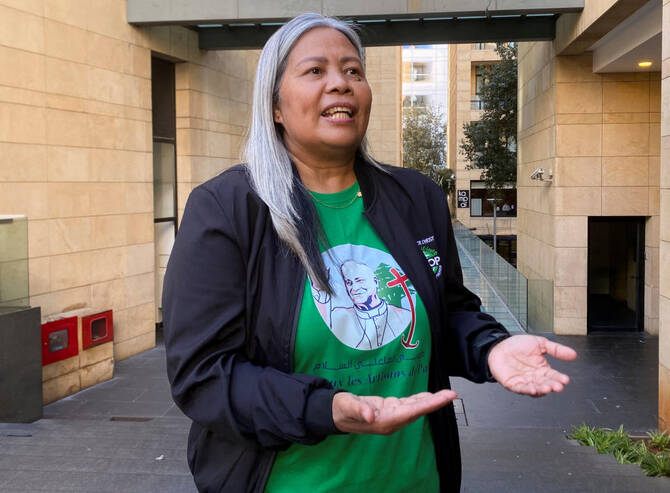
Filipino worker Loren Capobres, attends an interview with Reuters, in Beirut, Lebanon Dec. 2, 2025. (Reuters)
Short Url
Updated 03 December 2025
Follow

Migrants in Lebanon hope Pope’s peace message lingers amid fears of new war

  • “Migrants like me are not just workers. We are co-workers. We are contributors in this country, helpers, builders,” said Capobres
  • During last year’s war, Capobres’s church became a shelter for migrants and refugees

BEIRUT: Filipino worker Loren Capobres said the world stood still when she kissed Pope Leo’s hand this week in Lebanon, but hopes his message for peace will linger after his departure, leading to better working conditions and a lasting peace in the country.
Capobres, who is Catholic and has worked in Lebanon for 17 years, met Leo on Monday, alongside priests and other church volunteers on his first overseas trip as pope, in which he called on the Middle East’s leaders to reject the horror of war.
She shared testimonies of the particular challenges migrants faced during last year’s war between Israel and Lebanese armed group Hezbollah, when they were turned away from shelters hosting Lebanese fleeing intense Israeli strikes.
“Migrants like me are not just workers. We are co-workers. We are contributors in this country, helpers, builders,” said Capobres, one of more than 170,000 migrant workers in Lebanon.

A LASTING IMPACT
Leo’s departure comes as fears grow in Lebanon that a new conflict could start. Israeli strikes have killed at least 127 civilians since a 2024 truce, the United Nations human rights office said last month. A strike on Beirut’s southern suburbs last month was interpreted by many as a signal of a looming war.
Capobres hopes Leo’s push for peace across the region could take hold, and that authorities in Lebanon take heed.
“I hope that the Pope will give impact, his words will give impact for the people who are responsible for everything here in Lebanon. And, of course, I pray for peace,” she told Reuters.
During last year’s war, Capobres’s church became a shelter for migrants and refugees and she helped care for the displaced while staying there herself. “At the same time, I’m a refugee. At the same time, I’m helping,” she said.
In a Monday address after Capobres had spoken to him, Leo said that stories like hers “invite us to take a stand to ensure that no one else will have to flee from his or her country due to senseless and cruel conflicts.”

’BE STRONG’
Leo’s message of peace has a particular significance for migrants, many of whom would not be able to travel to their home countries without risking their ability to return to work.
“So we can go home, but we cannot come back. But as I said, I need to work,” said Capobres, a domestic worker.
She said fellow migrant workers, and even her employer, got in touch to congratulate her after her address to Leo.
“I’m happy that giving that testimony, I can inspire co-migrants, my fellow migrants, that their voice is heard through me,” she said.
When she finally had the opportunity to kiss the pope’s hand, Capobres said she “couldn’t see anything. I just cried. And then, you know, I feel that the world stopped.”
“But I do remember one word he said to me: be strong.”


Saudi intervention ends Socotra power crisis

Updated 5 sec ago
Follow

Saudi intervention ends Socotra power crisis

  • Sudden shutdown of the power plants after the operating company withdrew and disabled control systems
  • Saudi engineering and technical teams moved immediately after receiving an appeal from local authorities

ADEN: Electricity has returned to Yemen’s Socotra archipelago after urgent Saudi intervention ended days of outages that disrupted daily life and crippled vital institutions, including the general hospital, the university and the technical institute.

The breakthrough followed a sudden shutdown of the power plants after the operating company withdrew and disabled control systems, triggering widespread blackouts and deepening hardship for residents.

The Saudi Development and Reconstruction Program for Yemen said that its engineering and technical teams moved immediately after receiving an appeal from local authorities. Specialists were dispatched to reactivate operating systems that had been encrypted before the company left the island.

Generators were brought back online in stages, restoring electricity across most of the governorate within a short time.

The restart eased intense pressure on the grid, which had faced rising demand in recent weeks after a complete halt in generation.

Health and education facilities were among the worst affected. Some medical departments scaled back services, while parts of the education sector were partially suspended as classrooms and laboratories were left without power.

Socotra’s electricity authority said that the crisis began when the former operator installed shutdown timers and password protections on control systems, preventing local teams from restarting the stations. Officials noted that the archipelago faced a similar situation in 2018, which was resolved through official intervention.

Local sources said that the return of electricity quickly stabilized basic services. Water networks resumed regular operations, telecommunications improved, and commercial activity began to recover after a period of economic disruption linked to the outages.

In the health sector, stable power, combined with operational support, secured the functioning of Socotra General Hospital, the archipelago’s main medical facility.

Funding helped to provide fuel and medical supplies and support healthcare staff, strengthening the hospital’s ability to receive patients and reducing the need to transfer cases outside the governorate, a burden that had weighed heavily on residents.

Medical sources said that critical departments, including intensive care units and operating rooms, resumed normal operations after relying on limited emergency measures.

In education, classes and academic activities resumed at Socotra University and the technical institute after weeks of disruption.

A support initiative covered operational costs, including academic staff salaries and essential expenses, helping to curb absenteeism and restore the academic schedule.

Local authorities announced that studies at the technical institute would officially restart on Monday, a move seen as a sign of gradual stabilization in public services.

Observers say that sustained technical and operational support will be key to safeguarding electricity supply and preventing a repeat of the crisis in a region that depends almost entirely on power to run its vital sectors.