


BEIRUT: Pope Leo XIV wrapped up his three-day visit to Lebanon on Tuesday with a forceful appeal from Beirut to reject “the horror of war” and bring “an end to attacks and hostilities.”
He said: “Let no one still believe that armed conflict brings any good. Weapons kill, while negotiation, mediation and dialogue build. Let us all choose peace — let peace be our path, not just our goal.”
Lebanon was the second stop on the pope’s first overseas trip, which began in Turkiye, during which he has repeatedly pleaded for peace in the Middle East and warned that humanity’s future is at risk from proliferating global conflicts.
Reflecting on his meetings and visits across Lebanon, the pope said he had sensed “the deep spiritual roots of this country.” He expressed hope that “this spirit of brotherhood and commitment to peace may spread throughout the entire Middle East, even among those who today consider themselves enemies.”
However, his calls for calm appear to be short-lived. Shortly after the pope’s plane departed from Beirut’s Rafic Hariri International Airport and left Lebanese airspace bound for Rome, Israeli reconnaissance aircraft resumed flights over Beirut and its southern suburbs — patrols that had been paused during the papal visit.
On his final day in Lebanon, the pope began with a visit to the Sisters of the Cross hospital in Jal El-Dib, which treats patients with mental and psychological illnesses. Away from the media spotlight, the pope met children receiving care there.
“What we witness at the Cross Monastery is a lesson for everyone: We cannot forget the vulnerable, and society cannot chase comfort while ignoring the poor and those living in fragile conditions,” he said.
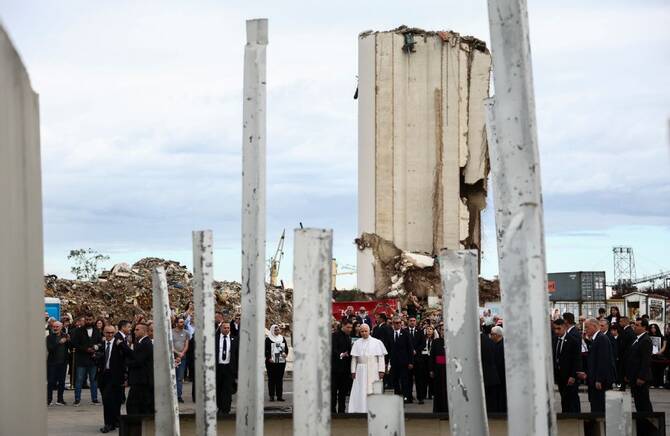
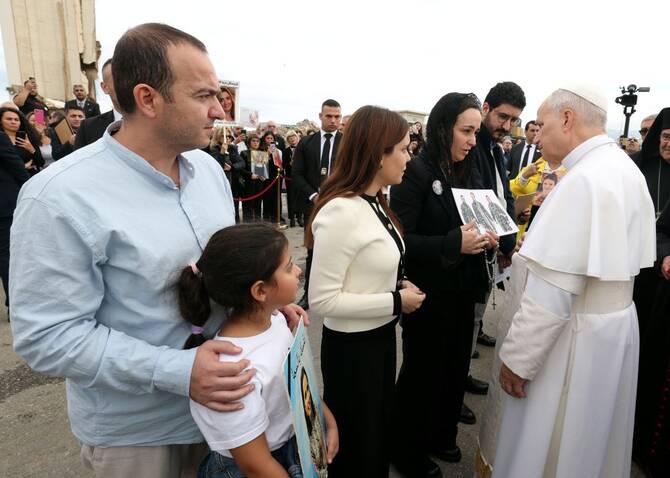
One of the most moving moments of Leo XIV’s entire trip — the first abroad since his election as patriarch — took place at the Port of Beirut, where he met families of the victims and survivors of the 2020 port explosion, in the presence of Prime Minister Nawaf Salam and Minister of Social Affairs Hanin Al-Sayyed, who herself lost her mother in the explosion.
The pope shook hands with everyone and listened to their stories. He was visibly moved by the tears of mothers and children who had lost loved ones. He then paused in a silent prayer before a memorial bearing the names of the 248 victims.
He said his brief stop at the port, “where the explosion destroyed not only a place, but the lives of so many,” was meant to show that he carries with him “the pain and the thirst for truth and justice felt by so many families.”
One of the most remarkable and unprecedented gatherings took place along the Beirut waterfront, where some 120,000 Lebanese from across the country and neighboring nations came together to pray for peace and stability. The event was attended by the president, speaker of parliament, the prime minister, ministers, MPs and party representatives, marking one of the most significant moments of the pope’s historic visit to Lebanon.
In his address, he called on Lebanese Christians to “place their future before God,” urging them to have courage. “The entire church looks at you with love and admiration,” he said.
He also appealed to the international community to support Lebanon, saying: “Listen to the voice of the people calling for peace.” He added that the Middle East “needs new approaches to reject the mentality of revenge and violence, to overcome political, social and religious divisions, and to open new chapters in the name of reconciliation and peace.”
“Do not give in to despair,” the pope said. “To Lebanon I say: Rise up, and be a sign of peace in the east.” Describing the Lebanese people as “witnesses and victims of the forces of evil,” he added that “the beauty of Lebanon is overshadowed by poverty, suffering, deep wounds, a fragile and unstable political situation, a stifling economic crisis weighing upon you, and violence and conflicts that have revived old fears.”
The pope renewed his call “not to be discouraged, not to yield to the logic of violence or the worship of the idol of money, and not to surrender to the evil that is spreading.” He added: “We have only one path to achieve this: Let us cast off the armor of our ethnic and political divisions, open our religious confessions to mutual encounter and reawaken in our hearts the dream of a united Lebanon; a Lebanon where peace and justice reign.”
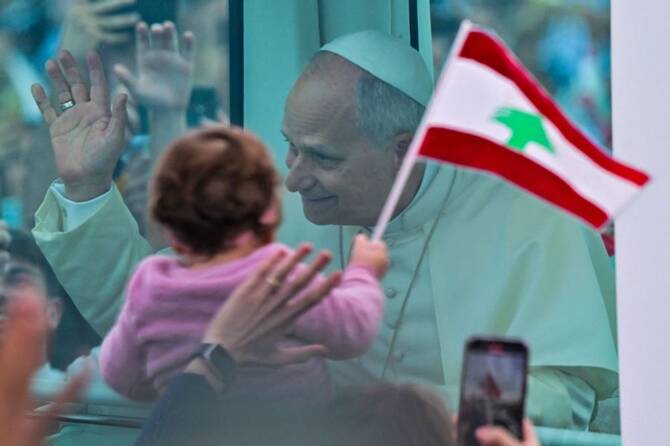
From early morning, Lebanese citizens from across the country lined the roads taken by the pope’s convoy, waving Lebanese and Vatican flags, chanting, and showering the route with flowers under tight security from the Presidential Guard.
An official farewell ceremony was held at Beirut airport, where Pope Leo said: “Departing is often more difficult than arriving. We have spent time together, and in Lebanon, I have found that people enjoy coming together, rather than being isolated.”
Lebanese President Joseph Aoun thanked the pope for “entrusting Lebanon with the message of peace,” adding: “We have heard your message and will continue to embody it. We hope to remain in your prayers, because we are a people who refuses death and departure. We have chosen to stand firm through love, peace and truth.”
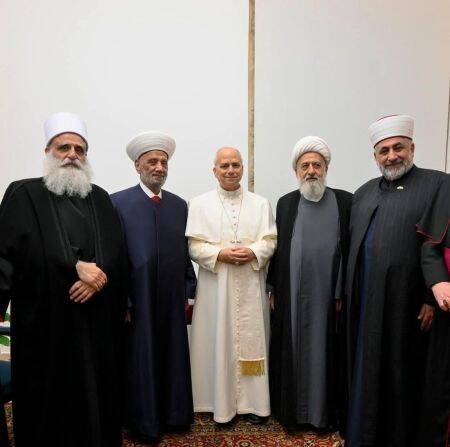
The pope held a private meeting at the Papal Embassy with Muslim spiritual leaders, including Lebanese Grand Mufti Sheikh Abdel Latif Derian, Vice-President of the Supreme Islamic Shiite Council Sheikh Ali Al-Khatib, Sheikh Akl of the Unitarian Druze Community, Sheikh Sami Abi Al-Muna, and Head of the Alawite Islamic Council Sheikh Ali Qaddour.
According to the Papal Embassy, the leaders discussed “the Lebanese reality and the difficult circumstances Lebanese is going through, especially in light of the ongoing Israeli attacks.” They asked the pope to advocate for stability in international forums, and he affirmed his commitment to continued diplomatic efforts.
During the meeting, Shiite leader Sheikh Ali Al-Khatib outlined his community’s vision for Lebanon, saying that “throughout history, the Shiite community has never had an independent or separate political project, but has always called for unity and integration.
“Israel has repeatedly invaded Lebanon, and the Lebanese, led by the Shiite community, had to confront this occupation and exercise their legitimate right to resistance due to their location on the border with Palestine,” he said.
“As a community, we are more committed to a state that fulfills its duty to defend its sovereignty and the dignity of its people. We are not enamored with taking up weapons or sacrificing our children as martyrs in place of the state. The ongoing Israeli attacks against Lebanon will reignite the situation on a large scale, and we hope that you will use your authority with the influential countries to curb this aggression and commit to the ceasefire agreement in order to preserve peace in Lebanon and the region.”