

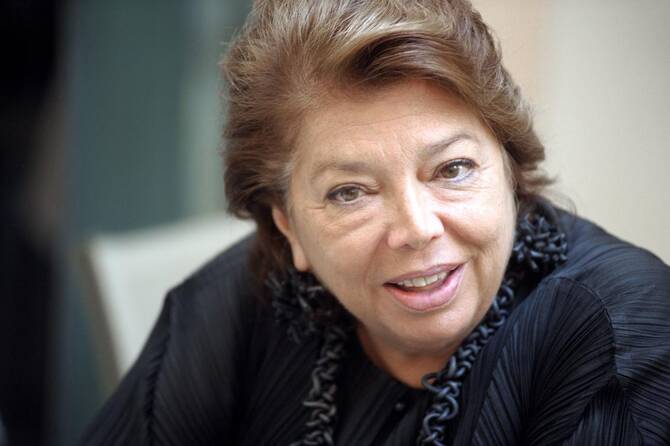

PARIS: Leila Shahid, who died Wednesday at the age of 76, was for more than twenty years the face and voice in Europe for the Palestinians.
Posted in Paris from 1993 to 2006, Shahid had also served as a representative to Ireland, the Netherlands, Denmark and later the EU from 2006 to 2015.
Faced with the war in the Gaza Strip, sparked by Hamas’s October 2023 attack on Israel, she consistently called on the international community to work for a ceasefire.
But in an interview with France Inter two days after the October 7 attack, she called herself “pessimistic” about the Palestinian future and warned against Israeli annexation of “what remains of the Palestinian territories.”
Known for her distinctive voice and rolled Rs, Shahid was born in Lebanon in 1949 to an affluent family originally from Jerusalem and grew up steeped in a lineage marked by politics and displacement.
Her family had been expelled from British-mandate Palestine for “nationalist activity.”
Her great-grandfather, who served as mayor of Jerusalem from 1904 to 1909, was among the many relatives to shape her worldview.
But the 1967 Arab-Israeli War, in which Israel defeated several of its Arab neighbors and captured East Jerusalem and the West Bank, Gaza, most of Syria’s Golan Heights and Egypt’s Sinai Peninsula, was a turning point.
“The defeat of 1967 was a major awakening for me,” she told AFP in 1993.
At 18, Shahid abandoned what she later described as a “protected” bourgeois youth in Beirut and went on to join the Palestine Liberation Organization.
Two years later, she met Yasser Arafat at a student congress in Jordan, forging an enduring loyalty to the Palestinian leader.
From 1969 to 1974, she worked in Palestinian refugee camps, particularly Shatila, where she witnessed first-hand the struggle against the Lebanese army for social self-governance.
“Those were the best years of my life,” she later said.
After earning a master’s degree in anthropology from the American University of Beirut, she began a doctoral thesis on the social structure of Palestinian refugee camps, which took her to the EPHE research institute in Paris.
- ‘Perpetual heartbreak’ -
However, the siege of the Tel Al-Zaatar camp by Lebanese Phalangists in 1976 drew Shahid back to politics.
Elected president of the Union of Palestinian Students in France, she worked closely with Azzedine Kalak, the PLO’s representative in Paris, and developed a close friendship with French author Jean Genet.
She then spent about 10 years in Morocco after her 1977 marriage to Moroccan writer and academic Mohamed Berrada.
But she found herself back in France after the outbreak of the first Palestinian intifada, or uprising, against Israeli rule in 1987.
Upon her return, she worked with Elias Sanbar and other exiled Palestinian intellectuals while also cultivating ties with Israeli peace activists.
In 1989, Shahid became the first woman to serve as a PLO representative abroad, posted to Ireland.
It was, she told AFP in 1993, a “recognition of the role women have played in the Palestinian cause for 40 years.”
She described living in “a perpetual heartbreak between my belonging to my people, the need to fight alongside them in my own way, and the desire for a normal and peaceful life.”
Shahid died at her home in southern France after several years of severe illness, according to Le Monde, with police treating suicide as the most likely cause.


