Why do ceasefires not stop the Israeli killing machine?

https://arab.news/4my42
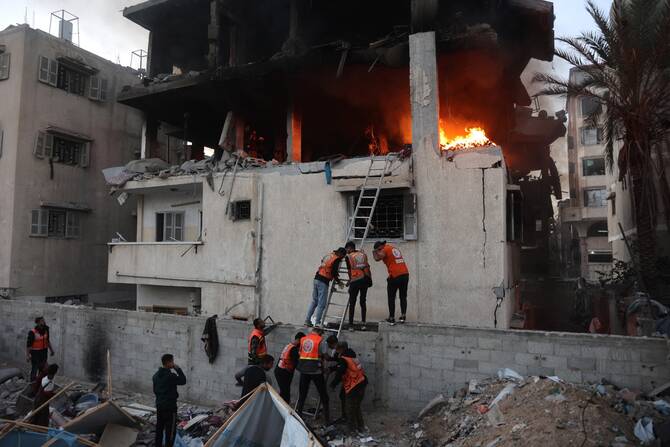
Despite the announcement and acceptance of ceasefire agreements in Gaza and Lebanon, the Israeli army — particularly its air force — has continued its deadly operations.
As of Monday, Israeli attacks carried out in Gaza since the US-brokered ceasefire took effect on Oct. 10 had killed between 318 and 342 Palestinians, according to the Gaza Health Ministry and the Gaza Government Media Office. UNICEF also reports that at least 67 children have been killed since the ceasefire began. In the same period, three Israeli soldiers were reported killed in incidents in or near the Gaza Strip. No Israeli civilian deaths inside Israel have been recorded in that time.
Meanwhile, in Lebanon, nearly 400 people have been killed since the ceasefire came into effect there a year ago, including five — among them a senior Hezbollah officer — in a blast that rocked a southern suburb of Beirut on Sunday.
Why? And who is being held responsible?
Unlike most traditional and successful ceasefire agreements, the US-led initiative in Gaza lacked key components. It failed to include two essential elements for a durable end to hostilities: a robust on-the-ground monitoring mechanism empowered to report violations; and a clear political roadmap addressing the root causes of the conflict.
Unlike most traditional and successful ceasefire agreements, the US-led initiative in Gaza lacked key components
Daoud Kuttab
To be fair, the US’ 20-point plan does mention the need for a temporary International Stabilization Force. But the agreement provides neither clarity on who will constitute this force nor a clear mandate for its operations. This ambiguity has handed Israel an easy escape route.
Israel unilaterally rejected the participation of troops from Turkiye, a NATO member with a majority Muslim population, and had earlier dismissed any role for Qatar, claiming both countries were too close to Hamas. It suggested Azerbaijan instead, but Baku quickly withdrew from consideration, as did Jordan and the UAE.
At the heart of this reluctance lies the absence of a clear mission. Most ceasefire monitoring forces are mandated only to observe and report — not to intervene, stop violators or disarm combatants. The US plan, later endorsed by the UN Security Council, calls for Gaza to become a demilitarized zone but fails to specify who will enforce this demilitarization.
Hamas insists that the question of armed resistance is a purely Palestinian matter and that no foreign force has the right to disarm its fighters. Even the issue of offering safe passage to some 200 resistance fighters sheltering in tunnels became contentious, as Israeli leaders — eager for images of Palestinian surrender — demanded they lay down their weapons before being allowed to leave.
What the failed ceasefires in Gaza and Lebanon have ultimately revealed is a waning US commitment
Daoud Kuttab
There is little doubt that Israel is constantly throwing a stick in the wheel, searching for excuses to delay moving to the second phase of the agreement, which includes reopening the Rafah crossing and allowing significantly more humanitarian aid into Gaza. Last week, the head of the Gaza Chamber of Commerce revealed that Israeli restrictions have fueled a black market that has extracted nearly $1 billion in “coordination fees,” benefiting both Israelis and Palestinians involved in this corrupt system. His statement underscores a bitter irony: the only area of genuine cooperation between Israelis and Palestinians is in crime and corruption.
The second reason the ceasefire has failed is the absence of any serious political engagement. Israel adamantly rejects any role for the Ramallah-based Palestinian Authority in Gaza and Prime Minister Benjamin Netanyahu repeatedly undermines prospects for Palestinian statehood. Washington’s growing frustration with Netanyahu appears to be behind the clause inserted into UNSC Resolution 2803 calling for Palestinian-Israeli dialogue, which the US has agreed to host, though no date or details have been announced.
What the failed ceasefires in Gaza and Lebanon have ultimately revealed is a waning US commitment. The Trump administration invested heavily in the Gaza ceasefire as long as Israeli hostages remained in captivity. Once they were released and the northern front grew quieter, Washington’s attention shifted to Ukraine.
But sustained US engagement will inevitably be needed if the current stalemate persists. Gaza, the West Bank and Lebanon are ticking time bombs. The region urgently requires two things: a credible peacekeeping force with a firm mandate to monitor and report violations, and a serious political process that tackles the core issues underlying the conflict. Without these, real ceasefires will remain elusive.
- Daoud Kuttab is an award-winning Palestinian journalist and former Ferris Professor of Journalism at Princeton University. He is the author of “State of Palestine Now: Practical and Logical Arguments for the Best Way to Bring Peace to the Middle East.” X: @daoudkuttab