

Dutch far right alive and well despite centrist victory

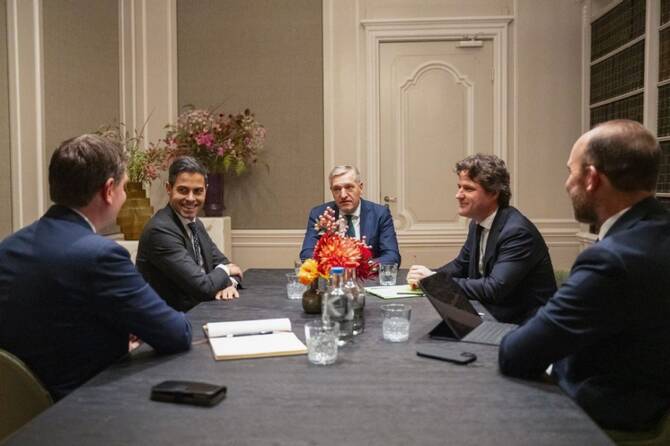
LtoR, Dutch election winner and D66 party leader Rob Jetten, informant and member of CDA party Sybrand van Haersma Buma and leader of the Christian Democratic Appeal (CDA) Henri Bontenbal attend a coalition government meeting in The Hague. (AFP)
Short Url
Updated 26 November 2025
Follow

Dutch far right alive and well despite centrist victory

  • While it lost 11 seats last month, the nationalist FvD party rose from three seats to seven

STAPHORST: In a small Dutch village just two hours from Amsterdam, women wearing traditional shawls, bonnets and pleated skirts set out to do their groceries one Monday morning.
Their old-fashioned garb is the norm in the town of Staphorst, nestled near the top end of the so-called Dutch Bible Belt, which stretches from Zeeland in the southwest to northeastern Overijssel.
The far right’s electoral success in this area attests to the movement’s persistence, despite a slim centrist victory over Geert Wilders in October elections.
Wilders’s PVV is not the only far-right party in the Netherlands. While it lost 11 seats last month, the nationalist FvD party rose from three seats to seven.
The FvD, which advocates climate-skeptic policies and a Dutch exit from the European Union, enjoyed its strongest score in Staphorst.
“We are a fan of the FvD in my house,” said Irena Nobel, 18, who told AFP she and her parents had voted for them.
Nobel admires the party’s 28-year-old leader Lidewij de Vos, calling her “a very intelligent woman who does not follow the general consensus.”

- Tattoos and three-piece suits -

Having secured 10 percent of the Staphorst vote, the FvD came third behind the PVV and the indomitable SGP — a reformist Protestant party.
FvD voters represent all social classes, according to local party councillor Remco Roelofs.
“They have tattoos, wear three-piece suits or go to vote wearing wooden clogs,” he told AFP.
But the JA21 party — an FvD breakaway — made the biggest gains, winning nine seats compared to one seat last political term.
“The FvD and JA21 can be considered part of a broader bloc of far-right parties in the Netherlands,” Stijn van Kessel, a political science professor at Queen Mary University of London, told AFP.
JA21 represents a “moderate” strand of the far right, while the FvD promotes a “more radical ideology,” Van Kessel said.

- ‘Normalized’ -

“Their ideology has largely become normalized, and together with the PVV, they attract a large number of voters,” he added.
Together, the three parties have 42 out of 150 seats — 28 percent of representation in parliament.
The FvD, which has cultivated links with Germany’s far-right AfD and Eric Zemmour in France, has argued that Wilders has watered down his stances to fit with established politics and has compared him to France’s other far-right firebrand Marine Le Pen.
The PVV lost a significant number of votes to the FvD and JA21, according to Van Kessel, who says these parties appeal to culturally conservative voters like those in Staphorst.
This manifests itself in anti-migrant opinions and a desire to preserve “national identity and traditional values,” he said, with the FvD “embodying these ‘nativist’, authoritarian positions.”
The Netherlands is no exception to the far right’s leaps and bounds in present-day Europe.
But Van Kessel noted that the variety of far-right parties represented in Dutch parliament was “remarkable.”


Arrivederci Milan Cortina. Italian organizers contemplating Rome bid for 2040 Summer Olympics

Updated 4 sec ago
Follow

Arrivederci Milan Cortina. Italian organizers contemplating Rome bid for 2040 Summer Olympics

  • The entire idea of the Milan Cortina Games was born out of the rejection of Rome’s bid for the 2024 Olympics by then-Mayor Virginia Raggi a decade ago
CORTINA D’AMPEZZO: Goodbye Milan Cortina. See you in Rome in 2040?
Now that the just-concluded Winter Olympics have been hailed for setting “a new, very high standard” by IOC President Kirsty Coventry, Italian organizers are contemplating a bid for the 2040 Summer Games.
“I think our country deserves another Summer Olympics,” Italian Olympic Committee (CONI) president Luciano Buonfiglio said over the weekend. “But let’s take it step by step. A candidacy has to be agreed on and shared with the government.”
The idea of the Milan Cortina Games was born out of the rejection of Rome’s bid for the 2024 Olympics by then-Mayor Virginia Raggi a decade ago. That came four years after then-Premier Mario Monti scrapped the city’s candidacy for the 2020 Games because of financial concerns; and after a Rome bid was narrowly defeated by Athens in the final round of voting for 2004.
“Scars help you remember” the defeats, said Giovanni Malagò, the head of the Milan Cortina organizing committee and former CONI president.
But Malagò, who is also an IOC member, suggested that Rome has a couple of key advantages in Olympic circles: its “unique” history of failed bids and the centerpiece venue for any Summer candidacy.
“Rome has a 70,000-seat stadium with an athletics track — which is huge in terms of sustainability,” Malagò said.
The existing Stadio Olimpico and surrounding Foro Italico complex would be a natural setting for athletics and swimming — the two biggest sports at the Summer Games.
Rome Mayor Roberto Gualtieri said during the Milan Cortina Games that he believes his city has “the conditions” for another bid — especially after welcoming more than 33 million people to the capital and Vatican for the 2025 Holy Year.
“If it’s considered a realistic goal, I’m open to collaborating with the IOC, government and CONI in order to create the most competitive bid possible,” Gualtieri said. “A capital like Rome should not be afraid of big challenges. The Jubilee showed off our organizational capacity for big events.”
With the 2028 Games coming up in Los Angeles and 2032 in Brisbane, Australia; and India and Qatar bidding for 2036; the 2040 Summer Games seem destined to return to Europe.
“Now is not the time to discuss this. It’s premature, wrong and even counterproductive,” Malagò said. “We need to understand the geopolitical landscape for post-2032.”
Malagò wouldn’t elaborate on speculation that he will run for Rome mayor after he finishes off his Milan Cortina duties, saying he would discuss “ideas that I have in mind” after next month’s Paralympics.
Andrea Abodi, Italy’s Minister for Sport and Youth, added: “It doesn’t necessarily require an announcement to build a winning bid.”