Considered a traitor: Life of an anti-war Ukrainian in Russia

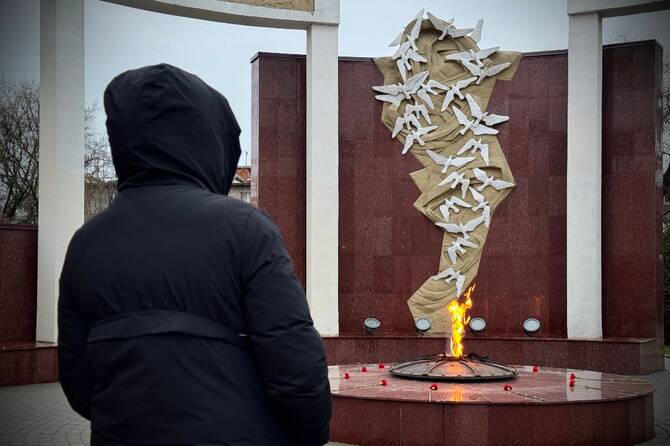
The 48-year-old Ukrainian living in Russia for 20 years, Maria (whose name has been changed to protect her identity) visits a World War Two memorial in the Moscow region. (AFP)
Short Url
Updated 23 February 2026
Follow

Considered a traitor: Life of an anti-war Ukrainian in Russia

  • Russia treats anyone with links to Ukraine as suspicious and has outlawed criticism of its military campaign

MOSCOW: In war-torn Ukraine, her family considers her a traitor. In tightly controlled Russia, her life is defined by solitude.
A Ukrainian living in Russia for the past 20 years, Maria — whose name AFP has changed for her safety — has for four years watched with horror as her adopted homeland waged war against her native country.
Her parents are her only family in Ukraine who still speak to her. The rest of her friends and relatives there have cut her off.
“They consider me a traitor,” Maria, 48, told AFP.
Her nephew, fighting for Ukraine, was wounded in combat while her son-in-law, drafted into Russia’s army, was killed.
After moving to Russia to study, Maria stayed and would regularly visit Ukraine until 2022.
Moscow’s decision to launch its full-scale military offensive on February 24, 2022 was “shocking” to her.
Maria has not seen her family in Ukraine since — unable to leave Russia as her Ukrainian passport expired.

- ‘Never see them again’ -

She is now trying to get Russian citizenship to be able to travel more freely, but is caught in a vicious bureaucratic cycle.
Russia treats anyone with links to Ukraine as suspicious and has outlawed criticism of its military campaign.
According to Maria, Ukrainians trying to get Russian nationality face interrogations about their families — and their opinion of the war.
In Moscow-controlled Ukrainian territory, Kyiv accuses Russia of handing out passports en masse, an attempt to erase the areas of their Ukrainian identity and history.
Maria told AFP she was constantly worried about her parents.
“My biggest fear is to never see them again.”
When she phones her mother, the call is interrupted by “sirens and explosions” — the soundtrack of Russia’s four-year-long military campaign.
She sometimes sees reports that Russia has struck her home city. If the phone lines to her parents are cut, she scrambles to find out exactly what districts.
Around 900,000 Ukrainian citizens lived in Russia before 2022.
Some left after Russia’s 2014 annexation of Crimea and more again after the Kremlin launched its 2022 offensive.
From Ukraine, some eight million fled to Europe in the first year of the war, the UN said.
At least 1.2 million — mainly from eastern Ukraine — fled to Russia, the UN said, but it has not published data on how many are still there.
Kyiv has accused Moscow of blocking and complicating travel to Russia by Ukrainians. Going through Russia is the only way for them to visit relatives in parts of Ukraine that Russia has captured and claims as its own.

- ‘Huge fear’ -

Along with forcing millions out of their homes, the war has killed hundreds of thousands of soldiers, tens of thousands of civilians and decimated much of eastern and southern Ukraine.
When her Russian son-in-law was drafted into Russia’s army in 2022, Maria was torn.
“On the one hand, I felt sorry for him as it was forced,” she said, recounting how he cried as he did not want to fight.
“On the other, I felt angry that he is going there to kill my relatives.”
Her nephew was at the front on the Ukrainian side at the same time and she had a “huge fear” they would face each other across the battlefield.
“This thought that he (my son-in-law) could go and kill my nephew horrified me,” she said.
When it was her son-in-law that ended up being killed, she had to comfort her daughter.
“He was her first love and we still cannot believe it as there was no burial, the body was not recovered.”
Maria tried to talk about it with her parents in Ukraine.
“I tried to tell them that I feel sorry for my son-in-law. But they said: ‘We don’t. He made his choice’.”
After that, Maria fell into depression, turning to a psychologist.
In Russia, where criticism of the campaign is banned, she was surrounded by supporters of the war.
In Ukraine, her relatives “did not want my support or compassion.”
“I became a black sheep.”
“We (Ukrainians in Russia) are not guilty of anything, we do not support (the offensive). We are worried for them and every strike, every bombing, affects us too,” she added.

- ‘Ukrainian songs’ -

Maria decided to stop actively reading news about the war, finding it “too hard that I can’t help my relatives.”
But the conflict has affected all corners of life in Russia — even splitting the beauty salon outside Moscow where she works.
“Many clients moved abroad because they did not support the military campaign,” Maria said.
Others “stopped coming to me, just because I am from Ukraine and I do not support this war.”
Her social circle shrank.
Urged on by officials and pro-war zealots, the Soviet-era practice of denunciations has skyrocketed in Russia during the war and Maria mostly prefers to be alone.
“It’s more comfortable for me because I know that I will not betray myself and not denounce myself.”
Her strategy for living among supporters of the war?
“I sing songs, Ukrainian songs, in my head” when listening to people publicly back the offensive.
As the war approaches the four-year mark, Maria has little optimism.
“I would like the war to end tomorrow,” she said.
“But I understand it’s not realistic, as each leader has his demands and nobody wants to compromise. No one cares about the people suffering.”


Epstein files reveal links to cash, women, power in Africa

Updated 26 February 2026
Follow

Epstein files reveal links to cash, women, power in Africa

  • Documents attest to Epstein’sclose ties with Karim Wade, son of former Senegalese president Abdoulaye Wade
  • They also reveal his ties to Nina Keita, niece of Ivorian president Alassane Ouattara

PARIS: Jeffrey Epstein built close ties with powerful figures in Senegal and Ivory Coast, files released by the US government last month show, detailing the late sex offender’s influence network across Africa.
Emails, scheduled meetings, investment projects, and loans reviewed by AFP attest to the disgraced New York financier’s close relationship with Karim Wade, son of former Senegalese president Abdoulaye Wade.
They also reveal his ties to Nina Keita, niece of Ivorian president Alassane Ouattara.
Wade and Epstein met in 2010 through Emirati businessman Sultan Ahmed bin Sulayem, who recently resigned as CEO of port giant DP World after mounting pressure over his close friendship with Epstein.
The pair quickly struck up a rapport.
“Thanks for coming. I think there are many things to consider... I feel confident that we will have fun,” Epstein wrote to Wade on November 15, 2010 after their first meeting in Paris.
“Have a safe trip back to your paradise Island,” Wade replied.
While Wade’s exchanges show no link to Epstein-related sex trafficking crimes, they do reveal conversations on potential business ventures in various sectors, such as finance and energy.
Nicknamed the “Minister of Heaven and Earth” for the multiple portfolios he held including international cooperation, energy, and air transport, Wade was a powerful figure in Senegal until April 2012, when his father’s bid for a third term sparked deadly riots.
Epstein saw him as “one of the most important players in africa” and invited him to meet close contacts such as Ehud Barak, then Israel’s defense minister.
He also put him in touch with Chinese businessman Desmond Shum to discuss “offshore banking.”
The US Department of Justice documents show Shum and Wade met in Beijing on May 9, 2011.
That same month, Wade planned an African tour through Senegal, Mali, and Gabon for Epstein.

‘You will not suffer’ 

Epstein and Wade’s relationship became even more apparent after the latter’s fortunes reversed when his father left office in 2012.
That autumn, Epstein proposed that his “friend” — under the Dakar authorities’ scrutiny over his assets — use his house in Florida.
“You and your family are welcome to use my house in palm beach, staff is there, pool etc. you will not suffer,” Epstein wrote.
“Txs a lot Brother for the advise,” Wade replied a few weeks later to another email, in which Epstein urged him to “stay mentally strong.”
Numerous files suggest Epstein became financially involved on Karim Wade’s behalf after his arrest in 2013 and his 2015 sentencing to six years in prison for corruption.
Karim Wade’s lawyer, Mohamed Seydou Diagne, sent two invoices in May 2014 and July 2015 of $500,000 to one of Epstein’s companies.
Contacted by AFP on Monday, Diagne said he “did not consider it useful to comment.”
Other archives suggest that Epstein covered at least $50,000 in fees for the US lobbying firm Nelson Mullins, hired by Wade’s entourage to secure his release.
Epstein regularly exchanged emails with Robert Crowe, a partner at the firm who kept him informed of their efforts in the US and Senegal.
In a June 16, 2016 email thread where Epstein and Crowe discussed whether then Senegalese president Macky Sall would pardon Wade, Crowe writes: “He has told my friends high up at State that he was going to do it. They have been putting pressure on him!“
Karim Wade was released from prison eight days later, on June 24, and went into exile in Qatar, which he credited for efforts toward his release.
Jeffrey Epstein was told by Sultan Ahmed bin Sulayem and Nina Keita.

‘A very interesting person!’

The DOJ documents show Nina Keita was close to both Epstein and Karim Wade and that she acted as a regular intermediary while Wade was in prison.
Keita also helped put Epstein in contact with her uncle, president of Ivory Coast since May 2011, and his team.
“He thought you were a very interesting person! ... they were all very happy to have you here,” she wrote on January 20, 2012, after the financier’s visit to Abidjan.
She had booked him the “ministerial suite” of the luxury Hotel Ivoire for that trip.
Ahead of the visit, Epstein had said he hoped to see “very pretty girls there, as well as interesting places.”
“You will!” Keita replied.
Emails show Keita, a former model, at least once sent photos and the phone number of a young woman to Epstein.
He then met this woman at the Ritz hotel in Paris on August 31, 2011.
“ask sadia to send pictures of her sister. i prefer under 25,” Epstein wrote to Keita after the meeting.
Now the deputy general director of Ivorian petroleum stocks company GESTOCI, Keita also appears in a February 2019 will in which Epstein requested that debts owed to him by a number of people be canceled upon his death.
AFP received no response to its requests for comment from both Keita and the Ivorian presidency, or from Karim Wade, who was contacted through his entourage.
The mere mention of a person’s name in the Epstein files does not in itself imply wrongdoing.