

Netherlands looks at trade ban on goods from Israeli settlements

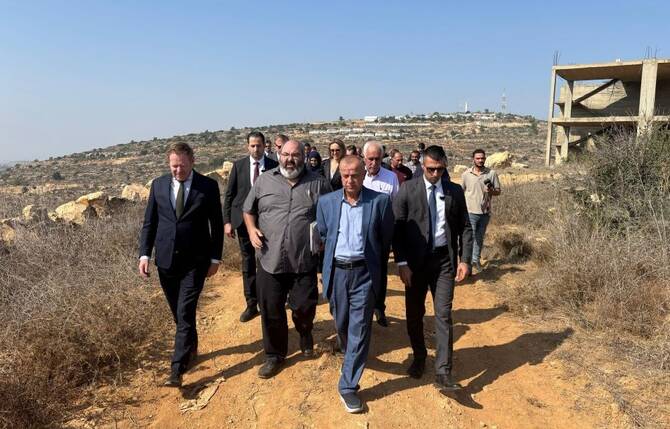
Minister of Foreign Affairs of the Kingdom of the Netherlands David van Weel, left, visits the West Bank. (X/@ministerBZ)
Short Url
Updated 11 November 2025
Follow

Netherlands looks at trade ban on goods from Israeli settlements

  • Foreign minister makes remarks during visit to West Bank
  • Dutch join EU members Spain, Slovenia, Ireland, Belgium in assessing sanctions on trade with settlements 

LONDON: The foreign minister of the Netherlands has said his country is working to ban goods from illegal Israeli settlements in occupied Palestine. 

David van Weel made the comments during a visit to the West Bank, where he visited an area previously attacked by Israeli settlers.

The Netherlands paused efforts to enact broader sanctions against Israel following the ceasefire with Hamas last month. However, violence by settlers in the West Bank has prompted international condemnation.

“Now we deem it is not a time to increase sanctions on Israel because we want to see the peace plan implemented and we want to also encourage Israel to play a positive part in this,” van Weel told The Guardian.

“At the same time, we’re not blind to any movements on the West Bank that might move the two-state solution further (away).”

Sanctions are tough for EU members to impose individually on trade as the issue falls within the broader remit of the bloc.

“It’s not easy to make a carve-out,” van Weel said. “We cannot just stop (all imports from illegal settlements) immediately because there is currently no legal basis for that. We are trying to make new policy now, then it has to go through parliament.”

The EU is Israel’s largest trading partner, making up a third of all Israeli exports. Goods from the settlements make up a relatively small proportion of those exports. 

The Netherlands joins Spain, Slovenia, Belgium and Ireland in planning to sanction trade with Israeli settlements in the West Bank. Belgium and Spain have also cut consular services to those living in settlements.

In June, nine member states asked the EU Commission to assess cutting trade with Israeli settlements after the International Court of Justice ruling on the illegality of Israel’s occupation of Palestine. They included Finland, Luxembourg, Poland, Portugal and Sweden.

The Netherlands is historically a staunch Israeli ally, but pushed the EU in May to review the association agreement with the country, which is the foundation of tariff-free trade and other links including in finance and scientific research.

This led to calls from within the EU in September to suspend the free trade agreement with Israel after it was found to have violated numerous human rights obligations.

There were also calls to sanction two far-right Israeli ministers, Itamar Ben Gvir and Bezalel Smotrich.

Sven Kuhn von Burgsdorff, a former EU envoy to Palestine, told The Guardian: “Business as usual is over … Time for impunity is over.”

More than 200 Palestinians have been killed by settlers and the Israeli military this year in the West Bank, including 40 children.

Eight attacks occurred daily on average in October, including against people, property and livestock. It marks a high point in the past 20 years of EU records.

The attacks come amid plans by far-right Israeli politicians in parliament to effectively annex the West Bank by making it subject to Israeli law. The bill passed the preliminary reading stage in October but is opposed by the US. 


Syrian government, Kurds to extend truce: sources to AFP

Updated 10 sec ago
Follow

Syrian government, Kurds to extend truce: sources to AFP

  • No official announcement has yet come from Damascus or SDF, but two sources said truce is to be extended by one month

DAMASCUS: The Syrian government and Kurdish forces have agreed to extend a ceasefire set to expire Saturday, as part of a broader deal on the future of Kurd-majority areas, several sources told AFP.

No official announcement has yet come from Damascus or the Kurdish-led Syrian Democratic Forces (SDF), but two sources said the truce is to be extended by one month.

On Tuesday, Damascus and the SDF agreed to a four-day ceasefire after Kurdish forces relinquished swathes of territory to government forces, which also sent reinforcements to a Kurdish stronghold in the northeast.

A diplomatic source in Damascus told AFP the ceasefire, due to expire on Saturday evening, will be extended “for a period of up to one month at most.”

A Kurdish source close to the negotiations confirmed “the ceasefire has been extended until a mutually acceptable political solution is reached.”

A Syrian official in Damascus said the “agreement is likely to be extended for one month,” adding that one reason is the need to complete the transfer of Daesh group militant detainees from Syria to Iraq.

All sources requested anonymity because they are not allowed to speak to the media.

After the SDF lost large areas to government forces, Washington said it would transfer 7,000 Daesh detainees to prisons in Iraq.

Europeans were among 150 senior IS detainees who were the first to be transferred on Wednesday, two Iraqi security officials told AFP.

The transfer is expected to last several days.

Daesh swept across Syria and Iraq in 2014, but backed by a US-led coalition, the SDF ultimately defeated the group and went on to jail thousands of suspected militants and detain tens of thousands of their relatives.

The truce between Damascus and the Kurds is part of a new understanding over Kurdish-majority areas in Hasakah province, and of a broader deal to integrate the Kurds’ de facto autonomous administration into the state.

Syrian President Ahmed Al-Sharaa’s Islamist forces toppled longtime ruler Bashar Assad in 2024.

The new authorities are seeking to extend state control across Syria, resetting international ties including with the United States, now a key ally.

The Kurdish source said the SDF submitted a proposal to Damascus through US envoy Tom Barrack that would have the government managing border crossings — a key Damascus demand.

It also proposes that Damascus would “allocate part of the economic resources — particularly revenue from border crossings and oil — to the Kurdish-majority areas,” the source added.

Earlier this month, the Syrian army recaptured oil fields, including the country’s largest, while advancing against Kurdish forces.