

Philippines’ Duterte authorized murders, ICC told as hearings open

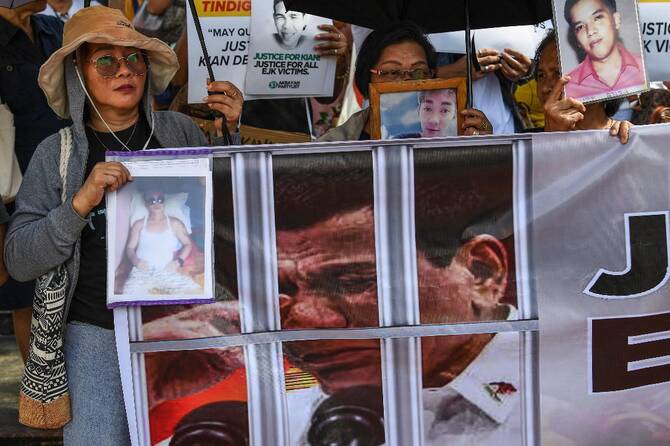
Families of victims of extrajudicial killings of former Philippine president Rodrigo Duterte's drug war display portraits of their loved ones during a protest in Manila, Philippines. (AFP)
Short Url
Updated 24 February 2026
Follow

Philippines’ Duterte authorized murders, ICC told as hearings open

  • Niang said Duterte played a “pivotal” role in the extrajudicial killings of suspected drug dealers and users, first as mayor of Davao City then as president

THE HAGUE: Rodrigo Duterte personally authorized murders and hand-picked some of the victims of his “war on drugs,” the International Criminal Court heard on Monday, as proceedings against the former Philippines president kicked off.
ICC deputy prosecutor Mame Mandiaye Niang said the week-long “confirmation of charges” hearings, where judges will decide whether to open a full trial against Duterte, was “a reminder that those in power are not above the law.”
The 80-year-old Duterte did not appear after the court granted a defense request for his absence, despite judges ruling he was fit to take part.
Following the hearings, the judges will have 60 days to issue a written decision on whether he should face a full trial.
Niang said Duterte played a “pivotal” role in the extrajudicial killings of suspected drug dealers and users, first as mayor of Davao City then as president.
He “authorized murders and personally selected some of the victims,” said Niang.
Duterte’s defense lawyer Nicholas Kaufman hit back, calling the charges “grievously misplaced and politically motivated.”
Duterte “stands behind his legacy resolutely. He maintains his innocence absolutely,” said Kaufman.
Kaufman acknowledged that his client was “a unique phenomenon” who was “gung-ho in his ways” and full of “hyperbole, bluster and rhetoric.”
However, he accused the prosecution of “cherry-picking” Duterte’s speeches, adding that many of them insist on the importance of sticking to the law.
Rival groups of demonstrators camped outside the court from early Monday.
Patricia Enriquez, a 36-year-old researcher, said it was a “historic moment” for victims of Duterte’s alleged crimes.
“It is emotional. It is hopeful. It is also very painful,” she told AFP.
“I’m hoping that all the Filipinos and everybody in the world will stand with us, stand with truth, stand with justice and stand with accountability.”
However, 35-year-old chef Aldo Villarta said it was a “slap in the face” for the Philippines that an international court was trying the country’s former leader.
“We’ve already suffered so long from colonization,” said Villarta, who also argued that Duterte’s human rights were being infringed by imprisonment.

‘High value targets’

Duterte faces three counts of crimes against humanity, with prosecutors alleging his involvement in at least 76 murders between 2013 and 2018.
The true number of killings during his campaign in the Philippines is thought to be in the thousands, and lawyers for the victims have argued that a full trial could encourage more families to come forward.
Niang said the murders charges were “merely a fraction” of the real numbers killed.
Another prosecutor, Julian Nicholls, said: “The evidence shows... that Mr.Duterte murdered thousands of his own people, Filippino men, women, and children.”
Showing multiple videos of Duterte threatening to kill criminals, Nicholls said: “He repeatedly promised to kill people. He said it. He did it. That is who he is.”
Duterte, who was president from 2016 to 2022, was arrested in Manila in March last year, flown to the Netherlands and has since been held at the ICC’s detention unit at Scheveningen Prison.
He followed his initial hearing three days later by video link, appearing dazed and frail and barely speaking.
The first of three counts against Duterte concerns his alleged involvement as a co-perpetrator in 19 murders carried out between 2013 and 2016 while he was mayor of Davao City.
The second relates to 14 murders of so-called “High Value Targets” in 2016 and 2017 when he was president.
The third charge covers 43 murders committed during “clearance” operations of lower-level alleged drug users or pushers across the Philippines between 2016 and 2018.
In Manila, about 60 relatives of those killed in the crackdown gathered around two television monitors to watch the hearing at a Catholic Church-run community center for the poor.
The mainly elderly and middle-aged women whose husbands or sons were shot dead in police operations told AFP they were disappointed Duterte had not been required to appear.
“Maybe he does not want to own up to his sins,” said Gloria Sarmiento, whose boyfriend was found dead alongside his brother in the last few weeks of the Duterte presidency.
“Maybe he is a coward.”


Stranded travelers scramble to make new connections as war shuts much of Middle East to air travel

Updated 6 sec ago
Follow

Stranded travelers scramble to make new connections as war shuts much of Middle East to air travel

  • Airspace or airports in Israel, Qatar, Syria, Iran, Iraq, Kuwait, Bahrain, Oman and the United Arab Emirates were closed, according to flight tracking sites and government agencies there

DUBAI: Hundreds of thousands of stranded travelers scrambled to make new connections and get through to airlines on jammed phone lines Sunday after the attack on Iran by the United States and Israel shut down much of the Middle East to air travel.
Tourists and business travelers crowded hotels and airports, with no word on when many airports would reopen or when flights to and through the Middle East would resume. Some governments advised their stranded citizens to shelter in place.
Shutdown airports in Dubai, Abu Dhabi and Doha — including Dubai International Airport, one of the busiest in the world — are important hubs for travel between Europe, Africa and the West to Asia. All three were directly hit by strikes.
Mohammad Abdul Mannan, in the crowd at Hazrat Shahjalal International Airport in Dhaka, Bangladesh, said he wasn’t concerned about the war, but that he needs to get his flight to the Middle East to make a living.
“We have set out to go for work, and we must go,” he said. “My only concern is how to go abroad and how to earn an income.”
Confusion reigned for many travelers as they tried to get answers on online portals or through busy phone lines.
In Dubai, stranded travelers could hear fighter jets overhead and an explosion when the Fairmont Palm Hotel was hit by a missile strike.
Many were unable to get updated flight information from tour operators or Dubai-based Emirates, which suspended all flights to and from Dubai until at least Monday afternoon.
Louise Herrle and her husband had their flight to Washington canceled on their way back to their Pittsburgh home after a tour of Dubai and Abu Dhabi, with no word when they could reschedule.
“We’re in the hotel room, we are not leaving it, so you’re not going to give it up until we know we have a flight out of here,” Herrle said. “I’m sure everyone else is in the same situation.”
Flights canceled, airports and airspaces still closed
Cirium, an aviation analytics firm, said it is hard to calculate the number of travelers stranded worldwide.
However, it estimated that at least 90,000 people alone change flights daily in the airports in Dubai, Doha or Abu Dhabi on just three airlines, Emirates, Qatar Airways and Etihad Airways.
Airspace or airports in Israel, Qatar, Syria, Iran, Iraq, Kuwait, Bahrain, Oman and the United Arab Emirates were closed, according to flight tracking sites and government agencies there.
More than 2,800 flights were canceled Sunday to and from airports across the Middle East, including those that remained open in Saudi Arabia, Jordan and Egypt, according figures on flight tracking site FlightAware. International airports in London, Mumbai, Delhi, Bangkok, Istanbul, Sri Lanka and Paris each reported dozens of flights canceled, as well.
Cancellations will extend beyond Sunday, at least.
Emirates suspended all flights to and from Dubai until at least Monday afternoon. Air India suspended all flights to and from the United Arab Emirates, Saudi Arabia, Israel and Qatar until Tuesday. Israeli airline EL AL said it was preparing to fly home Israelis stranded abroad once the airspace reopened and closed ticket sales for flights through March 21 to ensure stranded customers get priority.
Two airports in the United Arab Emirates reported strikes as the government there condemned what it called a “blatant attack involving Iranian ballistic missiles” on Saturday.
Officials at Dubai International Airport said four people were injured, while Zayed International Airport in Abu Dhabi said one person was killed and seven others were injured in a drone strike. Strikes were also reported at Kuwait International Airport.
Iran did not publicly claim responsibility.
Flight disruptions are likely to continue
Airlines urged passengers to check their flight status online before heading to the airport. Some airlines issued waivers to affected travelers that will allow them to rebook their flight plans without paying extra fees or higher fares. Others offered full refunds.
“For travelers, there’s no way to sugarcoat this,” said Henry Harteveldt, an airline industry analyst and president of Atmosphere Research Group. “You should prepare for delays or cancelations for the next few days as these attacks evolve and hopefully end.”
Mike McCormick, who used to oversee air traffic control for the Federal Aviation Administration, said countries might reopen their airspace once American and Israeli officials tell airlines where military flights are operating and how capable Iran remains at firing missiles.
‘No one really knows what’s going on’
The reverberations echoed far outside the Middle East — for example, airport authorities in the resort island of Bali in Indonesia said more than 1,600 tourists were stranded at I Gusti Ngurah Rai International Airport on Sunday after five flights to the Middle East were canceled or postponed.
Airlines that are crossing the Middle East will have to reroute flights around the conflict with many flights headed south over Saudi Arabia. That will cause delays and higher costs.
Kristy Ellmer, an American who had been on business meetings in Dubai, said she was staying in a hotel and keeping multiple flights booked in case airports reopen.
She said she was gaining confidence in the government’s ability to protect the city from missiles, but also keeping away from windows when she hears explosions.
“You hear a lot of explosions at times, there’s hundreds of them,” Ellmer said. “And so when we hear them we sort of just don’t stay near the windows just in case the glass was to break or there was some impact.”