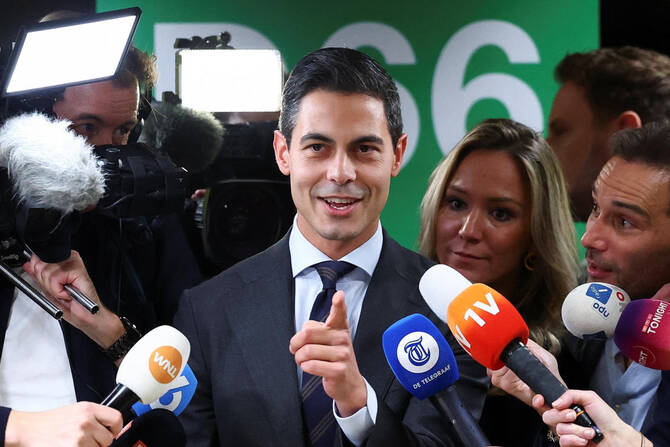
THE HAGUE: The Dutch election climaxed in an unprecedented cliffhanger Thursday, with only a few thousand votes separating the far-right party of firebrand Geert Wilders and a pro-European centrist party.
With 99.7 percent of votes tallied, the D66 party led by the energetic Rob Jetten, 38, was just 15,000 ahead of the anti-Islam PVV Freedom Party run by Wilders.
Every major party has ruled out working with Wilders, meaning Jetten is on track to become the country’s youngest and first openly gay prime minister — even if he comes second.
All eyes turned to some 100,000 overseas postal votes that will only be tallied Monday or Tuesday before a final result can be called.
Historically, expats have tended to prefer D66 over the PVV, so Wilders seems unlikely to overtake.
With far-right parties surging in France, Britain, and Germany, the vote was closely watched as a bellwether of populist strength in Europe.
Wilders was projected to carry 26 seats in the 150-seat parliament, which would be a loss of 11 compared to his stunning election win in 2023.
But there was a doubling of support for the extreme-right Forum for Democracy (FvD) from three to seven seats.
The hard-right JA21 also enjoyed a strong gain from one seat to nine.
“The radical right as a whole hasn’t really lost, due to the gains of JA21 and FvD,” Sarah de Lange, Professor of Dutch Politics at Leiden University, told AFP.
When the final result is eventually confirmed, a long process of trying to forge a coalition will begin, with 76 parliamentary seats required for a majority.
The likeliest possibility is a “grand coalition” combining the D66 (26 seats), the liberal VVD (22), the center-right CDA (18), and the left-wing Green/Labour group (20).
“It will certainly take time for the Netherlands to reach stability and a new coalition,” De Lange told AFP.
“The parties are ideologically very, very diverse, which will make compromising very challenging.”
On the streets of Amsterdam, Sanne-Louisa de Bruin told AFP she felt “actually hopeful and that’s nice after two years of feeling quite skeptical and not going anywhere.”
“I’m relieved with this result. I think we now have a basis for a coalition that is actually able to fix major issues in the Netherlands,” added the 31-year-old, who said she works in energy transition.
“I hope the rest of Europe follows.”
‘Historic election’
“This is a historic election result because we’ve shown not only to the Netherlands but also to the world that it is possible to beat populist and extreme-right movements,” Jetten told reporters.
Wilders, sometimes known as the “Dutch Trump,” had collapsed the previous government, complaining progress was too slow to achieve “the strictest asylum policy ever.”
“I want us to start quickly (to form a coalition), but only after we have all the information,” Wilders told reporters.
“We need to be crystal clear whether the PVV or D66 is the largest party,” added the 62-year-old, confirming he would take first shot at a coalition if he won.
Dutch voters had a bewildering range of 27 parties to choose from, grappling with a huge A3 sheet of paper listing the candidates.
The main issues were immigration and a housing crisis that especially affects young people in the densely populated country.
Jetten shot up the polls in the final days of the campaign thanks to strong media performances and an optimistic message.
“I want to bring the Netherlands back to the heart of Europe because without European cooperation, we are nowhere,” he told AFP after casting his vote in The Hague.
As a young man, Jetten represented The Netherlands as an athlete and ran as a pace-maker for multiple Olympic Champion Sifan Hassan, so he should be used to a close race.
The Green/Labour said it would appoint a new leader on Monday after Frans Timmermans, an experienced former European Commission vice president, threw in the towel after a disappointing result.
Violence and disinformation marred the campaign.
Demonstrators against shelters for asylum-seekers clashed with police in several cities, and violence erupted at an anti-immigration protest in The Hague last month.
Until a new government is formed, outgoing Prime Minister Dick Schoof will run the country — reluctantly. “I wouldn’t wish it on you,” he told one MP in parliament.