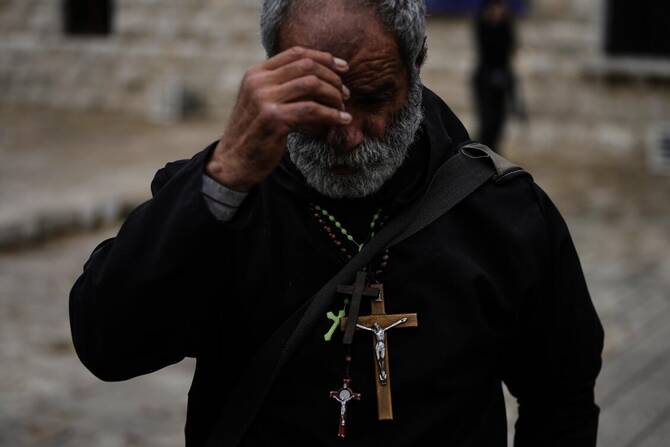
ANNAYA:Charbel Matar says a Lebanese saint saved his life when he was a child. Now, he is among pilgrims of all faiths who visit Saint Charbel’s tomb, soon to be graced by Pope Leo XIV.
“My family and I have great faith in Saint Charbel and always visit him,” said Matar, 69, at the Saint Maron Monastery in Annaya in the mountains of north Lebanon.
“I almost died when I was five. He performed a miracle and saved me from death, and kept me alive for 64 more years,” said Matar, whose parents changed his name from Roger to Charbel to honor the saint.
In Pope Leo’s first trip abroad since becoming head of the Catholic Church, the US-born pontiff will travel to Turkiye and Lebanon, arriving in Beirut on November 30 and visiting the Annaya monastery the following day.
Saint Charbel has broad popular appeal in Lebanon even beyond the Christian community, with many seeing him not only as a miracle worker but also as a national symbol.
Depictions of the saint with a white beard, his eyes lowered in prayer and wearing black garb, can be found in homes, vehicles and workplaces.
Randa Saliba, 60, called Saint Charbel “a message of love... and the face of Lebanon.”
The pope’s trip to his tomb was a must, she said during a visit to the monastery with her family.
The Catholic Church “can’t deny the miracles he performs and the people whose souls he transforms. He’s keeping the Christian message alive,” she added.
‘Not just Christians’
Charbel was born Youssef Makhlouf in north Lebanon in 1828 and entered the Lebanese Maronite Order aged 23, later joining Annaya’s Saint Maron Monastery, where he became a hermit, leading an ascetic life.
He was declared a saint in 1977.
Workers have been busy resurfacing the road to the quiet monastery in preparation for the arrival of the pope while visitors, including women wearing the Muslim hijab head covering, toured the site, lit candles or prayed faithfully to their saint.
Vice rector Tannous Nehme, excitedly awaiting the pope’s visit, estimated that the monastery drew around three million visitors annually.
“It’s not just Christians — a lot of Muslims come to visit, a lot of non-religious people come to visit. They come from everywhere — Africa, Europe, Russia,” Nehme said.
As incense lingered in the air, the stone monastery’s tranquillity was interrupted only by the sound of restoration work on Saint Charbel’s tomb.
When it was opened in 1950 in the presence of clergy, officials and doctors, they found his body well-preserved, more than half a century after his death in 1898.
Black-and-white footage of the event is still occasionally shown on Lebanese television.
The monastery has recorded tens of thousands of people who have been cured by Saint Charbel, with thousands of others believed to have been healed outside Lebanon.
One of the saint’s most famous miracles is that of Nohad Al-Shami from Lebanon’s Byblos region who was struck by an incurable illness in 1993.
Shami said Saint Charbel came to her in a dream and healed her. She died this year, aged 75.
‘Optimism’ for Lebanon
Pope Leo’s visit to Lebanon follows those of Benedict XVI in 2012 and John Paul II in 1997.
His trip includes meetings with senior officials in the crisis-hit country including President Joseph Aoun, the Arab world’s only Christian head of state.
Under multi-confessional Lebanon’s sectarian power-sharing system, the post of president is reserved for a Maronite Christian.
Lebanon’s Maronite church is in full communion with Rome.
“The pope’s visit is very important for Lebanon. It brings goodness and blessings... and optimism for the Lebanese people,” said Claude Issa, 56, a mother of three.
Lebanon has been no stranger to calamity in recent years.
A ceasefire in November 2024 was supposed to end more than a year of hostilities between Israel and militant group Hezbollah in which some 4,000 people were killed in Lebanon.
But Israel has kept up deadly strikes despite the truce, and many fear a return to expanded Israeli raids.
Before the war, Lebanon was reeling from an economic collapse that began in 2019, and a catastrophic explosion at Beirut’s port the following year that killed more than 220 people and injured some 6,500.
The pope will hold a silent prayer at the site of the explosion, for which nobody has yet been held accountable.
“The pope’s visit will revitalize people and make them feel there is still hope in Lebanon,” Issa said.


![]()

Pope to visit Lebanon’s beloved miracle saint as pilgrims seek hope amid crisis
Short Url
https://arab.news/puned
Pope to visit Lebanon’s beloved miracle saint as pilgrims seek hope amid crisis
- Charbel Matar says a Lebanese saint saved his life when he was a child. Now, he is among pilgrims of all faiths who visit Saint Charbel’s tomb, soon to be graced by Pope Leo XIV


Latest updates


© 2026 SAUDI RESEARCH & PUBLISHING COMPANY, All Rights Reserved And subject to Terms of Use Agreement.