

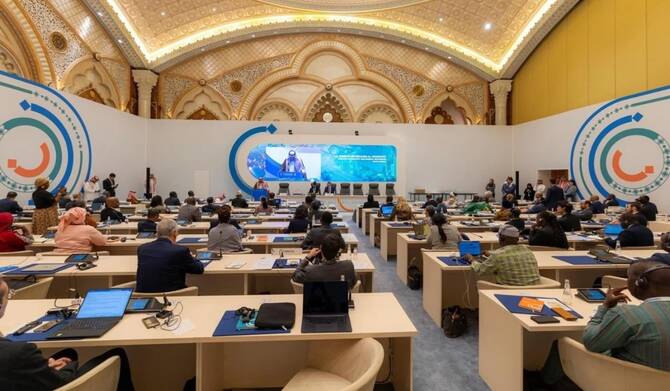
Saudi Arabia accelerates its efforts to build a global industrial base 

Speaking on the sidelines of the 21st General Conference of the UN Industrial Development Organization held in Riyadh, Al-Salem noted that many new investments are arriving with an integrated model. Al-Eqtisadiah
Short Url
Updated 24 November 2025
Follow

Saudi Arabia accelerates its efforts to build a global industrial base 

RIYADH: Saudi Arabia is advancing efforts to expand its base of integrated and foundational manufacturing industries, according to Khalid Al-Salem, president of the Royal Commission for Jubail and Yanbu. 

In an interview with Al-Eqtisadiah, Al-Salem said total investments across the commission’s cities have reached approximately SR1.5 trillion ($399.9 billion), most of which are concentrated in foundational industries.  

However, the Kingdom is shifting focus toward increasing the share of downstream manufacturing and linking it to existing foundational sectors to create higher added value through industrial integration. 

Speaking on the sidelines of the 21st General Conference of the UN Industrial Development Organization held in Riyadh, Al-Salem noted that many new investments are arriving with an integrated model, in which investors bring both foundational and downstream industries.   

This strategy is supported by the Ministries of Industry and Energy through incentives offered to investors who align downstream production with core industrial output. 

He highlighted a major project in Yanbu valued at approximately SR37 billion, which includes a requirement to develop final and intermediate downstream industries based on aluminum production. 

Additional projects in Jubail focus on specialized polypropylene compounds aimed at sectors such as automotive and aerospace, moving away from traditional general-purpose production. 

Regarding investor interests, Al-Salem said demand is diverse but predominantly focused on the mining and petrochemical sectors. 

This aligns with national efforts to integrate oil refineries with petrochemical production as part of the liquids-to-chemicals strategy. 

He added that the estimated value of Saudi Arabia’s mineral resources has increased by 90 percent since 2018. The Minister of Industry recently stated that the value of discovered rare earth metals in the Kingdom is estimated at SR375 billion. 

Al-Salem also addressed developments in transport infrastructure, noting the launch of the railway network in Jubail and ongoing work to link Ras Al-Khair with Jubail and then to Riyadh. 

These connections are expected to enhance the movement of goods and operational materials for factories. 

Operational approval has been granted for Jubail Airport, which will serve private aviation and cargo. A site near the airport has been allocated to a global investor to develop logistics services.  

Al-Salem said the Land Bridge project, previously outlined by the Minister of Transport, is among the Kingdom’s most significant transport initiatives. It will connect Yanbu Industrial City with Riyadh, Rabigh, and Jeddah, strengthening integration among industrial cities, especially as Yanbu’s production capacity surpasses its current port capacity.     

He added that these projects and transformations will help attract global investments, support industrial integration, and enhance the international competitiveness of the Royal Commission’s cities.    

Al-Salem said the commission is undergoing a strategic shift from merely providing basic infrastructure to enabling the private sector and developing integrated service systems that align with the Kingdom’s advanced industrial goals under Vision 2030.   

He also highlighted opportunities tied to clean energy, pointing to the Ministry of Energy initiatives in carbon capture and green hydrogen.    

He said these projects represent a strategic opportunity for the commission’s industrial cities, noting their appeal to global investors seeking digital and environmentally conscious industrial environments.    

He referred to several partnerships aligned with this direction, including collaborations in 3D printing, logistics projects with SABIC, and initiatives in inspection and calibration services.    

He said these services are increasingly essential to industrial operations and that the commission is working to enable the private sector to deliver them, enhancing the cities’ attractiveness to investors.  

Khalil bin Salamah, vice minister of Industry and Mineral Resources for Industrial Affairs, stated that Saudi women now make up more than 40 percent of the industrial workforce in the micro, small, and medium-sized enterprise sector. He added that their presence is also growing in managerial and leadership roles.    

Speaking at the UNIDO conference, bin Salamah said Saudi Arabia has launched five new industrial cities, bringing the total to 39, and has expanded four existing special economic zones.    

He said the country is positioning itself as a regional hub for green steel, electric vehicles, and renewable energy component manufacturing, aligning with global decarbonization goals and UNIDO’s sustainability focus.   

He emphasized that the Kingdom’s manufacturing vision extends beyond infrastructure, aiming to build value chains that empower people, foster innovation, and preserve the environment.    

Bin Salamah also highlighted opportunities for Saudi youth, noting that more than 65 percent of the population is under 35.    

He added: “To channel this energy and harness this promise, institutions such as the National Academy for Industry and the Factories of the Future Program have trained more than 80,000 young Saudi men and women in fields such as robotics, automation, and AI-based production systems — technologies that will shape their future.”    

Gerd Muller, director-general of UNIDO, affirmed that Saudi Arabia plays a leading role in the Arab world and said the organization is committed to strengthening future cooperation.  


Accelerating growth boosts investor confidence

Updated 06 December 2025
Follow

Accelerating growth boosts investor confidence

  • Startups attract fresh capital to scale AI, health tech, and infrastructure

RIYADH: Startups across the Middle East and North Africa are accelerating growth through strategic funding rounds, partnerships, and technological innovation. 

From agriculture tech and AI-led cybersecurity to digital health and home renovation, this week’s developments reflect the region’s expanding startup ecosystem and investor confidence across key verticals.  

Saudi agritech startup Nabt has raised $3.4 million in a seed extension round, bringing its total funding to $5 million.  

The round was led by SHG Group, with participation from Merak Capital and several angel investors, signaling strong investor confidence in the company’s long-term growth strategy.  

The funding announcement took place during a signing ceremony at the Sunbola program event under the Ministry of Environment, Water, and Agriculture.  

Founded to build both physical and digital infrastructure for the fresh-produce sector, Nabt connects farmers directly with commercial buyers through fulfillment centers that handle sorting, cold storage, and last-mile logistics.  

The company recently launched the Nabt Online Auction to support large-scale produce trading across the Kingdom, and Nabt Intel, which provides real-time pricing and market-demand data. 

CEO Abdullah Al-Otaibi said: “In just two years, Nabt has proven that building transparent and efficient infrastructure for fresh produce is not only possible but essential.”  

The new capital will support expansion into additional Saudi cities and further develop Nabt’s infrastructure and services to boost food security and farmer profitability across the country.   

COGNNA raises $9.2m 

COGNNA, a Saudi cybersecurity company founded in 2022, has closed a $9.2 million series A round led by Impact46 and co-led by BNVT Capital, with participation from Vision Ventures and Tali Ventures.  

The company offers AI-driven security operations tailored for enterprises and SMEs through its Agentic SOC platform.  

Combining AI automation with human oversight, COGNNA’s platform helps organizations simplify compliance and proactively defend against cyber threats. 

Chief Technology Officer Ziyad Al-Sheri stated: “Through our AI-led platform, we are building an Agentic SOC that doesn’t just respond to threats — it anticipates them.”  

The funding will be used to accelerate global expansion, enhance R&D in AI automation, and scale operational teams and infrastructure to meet growing demand. 

The company plans to allocate capital across product development, marketing, hiring, and international operations.  

Funch raises $500k 

Funch, a Dubai-based AI-native lunch subscription startup, has secured $500,000 in a pre-seed round led by Angelspark, with participation from investors including Mostafa Kandil, Mahesh Murthy, and Tushar F.  

Founded in 2025 by Ahmad Joehnny and Ghada Zanaty, the platform offers flexible, credit-based lunch subscriptions for 19 Emirati dirhams per day with no delivery fees. 

Founded in 2025 by Ahmad Joehnny and Ghada Zanaty, Funch offers flexible, credit-based lunch subscriptions with no delivery fees. (Supplied)

Funch replaces traditional meal plans with a system where users can pause, skip, or cancel orders while using credits only when meals are delivered.

“Our model is built around pre-planned orders, enabling us to operate with higher efficiency, reduce waste, and cut emissions with fewer trips,” said co-founder and chief operating officer Ghada Zanaty.  

The company leverages AI to forecast demand, optimize routes, rotate menus, and streamline logistics, and will use the funding to scale across Dubai and develop its AI systems further. 

Paymob teams up with Robusta 

Egyptian fintech Paymob and software development firm Robusta Technology Group have announced a strategic partnership to accelerate digital transformation across Egypt and the wider region.  

The collaboration will integrate Paymob’s digital payments infrastructure with Robusta’s AI-driven product development and analytics capabilities.  

The joint initiative aims to deliver intelligent digital experiences for SMEs and enterprises, supporting Egypt’s Vision 2030 goals. 

Both companies plan to expand regionally and develop future offerings combining automation, analytics, and seamless payment systems to improve operational efficiency for merchants and startups.  

Reno raises $4m

UAE-based renovation technology platform Reno has raised $4 million in a mix of equity and debt funding.  

The round included investments from Sanabil 500, Hub71, and Plus VC, as well as Zero 100 VC, FlyerOne Ventures,  and Sandstorm VC. AngelSpark and Swiss Founders Fund also invested.

Founded in 2024 by Marc Michel, Amr Hosny, and Farah Karabeg, Reno offers a tech-enabled, end-to-end solution for interior design and renovation services in both residential and commercial sectors.  

Reno aims to streamline the renovation process through a unified digital platform, allowing customers to manage projects from planning through execution.  

The company plans to use the new capital to expand across the GCC region, enhance its technological infrastructure, and further develop its customer experience. 

Glenwood PE and Mubadala invest in Korean desalination firm NanoH2O

Glenwood Private Equity and Abu Dhabi’s Mubadala Investment Company, along with co-investors, have completed a co-investment in NanoH2O, a Seoul-based reverse osmosis membrane manufacturer previously operating as LG Water Solutions under LG Chem.  

All closing conditions and regulatory approvals for the investment have been fulfilled.  

NanoH2O, which became an independent entity in 2024, supplies desalination and brackish water treatment solutions to municipal and industrial clients worldwide. More than 95 percent of its revenue is generated outside South Korea. 

“We have strong conviction in NanoH2O’s technology leadership and long-term growth potential,” said Mohamed Al-Badr, head of Asia at Mubadala.  

The firm aims to support NanoH2O’s global expansion, particularly in the MENA region, amid growing concerns over water security and decarbonization.