

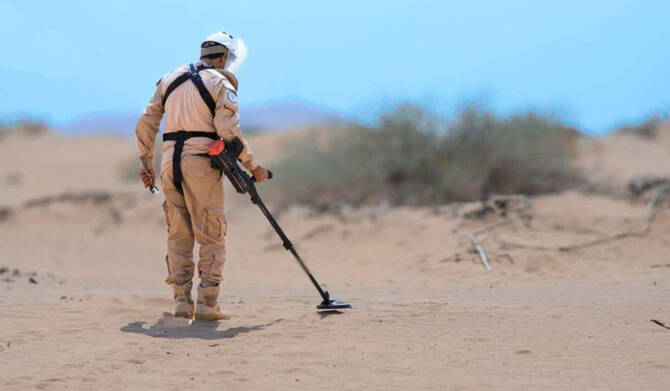
Saudi project clears 2,108 explosive devices in Yemen

The demining operations took place in Marib, Aden, Jouf, Shabwa, Taiz, Hodeidah, Lahij, Sanaa, Al-Bayda, Al-Dhale and Saada. (SPA)
Short Url
Updated 02 February 2026
Follow

Saudi project clears 2,108 explosive devices in Yemen

  • Ousama Al-Gosaibi, Project Masam’s managing director, said the initiative had cleared a total of 534,813 mines since it began in 2018

RIYADH: Members of Saudi Arabia’s Project Masam removed 2,108 explosive devices from various regions of Yemen last week.

The total included 2,000 unexploded ordnances, 75 anti-tank mines, 31 anti-personnel mines and two improvised explosive devices, according to a recent report.

The explosives were planted indiscriminately and posed a threat to civilians, including children, women and the elderly.

The demining operations took place in Marib, Aden, Jouf, Shabwa, Taiz, Hodeidah, Lahij, Sanaa, Al-Bayda, Al-Dhale and Saada.

Ousama Al-Gosaibi, Project Masam’s managing director, said the initiative had cleared a total of 534,813 mines since it began in 2018.

Teams are tasked with clearing villages, roads and schools to facilitate the safe movement of civilians and delivery of humanitarian aid.

The project trains local demining engineers, provides them with modern equipment, and offers support to Yemenis injured by the devices.


Two Holy Mosques authority launches smart interactive map system

Updated 4 sec ago
Follow

Two Holy Mosques authority launches smart interactive map system

MADINAH: A new smart interactive map system has been inaugurated for the Grand Mosque and the Prophet’s Mosque.

CEO of the General Authority for the Care of the Affairs of the Grand Mosque and the Prophet’s Mosque Ghazi Al-Shahrani said that the smart interactive map facilitated the movement of visitors and worshipers while significantly enhancing navigational efficiency within the two holy mosques. The system is designed to guide visitors along the most suitable routes, support real-time updates, ensure safe navigation and enhance the overall quality of the experience.

Al-Shahrani said that the results achieved were part of the authority’s efforts to advance digital transformation and leverage smart technologies in serving pilgrims. He said that this system was one of dozens launched recently that contributed to generating operational data that supported decision-making, enhanced understanding of challenges and paved the way for developing future digital systems.

Interactive maps are part of a smart digital system that provides real-time spatial guidance, powered by live operational data linked to control rooms. This enables visitors to be directed to the most appropriate routes during closures or congestion, with immediate and accurate updates.

Executive vice president of digital transformation at the authority, Mohammed Al-Saqr, said that the pilot phase of the maps, which began during Ramadan, was integrated with the color coding and metric addressing system, which divided the Two Holy Mosques into clear geographical zones that supported smart operations and activated spatial data as part of an integrated services and analytics ecosystem. He said that this launch represented the first step in a project that would continue to evolve over the coming years, with further development planned through 2026.

Al-Saqr said that the system featured more than 950 points of interest across 13 service categories, supported by more than 650 QR codes for easy access. It could also generate more than 100,000 dynamic routes, automatically optimized in real time based on operational conditions and crowd flow.

Director of business solutions at the authority, Waheeb Al-Mutrafi, said that the maps enabled precise location-based reporting and contributed to accelerating access to electric carts through ticket numbers via a smart platform built on field data verified over several months, enhancing operational efficiency and improving the quality of services provided to worshippers.