


RIYADH: Saudi Arabia is emerging as a leader in sustainable industrialization, spearheading regional efforts to transform the Middle East’s industrial landscape, a forum in Riyadh heard.
At the 2024 UN Industrial Development Organization Multilateral Industrial Policy Forum, experts highlighted the Kingdom’s leadership in clean energy and industrial growth, driven by its Vision 2030 strategy.
Naif Al-Osaimi, executive vice president of the National Industrial Development and Logistics Program, emphasized Saudi Arabia’s pivotal role in reshaping the regional industrial environment.
“The National Industrial Development and Logistics Program is one of the Vision 2030 plans to diversify and grow the Saudi economy,” Al-Osaimi said. “We aim to transform the Kingdom into a leading industrial powerhouse and a global logistics hub while maximizing the value created by the energy and mining sectors.”

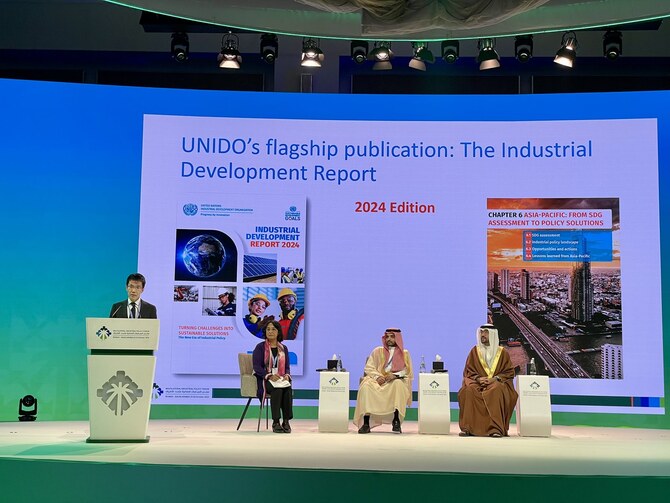
Naif Al-Osaimi, executive vice president of the National Industrial Development and Logistics Program, speaks at the 2024 UNIDO Multilateral Industrial Policy Forum. Screenshot
In line with these national ambitions, Saudi Arabia has taken bold steps to leverage its renewable energy resources, notably in green hydrogen production.
According to the “Industrial Development Report 2024” by UNIDO, Saudi Arabia is “leveraging renewables to produce green hydrogen,” a key step in reducing carbon emissions and promoting a low-emission economy.
These developments are crucial as the Kingdom seeks to become a global leader in clean energy while reducing its dependence on fossil fuels.
Al-Osaimi said the synergy-driven approach of the NIDLP ensures that each sector within the economy contributes to and benefits from others, creating a cycle of maximized economic value.
“In NIDLP, we build on the synergies between sectors, we make sure that each sector feeds another sector to create the maximum economic value out of this process,” he added.
Regionally, Saudi Arabia’s leadership is part of a larger movement within the Gulf Cooperation Council countries to promote sustainable industrialization.
The report highlighted the efforts of the Gulf Organization for Industrial Consulting, which is coordinating industrial policies across the GCC to foster collaboration and ensure that each nation benefits from collective advancements in technology, energy, and infrastructure.
Neighboring Bahrain is also making significant strides in sustainable industrial development. Khaled Al-Alawi, assistant undersecretary for industrial development in Bahrain, shared insights into the country’s strategy during the same panel at MIPF.
“The industrial sector strategy spans from the years 2022 to 2026 to shape policies and build partnerships to build a robust and vibrant manufacturing sector in the Kingdom of Bahrain,” Al-Alawi said.
He added that the main key performance indicators of this strategy are “to increase the sector’s contribution to the overall GDP (gross domestic product), increase national origin exports, and create value and quality job opportunities for Bahrainis.”
Saudi Arabia’s industrial policy also focuses on renewable energy, digital transformation, and logistics — three pillars of its strategy to reduce dependency on oil.
As Al-Osaimi said the Kingdom is actively fostering partnerships between the private sector and government entities to ensure the success of its industrial ambitions.

Khaled Al-Alawi, Bahrain’s assistant undersecretary for industrial development, speaks at the 2024 UNIDO Multilateral Industrial Policy Forum. Screenshot
Saudi Arabia’s vision is already shaping the region’s future. With Bahrain and other GCC nations following suit, the Middle East is transforming into a hub for sustainable, technologically advanced industries.
The UNIDO report highlighted that Saudi Arabia’s commitment to Industry 4.0 technologies and renewable energy is driving this regional transformation, ensuring that the Gulf remains competitive in an evolving global economy.
The Kingdom is also leading the region in green energy initiatives, particularly in leveraging renewable energy to produce green hydrogen, a key focus in reducing carbon emissions.


