

Pakistani, Libyan commanders discuss regional security, military cooperation
Pakistani, Libyan commanders discuss regional security, military cooperation/node/2631507/pakistan
Pakistani, Libyan commanders discuss regional security, military cooperation
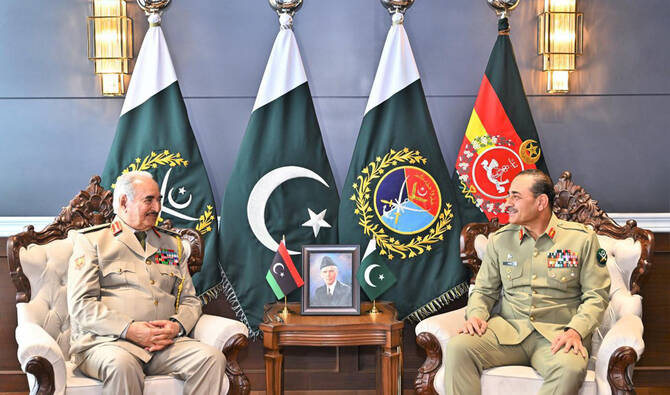
Libyan National Army Commander Commander Field Marshal Khalifa Haftar (L) meeting with Pakistan’s Chief of Defense Forces Field Marshal Asim Munir in Rawalpindi on February 2, 2026. (ISPR)
ISLAMABAD: Libyan National Army Commander Field Marshal Khalifa Haftar met with Pakistan’s Chief of Defense Forces Field Marshal Asim Munir in Rawalpindi and discussed with him military cooperation and regional security, the Pakistani military said on Monday.
The meeting takes place after Munir’s visit to Libya in December that was followed by reports suggesting Pakistan had struck a $4 billion defense deal to sell military equipment, including JF-17 fighter jets and Super Mushak trainer aircraft, to the Libyan National Army that controls eastern Libya. There has been no official confirmation of the deal so far.
Haftar and Prime Minister Dr. Osama Saad Hammad, who governs eastern Libya, called on Field Marshal Munir at Pakistan Army’s General Headquarters in Rawalpindi, according to the Inter-Services Public Relations (ISPR), the Pakistani military’s media wing.
“During the meeting, both sides exchanged views on matters of mutual interest, with particular focus on security dynamics in respective regions and professional cooperation,” the ISPR said in a statement.
“The discussion underscored the importance of continued engagement and collaboration between the Armed Forces of Pakistan and Libya.”
Libya has been subject to a UN arms embargo since 2011, requiring approval from the UN for transfers of weapons and related material. It was not clear whether Pakistan or Libya had applied for any exemptions to the UN embargo.
During Monday’s meeting, Munir reaffirmed Pakistan’s commitment to strengthening bilateral relations with Libya, reiterating his country’s support for peace, stability and institutional development in Libya, according to the ISPR.
“The meeting was held in a cordial and constructive atmosphere, reflecting the longstanding friendly relations between Pakistan and Libya,” the Pakistani military said.
ISLAMABAD: Pakistan and Qatar on Tuesday agreed to deepen their strategic and economic cooperation during high-level talks between Prime Minister Shehbaz Sharif and his Qatari counterpart Sheikh Mohammed bin Abdulrahman bin Jassim Al Thani, Sharif’s office said.
Sharif visited Qatar along with a high-level delegation on the invitation of Qatari emir Sheikh Tamim bin Hamad Al Thani. The Pakistani premier also held meetings with Qatar’s trade and defense ministers to discuss cooperation in various domains.
The visit came at a time when Pakistan is seeking closer economic engagement with Gulf partners amid its broader push to stabilize the economy and attract investment, while maintaining security and defense cooperation with key regional states.
During their meeting in Doha, PM Sharif and Qatar’s Sheikh Mohammed discussed bilateral relations and exchanged views on regional and international developments, according to the Pakistan prime minister’s office.
“They reaffirmed the strong brotherly relations between Pakistan and Qatar and expressed satisfaction at the growing momentum in political, economic and institutional ties,” Sharif’s office said.
“Discussions focused on enhancing cooperation in the fields of trade and investment, energy, defense, manpower and labor and culture, with both sides stressing the importance of their task force to accelerate cooperation in all these areas.”
Pakistan and Qatar maintain strong trade and investment ties. In 2022, the office of Qatar’s emir said the Qatar Investment Authority planned to invest $3 billion in Pakistan, targeting sectors including transport, aviation, education, health, media, technology and labor.
Nearly 300,000 Pakistanis live and work in Qatar, according to Pakistan’s foreign office, with many employed in health, education, engineering and public services, as well as construction and transport. The two countries engage through forums such as the Bilateral Political Consultations and the Joint Ministerial Commission.
Sharif said he had productive discussions with Qatar’s emir, Sheikh Tamim bin Hamad Al Thani, on how the two sides could transform their brotherly ties into mutually beneficial economic relationships.
“We also took stock of the regional situation,” he said on X. “Pakistan and Qatar will continue to work together for peace and stability in the region and beyond.”
Prime Minister Shehbaz Sharif (second right) meets the Qatari Emir Qatar’s emir Sheikh Tamim bin Hamad Al Thani (left) in Doha, Qatar, on February 24, 2026. (PID)
DIALOGUE WITH AFGHANISTAN
Earlier, Sharif and Qatar’s Deputy PM Sheikh Saoud Al-Thani discussed the situation in Afghanistan and called for dialogue to support regional stability.
The meeting took place amid renewed tensions after Islamabad carried out airstrikes last week on what it described as Tehreek-e-Taliban Pakistan (TTP) targets inside Afghanistan. Kabul said the strikes killed civilians and vowed to respond to what it called a violation of its sovereignty.
“Regional developments were also discussed, in particular the situation in Iran and Afghanistan,” Sharif’s office said in a statement. “Both sides emphasized the importance of dialogue, de-escalation and collective efforts to promote peace and stability in the region.”
This was the second time in less than six months that Pakistan conducted airstrikes in Afghanistan. The last strikes triggered heavy, weeklong clashes between the neighbors along their border before Qatar and Turkiye mediated a ceasefire between them in Oct. last year.
Separately, Sharif held meetings with Qatar’s State Minister for Trade Dr. Ahmed bin Mohammed Al-Sayed and a delegation of the Qatar Businessmen Association (QBA), highlighting Pakistan’s investment-friendly reforms.
He invited QBA members to explore opportunities in infrastructure, logistics, energy, agriculture, technology and export-oriented manufacturing, his office said.