

T20 World Cup: Pakistan’s India boycott splits fans as politics overshadows cricket

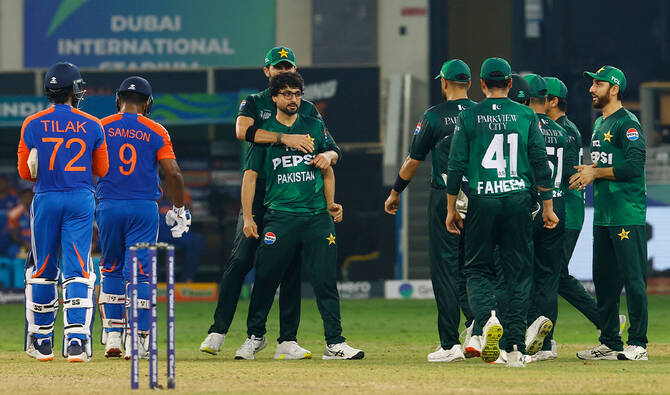
Pakistan's Abrar Ahmed celebrates after taking the wicket of India's Sanju Samson at - Dubai International Cricket Stadium, Dubai, United Arab Emirates on September 28, 2025. (REUTERS)
Short Url
Updated 02 February 2026
Follow

T20 World Cup: Pakistan’s India boycott splits fans as politics overshadows cricket

  • The boycott has dealt a blow to the ICC’s marquee event, with India-Pakistan matches ‌the biggest drivers ‌of global viewership, revenue
  • On the streets, many Pakistani fans back the boycott as a response to what they see as India’s growing influence over cricket governance

KARACHI: Pakistan’s decision to boycott its Twenty20 World Cup match against India has drawn widespread support from fans ​and administrators who hailed the move as a long-overdue stand in a rivalry in which sport and geopolitics have collided.

The government on Sunday cleared Pakistan to take part in the tournament beginning February 7 but barred the team from playing India in a February 15 group match in Colombo, a decision the International Cricket Council (ICC) said was not in the interests of the global game.

The boycott deepened a long freeze in bilateral cricket between the nuclear-armed neighbors — who have not played a full series since 2012–13 and now meet largely at neutral venues — and dealt a blow to the ICC’s marquee event, with India-Pakistan matches ‌the biggest drivers ‌of global viewership and revenue.

’ENOUGH IS ENOUGH’

For many in Pakistan, however, ‌the ⁠boycott ​was less ‌about cricketing issues, with Pakistan forfeiting two points by skipping the match, and more about symbolism.

“Enough is enough,” former Pakistan Cricket Board (PCB) chairman Najam Sethi told Reuters, accusing India’s board of politicizing the ICC. “It’s time to challenge this duplicitous approach by exercising PCB’s options in alliance with Bangladesh.”

The Indian government, the Board of Control for Cricket in India (BCCI) and the International Cricket Council did not respond to requests for comment.

The ICC said it was still awaiting an official communication from the Pakistan Cricket Board (PCB) conveying their “position of selective participation.”

“While the ICC respects the roles ⁠of governments in matters of national policy, this decision is not in the interest of the global game or the welfare of fans ‌worldwide, including millions in Pakistan,” the Dubai-based body said in a ‍statement on Sunday.

The government has not publicly detailed ‍its reasoning, but Mosharraf Zaidi, a spokesperson for Prime Minister Shehbaz Sharif, linked the move to security ‍tensions with India.

“Nothing is more important than the memory of Pakistani citizens and troops murdered by Indian proxy terrorists over the weekend,” Zaidi said. “With funerals taking place today, this was the least that could be done.”

The remarks followed coordinated attacks by Baloch separatist militants across Pakistan’s southwestern Balochistan province over the weekend that killed nearly 50 people.

India’s ​foreign ministry rejected Pakistan’s accusations, calling them “baseless” and accusing Islamabad of deflecting attention from its own internal issues.

Pakistan’s World Cup jersey has been branded the “Markhor Edition,” after the national ⁠animal, a symbol of resilience also used in military iconography, Geo TV reported.

’LET CRICKET JUST BE A GAME’

On the streets of Pakistan’s major cities, many cricket fans backed the boycott as a response to what they see as India’s growing influence over global cricket governance.

“This arrogance of India should be broken a little,” said Mohammad Asghar, a fan in Karachi. “They should realize someone has come forward to challenge them.”

Others drew parallels with Bangladesh’s earlier withdrawal from the tournament over safety concerns, a move that led to Scotland replacing them, and questioned why Pakistan should be held to a different standard.

“If Bangladesh can boycott for one player’s safety, why can’t Pakistan take a stand?” said Ayaz Ahmed.

The decision also sparked heated debate on social media, with users divided between calls for “self-respect” and warnings that skipping the match could further isolate Pakistan in global cricket.

Former Pakistan captain Shahid Afridi agreed.

“Cricket ‌can open doors when politics closes them,” he wrote on X. “It’s regrettable that Pakistan won’t play India, but this is the moment for the ICC to prove it is impartial.”


Pakistan says defense pact with Saudi Arabia elevated brotherly ties to ‘new heights’

Updated 25 February 2026
Follow

Pakistan says defense pact with Saudi Arabia elevated brotherly ties to ‘new heights’

  • Pakistan, Saudi Arabia signed strategic defense pact last year pledging aggression against one will be treated as attack on both
  • Deputy PM Ishaq Dar says enduring bonds with Islamic and Arab nations form vital pillar of Pakistan’s foreign policy 

ISLAMABAD: Deputy Prime Minister Ishaq Dar said on Wednesday that Pakistan’s defense pact with Saudi Arabia elevated its brotherly ties with the Kingdom to “new heights,” stressing that close ties with Arab and Islamic nations form a key pillar of Islamabad’s foreign policy. 

Pakistan and Saudi Arabia signed a Strategic Mutual Defense Agreement on Sept. 17 last year, pledging that aggression against one country would be treated as an attack on both, enhancing joint deterrence and formalizing decades of military and security cooperation.

Both nations agreed in October 2025 to launch an economic cooperation framework to strengthen trade and investment ties. 

“In the Middle East, our landmark Strategic Mutual Defense Agreement with Saudi Arabia has elevated our brotherly ties to new heights,” Dar said while speaking at the Pakistan Governance Forum 2026 event in Islamabad. 

The Pakistani deputy prime minister was speaking on the topic “Navigating International Relations Amidst Changing Geo-Politics.”

Dar noted that Pakistan has reinforced partnerships with other Middle Eastern nations such as the UAE, Qatar, Jordan, Oman, Egypt and Bahrain. He said these partnerships have yielded “concrete agreements” in investment, agriculture, infrastructure, and energy sectors. 

“Our enduring bonds with Islamic and Arab nations form a vital pillar of our foreign policy, and we will continue to expand our partnerships across Asia, Latin America, and Africa,” he said. 

Dar pointed out that the presidents of Kazakhstan, Uzbekistan and Kyrgyzstan have undertaken visits to Pakistan in recent months, reflecting Central Asian nations’ desire to boost cooperation with Islamabad.

On South Asia, the Pakistani deputy PM said Pakistan has successfully transformed its fraternal ties with Bangladesh into “a substantive partnership.”

“Similarly, the trilateral mechanism involving China, Pakistan, and Bangladesh has been launched with a view to expanding and deepening regional cooperation and synergy,” the Pakistani minister said. 

He said Islamabad has strengthened its “all-weather” partnership with China via the second phase of the multi-billion-dollar China-Pakistan Economic Corridor agreement and “unwavering support” from both sides for each other’s core interests. 

Dar said Pakistan had also reinvigorated its partnership with the US, advancing cooperation in trade, technology, investment, and regional stability. 

“This calibrated approach has enhanced our ability to navigate complexity with skill and confidence, ensuring that our national interests are served without compromising our core foreign policy principles,” he said.