

Pakistan condemns Indian minister’s ‘revisionist’ remarks about Sindh province

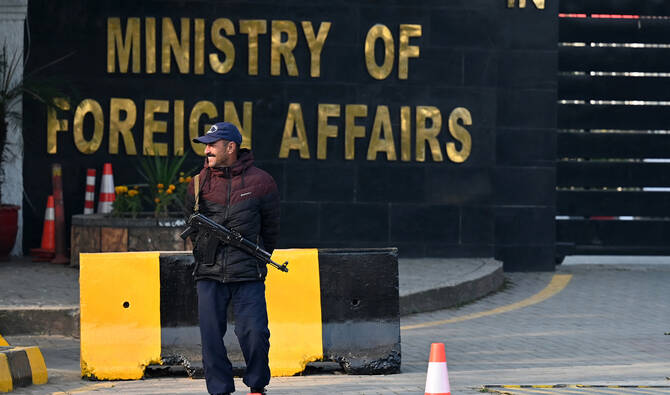
A Pakistani police officer stands guard outside the Ministry of Foreign Affairs in Islamabad on January 18, 2024. (AFP/File)
Short Url
Updated 23 November 2025
Follow

Pakistan condemns Indian minister’s ‘revisionist’ remarks about Sindh province

  • Rajnath Singh said ‘civilizationally, Sindh will always be a part of India and as far as land is concerned, borders can change’
  • Pakistan urges India to refrain from ‘provocative rhetoric,’ vows to safeguard its security, national independence and sovereignty

ISLAMABAD: The foreign office in Islamabad on Sunday condemned Indian Defense Minister Rajnath Singh’s “dangerously revisionist” remarks about Pakistan’s southern Sindh province, saying such statement reveal New Delhi’s “expansionist” designs.

Singh said that Sindhi Hindus from his generation never fully accepted the accession of the province to Pakistan in 1947, according to Indian media reports.

He said the province “will always be a part of India” civilizationally and that “who knows, tomorrow Sindh may return to India again” as borders can change, India’s The Hindu newspaper reported.

The Pakistani foreign office said such statements reveal the mindset that seeks to “challenge established realities and stands in clear violation of international law, the inviolability of recognized borders and the sovereignty of states.”

“We urge Mr. Rajnath Singh and other Indian leaders to refrain from provocative rhetoric that threatens regional peace and stability,” the Pakistani foreign office said, urging New Delhi to address grievances of marginalized communities and religious minorities in India.

“We call on India to take credible steps toward the genuine resolution of the Jammu and Kashmir dispute in accordance with UN Security Council resolutions and the aspirations of the Kashmiri people under occupation.”

Nuclear-armed India and Pakistan were carved out of the Indian subcontinent at the end of the British rule in 1947. The disputed Himalayan region of Kashmir has since been a flashpoint between the neighbors.

The two countries control part of the territory but claim it in full and have fought multiple wars over the region. Both engaged in a four-day military conflict in May over a militant attack in Indian-administered Kashmir that New Delhi blamed on Pakistan. Islamabad denied involvement.

The foreign office said that Pakistan remains committed to peaceful resolution of all disputes with India on the basis of justice, equity and established international legal norms.

“At the same time, as in the past, Pakistan is firmly resolved to safeguard its security, national independence and sovereignty,” it added.


OIC’s COMSTECH stresses academic collaborations across Muslim world in Islamabad meeting

Updated 4 sec ago
Follow

OIC’s COMSTECH stresses academic collaborations across Muslim world in Islamabad meeting

  • COMSTECH holds annual meeting in Islamabad featuring 30 delegates from Iran, Somalia, Palestine, Indonesia and other OIC states
  • Limited pool of skilled professionals one of the foremost challenges facing Muslim world, notes COMSTECH secretary general 

ISLAMABAD: The OIC Standing Committee on Scientific and Technological Cooperation (COMSTECH) called for stronger academic collaboration across Islamic states to secure the future of higher education in the Muslim world, state-run media reported on Saturday. 

COMSTECH’s Coordinator General Prof. Dr. Muhammad Iqbal Choudhary was speaking at the Annual Meeting of the COMSTECH Consortium of Excellence at the organization’s Secretariat in Islamabad. The event brought together vice chancellors, rectors, and senior representatives from leading universities across OIC member and observer states. 

Nearly 30 international delegates representing universities from Iran, Somalia, Palestine, Indonesia, Malaysia, Thailand, Uganda, Bangladesh, Benin, Cameroon, Gabon, Côte d’Ivoire, and Senegal joined their counterparts from several Pakistani institutions at the meeting. Participants attempted to chart a collective path forward for tertiary education in OIC countries.

“Collaborations, knowledge sharing, best practices, exchange of scholars, technology transfer and joint academic programs are vital for overcoming the educational challenges faced across the OIC region,” Choudhary said, according to the state-run Associated Press of Pakistan (APP).

The COMSTECH secretary general noted that one of the foremost developmental challenges facing OIC nations remains the limited pool of skilled professionals and workforce. 

He said this gap can only be bridged through strengthened tertiary education systems and expanded opportunities for knowledge transfer.

Discussions at the event highlighted the urgent need for competency-driven education, modern pedagogical tools, university–industry partnerships and collaborative training programs designed to equip graduates with the skills necessary to address emerging global challenges.

“The Annual Meeting served as a vital platform for reviewing progress achieved over the past year, identifying future priorities, and deepening academic cooperation to promote scientific excellence and sustainable development across the OIC region,” the APP said.