UN human rights rapporteur calls on United States to lift sanctions on Cuba

1 / 2
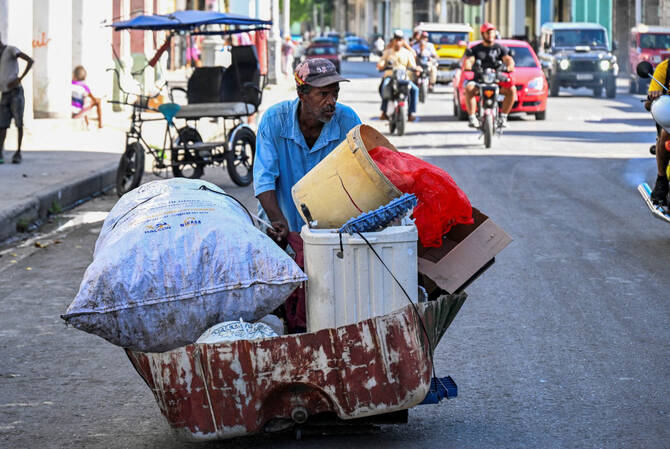
A man carries collected garbage on a street in Havana on July 21, 2025. (AFP)
2 / 2
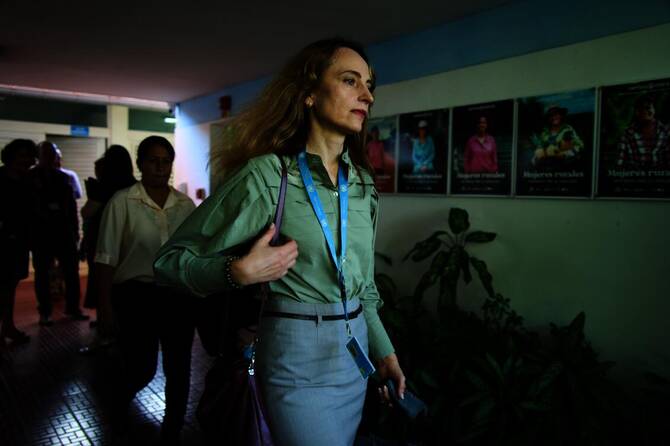
Special Rapporteur of the United Nations Human Rights Council Alena Douhan departs after attending a press conference in Havana on Nov. 21, 2025. (AP Photo)
Short Url
Updated 22 November 2025
Follow

UN human rights rapporteur calls on United States to lift sanctions on Cuba

  • Cuba has struggled since 2020 with an economic and energy crisis. Its gross domestic product has shrunk, and its 10 million residents have endured blackouts, food shortages and inflation.

HAVANA: A United Nations human rights expert on Friday urged the United States to lift its sanctions on Cuba, saying they are impacting the island’s entire population, hitting sectors including health care, nutrition and education.
Alena Douhan, Special Rapporteur of the United Nations Human Rights Council, said it was her second visit to Cuba — her first was in 2023 — and that she has observed a further deterioration of all sectors due to stricter measures imposed by Washington.
“For the communities with low income, the higher inflation as well as the scarcity of resources makes it very difficult to even get proper nutrition,” she said, calling on the United States to stop using sanctions and “maximum pressure constraints.”
In late October, the UN General Assembly voted overwhelmingly to condemn the US economic embargo of Cuba for a 33rd year.
Cuba has struggled since 2020 with an economic and energy crisis. Its gross domestic product has shrunk, and its 10 million residents have endured blackouts, food shortages and inflation. Cuban officials have blamed the economic squeeze on the COVID shutdowns, stricter US sanctions and other factors.
“As we talk about children as a very vulnerable group, the fact that those kids are not getting sufficient meals means that the educational and cultural programs as well as the participation in any development activity of children are substantially reduced” because there are no resources to do it, she said.
Douhan said Cuban are being affected by a medicine shortage.
“As I reflected in my report, 69 percent of the medicine necessary for the people in Cuba are not available that is why we are observing the growing of the mortality rate,” she said.
The embargo was imposed in 1960 after Fidel Castro led a revolution that toppled dictator Fulgencio Batista and nationalized properties belonging to US citizens and corporations.
In 2016, Cuban President Raul Castro and President Barack Obama officially restored relations. That year, the US abstained, for the first time, on the General Assembly resolution calling for an end to the embargo.
Obama’s successor, Donald Trump, sharply criticized Cuba’s human rights record. The US again voted against the resolution in 2017 and ever since.
Sanctions increased significantly during Trump’s first term, continued under his successor, President Joe Biden, and were tightened again after Trump returned to office this year.


Indian teacher who created hundreds of learning centers wins $1 million Global Teacher Prize

Updated 55 min 20 sec ago
Follow

Indian teacher who created hundreds of learning centers wins $1 million Global Teacher Prize

  • Nagi is the 10th teacher to win the award, which the foundation began handing out in 2015

DUBAI: An Indian teacher and activist known for creating hundreds of learning centers and painting educational murals across the walls of slums won the $1 million Global Teacher Prize on Thursday.
Rouble Nagi accepted the award at the World Governments Summit in Dubai in the United Arab Emirates, an annual event that draws leaders from across the globe.
Her Rouble Nagi Art Foundation has established more than 800 learning centers across India. They aim to have children who never attended school begin to have structured learning. They also teach children already in school.
Nagi also paints murals that teach literacy, science, math and history, among other topics.
The prize is awarded by the Varkey Foundation, whose founder, Sunny Varkey, established the for-profit GEMS Education company that runs dozens of schools in Egypt, Qatar and the UAE.
“Rouble Nagi represents the very best of what teaching can be – courage, creativity, compassion, and an unwavering belief in every child’s potential,” Varkey said in a statement posted to the Global Teacher Prize website. “By bringing education to the most marginalized communities, she has not only changed individual lives, but strengthened families and communities.”
Nagi plans to use the $1 million to build an institute that offers free vocational training.
Stefania Giannini, UNESCO Assistant Director-General for Education, said Nagi’s prize “reminds us of a simple truth: teachers matter.”
In comments carried on the prize website, Giannini said UNESCO was “honored to join the Global Teacher Prize in celebrating teachers like you, who, through patience, determination, and belief in every learner, help children into school — an act that can change the course of a life.”
Nagi is the 10th teacher to win the award, which the foundation began handing out in 2015.
Past winners of the Global Teacher Prize have included a Kenyan teacher from a remote village who gave away most of his earnings to the poor, a Palestinian primary school teacher who teaches her students about non-violence and a Canadian educator who taught a remote Arctic village of Inuit students. Last year’s winner was Saudi educator Mansour Al-Mansour, who was known for his work with the poor in the kingdom.
GEMS Education, or Global Education Management Systems, is one of the world’s largest private school operators and is believed to be worth billions. Its success has followed that of Dubai, where only private schools offer classes for the children of the foreigners who power its economy.