

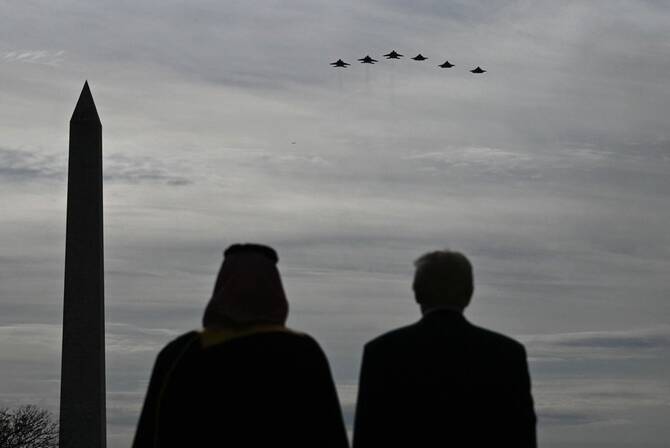
Saudi Arabia, US sign agreements to deepen strategic partnership

The meeting was co-chaired by President Trump and Crown Prince Mohammed and was attended by senior Saudi and US officials. (AFP)
Short Url
Updated 19 November 2025
Follow

Saudi Arabia, US sign agreements to deepen strategic partnership

RIYADH: Saudi Arabia and the US signed a number of agreements on Tuesday to bolster their strategic ties as Crown Prince Mohammed bin Salman visited the White House.

He and US President Donald Trump signed agreements on strategic defense, artificial intelligence, nuclear energy, critical metals, Saudi investments, financial and economic partnership, education and training, and vehicle safety standards.

During the meeting at the White House, both sides reviewed bilateral relations and discussed joint efforts to advance their strategic partnerships.

They also addressed regional and international developments, and ways to strengthen regional and global security and stability.

The meeting was co-chaired by Trump and the crown prince, and was attended by senior Saudi and US officials.

The defense agreement affirms that the two countries are capable security partners able to work together to confront regional and international challenges and threats, the Saudi Press Agency reported.

It deepens long-term defense coordination, enhances deterrence capabilities and readiness, and supports the development and integration of defense capacities between the two countries, the SPA added.

Saudi Defense Minister Prince Khalid bin Salman said the agreement “underscores both nations’ firm commitment to deepening their strategic partnership, enhancing regional security, and advancing global peace and stability.”

Saudi Ambassador to the US Princess Reema bint Bandar said the “agreements will spur investment into both countries, generate job opportunities for Saudis and Americans, and reinforce our shared commitment to regional and global security.”

Earlier in the Oval Office, Trump offered a warm welcome to the crown prince, who announced that the Kingdom’s US investments would be increased to almost $1 trillion from a promise of $600 billion announced by Riyadh earlier this year.

“Today is a very important time in our history,” said the crown prince. “There’s a lot of things we’re working on for the future.”


Royal reserve intensifies efforts for environmental conservation

Updated 05 December 2025
Follow

Royal reserve intensifies efforts for environmental conservation

  • Protection contributes toward sustainability to align with Saudi Vision 2030

RIYADH: The King Salman bin Abdulaziz Royal Reserve Development Authority is intensifying efforts to protect the vegetation, wildlife, and public property within its reserve, the largest in the Kingdom at 130,700 sq. km.

Distinguished by its nature, terrain and archaeological sites (some dating back to 8000 B.C.), its protection contributes to environmental sustainability and aligns with Saudi Vision 2030’s goal of making the Kingdom a global environmental tourist destination, the Saudi Press Agency reported.

The authority’s efforts include enforcing regulations against violators, in partnership with the Special Forces for Environmental Security; rehabilitating damaged lands affected by overgrazing and desertification; planting nearly 4 million seedlings; rehabilitating 750,000 hectares of degraded land to restore plant life; and distributing tonnes of native wild seeds.

The authority has urged adherence to regulations, stressing continuous monitoring and enforcement against violations.

The royal reserve, a vast ecological haven across the Northern Borders, Jouf, Tabuk and Hail regions, is a vital hub for migratory birds. It is home to more than 290 bird species, with 88 percent being migratory and 12 percent resident.

This accounts for 58 percent of all bird species recorded in the Kingdom. The reserve also protects 26 bird species listed as threatened on the International Union for Conservation of Nature Red List.

The reserve serves as the Kingdom’s first stop for flocks arriving from Asia and Europe in the autumn, and their last station before departing in spring.

With its rich biodiversity, balanced environment and varied landscapes, the reserve also stands as a natural sanctuary, hosting remarkable species such as the steppe eagle, the eastern imperial eagle, and the houbara bustard.