

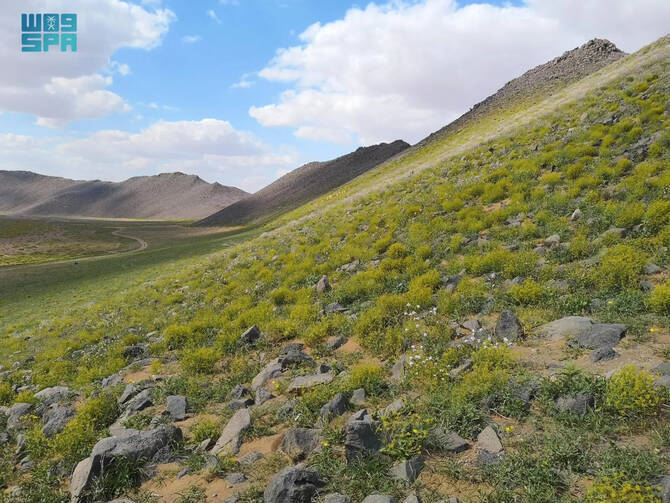
Royal reserve intensifies efforts for environmental conservation

The campaign aims enforcing regulations against violators in partnership with the Special Forces for Environmental Security, rehabilitating damaged lands affected by overgrazing and desertification, planting seedlings and rehabilitating degraded land. (SPA)
Short Url
Updated 05 December 2025
Follow

Royal reserve intensifies efforts for environmental conservation

  • Protection contributes toward sustainability to align with Saudi Vision 2030

RIYADH: The King Salman bin Abdulaziz Royal Reserve Development Authority is intensifying efforts to protect the vegetation, wildlife, and public property within its reserve, the largest in the Kingdom at 130,700 sq. km.

Distinguished by its nature, terrain and archaeological sites (some dating back to 8000 B.C.), its protection contributes to environmental sustainability and aligns with Saudi Vision 2030’s goal of making the Kingdom a global environmental tourist destination, the Saudi Press Agency reported.

The authority’s efforts include enforcing regulations against violators, in partnership with the Special Forces for Environmental Security; rehabilitating damaged lands affected by overgrazing and desertification; planting nearly 4 million seedlings; rehabilitating 750,000 hectares of degraded land to restore plant life; and distributing tonnes of native wild seeds.

The authority has urged adherence to regulations, stressing continuous monitoring and enforcement against violations.

The royal reserve, a vast ecological haven across the Northern Borders, Jouf, Tabuk and Hail regions, is a vital hub for migratory birds. It is home to more than 290 bird species, with 88 percent being migratory and 12 percent resident.

This accounts for 58 percent of all bird species recorded in the Kingdom. The reserve also protects 26 bird species listed as threatened on the International Union for Conservation of Nature Red List.

The reserve serves as the Kingdom’s first stop for flocks arriving from Asia and Europe in the autumn, and their last station before departing in spring.

With its rich biodiversity, balanced environment and varied landscapes, the reserve also stands as a natural sanctuary, hosting remarkable species such as the steppe eagle, the eastern imperial eagle, and the houbara bustard.


Saudi Arabia, regional partners reject any move to displace Palestinians from Gaza

Updated 33 min 14 sec ago
Follow

Saudi Arabia, regional partners reject any move to displace Palestinians from Gaza

  • Expressed deep concern over Israeli statements about the opening of the Rafah crossing in one direction only

RIYADH: The foreign ministers of Saudi Arabia, Egypt, Jordan, UAE, Indonesia, Pakistan, Turkiye and Qatar on Friday expressed deep concern over Israeli statements about the opening of the Rafah crossing in one direction only, the Saudi Press Agency reported. 

In a joint statement, the ministers said it was a move that could facilitate the displacement of Palestinians from the Gaza Strip into Egypt.

They firmly rejected any attempts to force Palestinians from their land, stressing the need for full adherence to the plan put forward by US President Donald Trump, which stipulated opening of the Rafah crossing in both directions and guaranteeing freedom of movement without coercion.

The ministers emphasized that conditions must be created to allow Palestinians to remain on their land and take part in rebuilding their homeland, under a comprehensive framework aimed at restoring stability and addressing the humanitarian crisis in Gaza.

They reiterated their appreciation for Trump’s commitment to regional peace and underscored the importance of implementing his plan in full and without obstruction.

The statement also highlighted the urgent need for a sustained ceasefire, an end to civilian suffering, unrestricted humanitarian access to Gaza, and the launch of early recovery and reconstruction efforts.

The ministers further called for conditions that would enable the Palestinian Authority to resume its responsibilities in the enclave.

The eight countries reaffirmed their readiness to continue coordinating with the US and international partners to ensure full implementation of UN Security Council Resolution 2803 and other relevant resolutions, in pursuit of a just and lasting peace based on international law and the two-state solution, including the establishment of an independent Palestinian state along the 1967 borders with East Jerusalem as its capital.