
RIYADH: Drought in Saudi Arabia intensifies ecological imbalances by reducing water availability, degrading soils, and accelerating desertification in a landscape already adapted to scarce rainfall. The consequences are far-reaching: vegetation thins, pollinator and herbivore populations decline, seasonal valleys dry up, and the loss of plant roots increases wind and water erosion, weakening soil fertility and slowing recovery.
In addition, drought pressures groundwater resources as communities and agriculture compensate for surface water shortfalls, lowering water tables and threatening microhabitats that support migratory birds and endemic species. Over time, these environmental stresses ripple into human lives, endangering livelihoods and food security.
“The value of having a balanced ecosystem is that we then understand that it can sustain those people who rely on it,” Inger Andersen, executive director of the UN Environment Programme, told Arab News.
She added: “Some people who are living in cities may think they aren’t relying on the ecosystem because they get their food from the grocery store, but the reality, of course, is that there was an ecosystem somewhere in the world that provided that food that they purchase.
“So, we are all relying on that ecosystem not just on the food we eat, but also for the houses we live in because we construct houses out of things we take out of the earth.”
Opinion
This section contains relevant reference points, placed in (Opinion field)
Globally, drought is a growing challenge. The National Centers for Environmental Information reported that 1.84 billion people experienced drought conditions between 2022 and 2023. The UN Convention to Combat Desertification and the World Meteorological Organization warn that hydrological extremes are intensifying as the planet warms.
One UN estimate suggests that droughts could affect more than 75 percent of the global population by mid-century if the environmental crisis continues. Already, 3.6 billion people worldwide face water access issues for at least one month each year, highlighting drought as both an ecological and humanitarian concern.

In Saudi Arabia, reduced rainfall limits recharge of valleys that feed native plants such as date palms and wild shrubs, while degrading grazing lands. (PMBSRR photo)
In Saudi Arabia, reduced rainfall limits recharge of valleys that feed native plants such as date palms and wild shrubs, while degrading grazing lands. Communities in affected areas often must adapt their livelihoods or increase groundwater pumping, perpetuating desertification and threatening biodiversity.
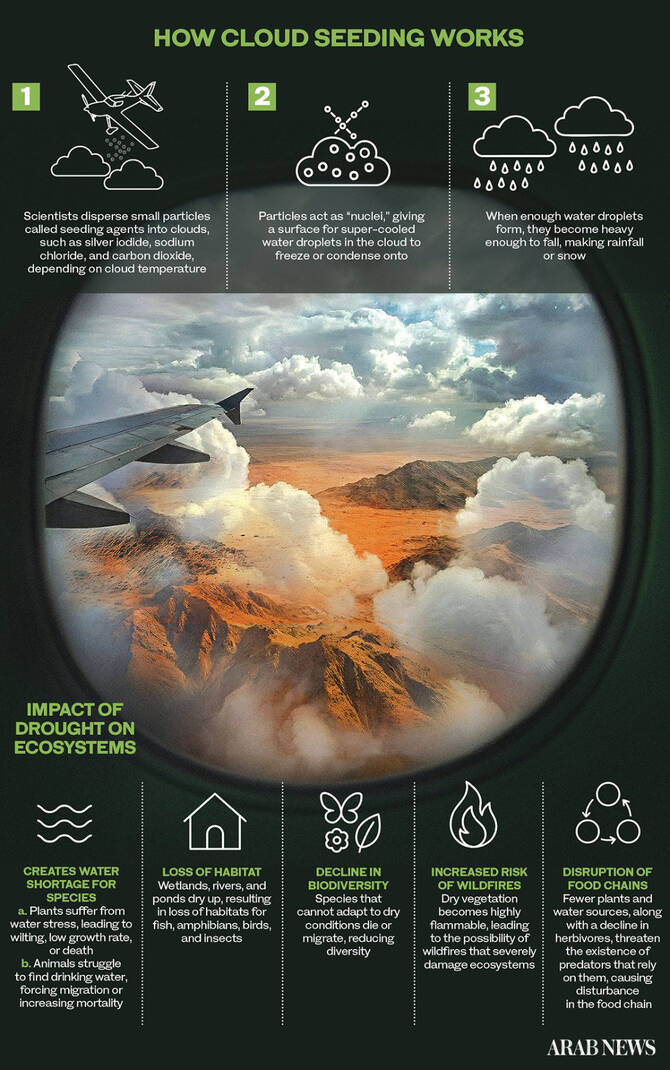
To address these challenges, Saudi Arabia has implemented multiple mitigation strategies. These include wastewater reuse, advanced irrigation methods such as drip systems, landscape restoration, and afforestation projects to stabilize soils. Among the most significant interventions is cloud seeding, which has been adopted as an active weather-modification tool.
DID YOU KNOW?
• UN estimates suggest that by mid-century, droughts could impact over 75 percent of the global population.
• Nearly 2 billion people worldwide faced drought conditions between 2022 and 2023.
• Agriculture accounts for 70 percent of the world’s freshwater use, according to the World Wildlife Fund.
In an interview, Mazen Asiri, executive director of the Regional Center for Climate Change, explained its benefits: “Among its benefits is that it supports tourism, and the surface water content, which enhances plant growth and vegetation cover.”
The Regional Center for Climate Change, established in 2020 under the National Center for Meteorology, builds a climate change database with high spatial accuracy projecting to 2100. It conducts climate scenario modeling, studies, and reports to predict future climate trends and assess impacts on the environment and human activity.
Cloud-seeding techniques employ aircraft and ground-based generators to spread seeding substances into clouds, stimulating droplet formation and increasing rainfall potential, depending on cloud conditions. Techniques include hygroscopic seeding — using salt particles to encourage coalescence—and ice-phase seeding with silver iodide or other nuclei to help create ice crystals when precipitation is high.
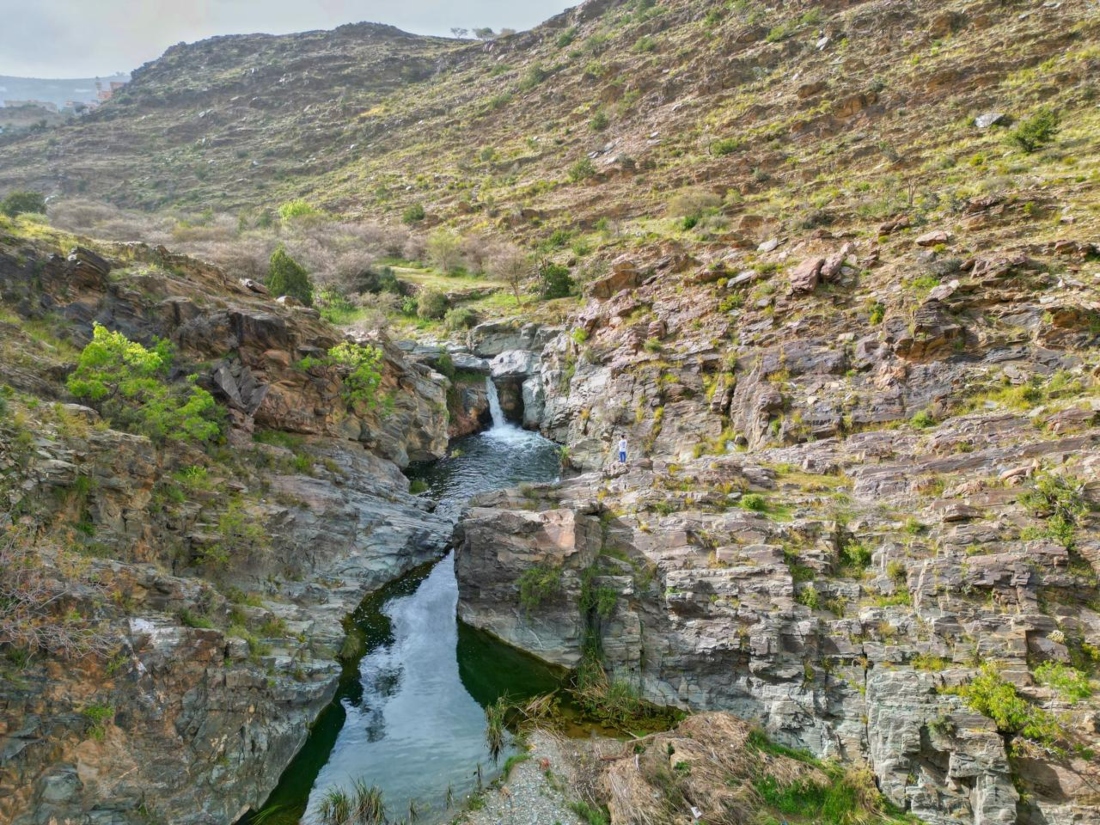
In Saudi Arabia, reduced rainfall limits recharge of wadis that feed various native plants, such as date palms and other wild shrubs, and degrades grazing lands, forcing communities in affected areas to change their livelihoods or increase groundwater pumping. (NCVC)
While cloud seeding can enhance rainfall and provide short-term relief for ecosystems, it cannot fully counter long-term drying trends caused by Saudi Arabia’s climate and global climate change. Realistically, it can improve seasonal rainfall in seeded storms, boosting local surface water and temporarily supporting agriculture and stressed ecosystems.
Alongside cloud seeding, Saudi Arabia pursues water supply diversification, landscape restoration, and regional climate adaptation planning to address the root causes of drought. Integrating these measures with sustainable water governance, managed water recharge, and public education on conservation provides a holistic strategy to restore ecological balance.
“We need concerted efforts, community integration, and raising awareness about environmental stewardship and conservation. What we do now is for the next generation, not for ourselves,” Asiri concluded.