

Pakistan rights minister calls for strict action against men for burning woman alive

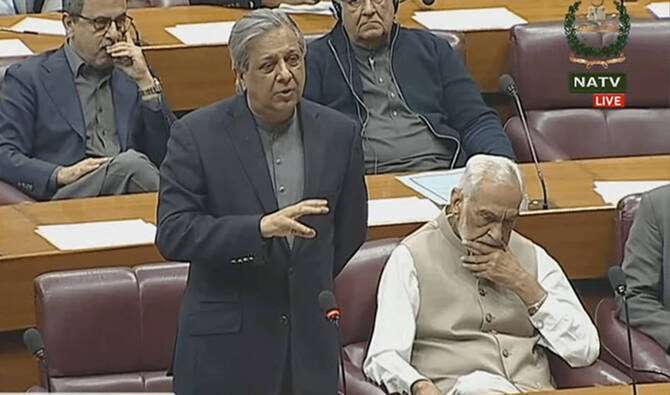
Screengrab taken from live transmission of the National Assembly of Pakistan showing Pakistan's Law Minister, Azam Nazeer Tarar (standing) presenting the 27th constitutional amendment in the National Assembly of Pakistan in Islamabad, Pakistan, on November 11, 2025. (National Assembly Of Pakistan/YouTube)
Short Url
Updated 05 December 2025
Follow

Pakistan rights minister calls for strict action against men for burning woman alive

  • Kaneez Fatima was burned alive allegedly by her husband last month in eastern Bahawalnagar city, reports say
  • Women in Pakistan face widespread discrimination, domestic violence and workplace harassment, as per rights groups

ISLAMABAD: Pakistan’s Human Rights Minister Azam Nazeer Tarar on Friday urged the Punjab government to take strict legal action against men who are accused of burning a woman alive recently. 

As per local media reports, Kaneez Fatima, a mother of five, was burnt alive allegedly by her husband Muhammad Ashraf and six accomplices in the eastern city of Bahawalnagar on Nov. 30. 

The report said Fatima had married Ashraf, who was already married to another woman, five years ago. It added that Ashraf often fought with Fatima. Police arrested Ashraf and four of his accomplices on Monday and registered a case against all seven suspects under Sections 302 (punishment for murder), 149 (unlawful assembly), and 148 (rioting with a deadly weapon) of the Pakistan Penal Code.

“The federal minister [Tarar] has called on the Punjab government and relevant law enforcement agencies to conduct an immediate and transparent investigation,” Pakistan’s Ministry of Human Rights said in a statement.

“The federal minister [Tarar] expressed hope that the Punjab government and law enforcement agencies will take strict legal action against those involved in the incident.”

Women in Pakistan face widespread discrimination, domestic violence and workplace harassment, according to rights groups. Several women are also killed each year in Pakistan for so-called honor by men of their family for choosing to marry of their own accord. 

Pakistan has introduced several policies to strengthen protections for women, but implementation remains uneven. 

In November, on the International Day for the Elimination of Violence Against Women, Pakistan Prime Minister Shehbaz Sharif said his government was taking legislative, administrative and institutional measures to improve safety and expand access to justice including support centers, dedicated police desks for women, hotlines along with financial and legal assistance for survivors.


Sindh assembly passes resolution rejecting move to separate Karachi

Updated 21 February 2026
Follow

Sindh assembly passes resolution rejecting move to separate Karachi

  • Chief Minister Shah cites constitutional safeguards against altering provincial boundaries
  • Calls to separate Karachi intensified amid governance concerns after a mall fire last month

ISLAMABAD: The provincial assembly of Pakistan’s southern Sindh province on Saturday passed a resolution rejecting any move to separate Karachi, declaring its territorial integrity “non-negotiable” amid political calls to carve the city out as a separate administrative unit.

The resolution comes after fresh demands by the Muttahida Qaumi Movement (MQM) and other voices to grant Karachi provincial or federal status following governance challenges highlighted by the deadly Gul Plaza fire earlier this year that killed 80 people.

Karachi, Pakistan’s largest and most densely populated city, is the country’s main commercial hub and contributes a significant share to the national economy.

Chief Minister Syed Murad Ali Shah tabled the resolution in the assembly, condemning what he described as “divisive statements” about breaking up Sindh or detaching Karachi.

“The province that played a foundational role in the creation of Pakistan cannot allow the fragmentation of its own historic homeland,” Shah told lawmakers, adding that any attempt to divide Sindh or separate Karachi was contrary to the constitution and democratic norms.

Citing Article 239 of Pakistan’s 1973 Constitution, which requires the consent of not less than two-thirds of a provincial assembly to alter provincial boundaries, Shah said any such move could not proceed without the assembly’s approval.

“If any such move is attempted, it is this Assembly — by a two-thirds majority — that will decide,” he said.

The resolution reaffirmed that Karachi would “forever remain” an integral part of Sindh and directed the provincial government to forward the motion to the president, prime minister and parliamentary leadership for record.

Shah said the resolution was not aimed at anyone but referred to the shifting stance of MQM in the debate while warning that opposing the resolution would amount to supporting the division of Sindh.

The party has been a major political force in Karachi with a significant vote bank in the city and has frequently criticized Shah’s provincial administration over its governance of Pakistan’s largest metropolis.

Taha Ahmed Khan, a senior MQM leader, acknowledged that his party had “presented its demand openly on television channels with clear and logical arguments” to separate Karachi from Sindh.

“It is a purely constitutional debate,” he told Arab News by phone. “We are aware that the Pakistan Peoples Party, which rules the province, holds a two-thirds majority and that a new province cannot be created at this stage. But that does not mean new provinces can never be formed.”

Calls to alter Karachi’s status have periodically surfaced amid longstanding complaints over governance, infrastructure and administrative control in the megacity, though no formal proposal to redraw provincial boundaries has been introduced at the federal level.