

US firm eyes long-term investment in Pakistan’s mining and mineral sectors, government says

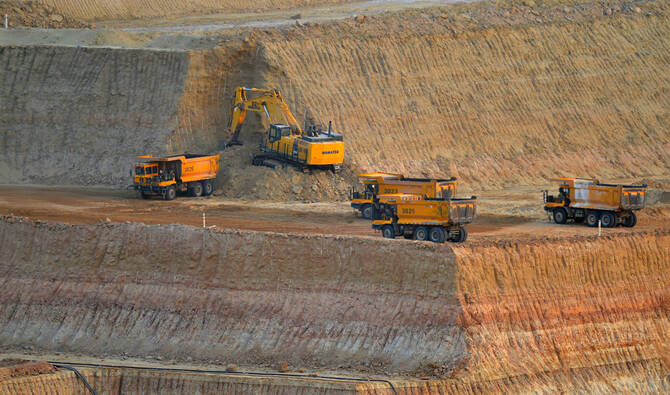
This picture taken on May 23, 2018 shows trucks transporting soil in an open-pit coal mining site at Islamkot in the desert Tharparkar district in Pakistan's southern Sindh province. (AFP/File)
Short Url
Updated 14 November 2025
Follow

US firm eyes long-term investment in Pakistan’s mining and mineral sectors, government says

  • The development comes over a month after Pakistan dispatched first ever shipment of rare earth, critical minerals to the US
  • It followed a landmark $500 million deal between the two countries for joint development of the entire mineral value chain

ISLAMABAD: Nova Minerals, a US-based mining exploration and development company, has expressed interest in long-term investment in Pakistan’s mining and mineral sectors, the Pakistani government said on Thursday, citing the country’s geological diversity and improved policy environment.

The statement came after Board of Investment (BOI) Minister Qaiser Ahmed Sheikh’s meeting with a delegation from Nova Minerals Ltd., a US-based firm listed on the ASX and NASDAQ that focuses on gold, antimony and rare earth minerals, according to Pakistan’s Press Information Department (PID).

Sheikh highlighted Pakistan’s vast and largely untapped potential in the minerals and mining sector, emphasizing that the country offers promising investment opportunities across multiple areas, particularly in exploration and processing of high-value minerals.

He stressed that his government is committed to promoting value-added exports and aims to transition from raw mineral extraction toward local mineral processing and industrial upscaling, assuring the BOI will fully facilitate foreign investors and joint ventures.

“The Nova Minerals delegation expressed strong interest in exploring investment opportunities in Pakistan’s mineral and mining sectors, particularly in antimony and rare earth minerals. The company’s representatives conveyed that Pakistan’s geological diversity, government facilitation, and policy reforms make it an attractive destination for long-term investment,” the PID said.

“They also expressed interest in establishing technical collaboration, knowledge exchange, and feasibility studies to assess specific investment projects in partnership with local entities.”

The development comes more than a month after Pakistan dispatched its first ever shipment of rare earth and critical minerals to the United States, a Chicago-based public relations (PR) firm said, following a landmark $500 million deal between the two countries.

The agreement, signed between American firm US Strategic Metals (USSM) and Pakistan’s Frontier Works Organization (FWO), aimed to create a framework for joint development of the entire mineral value chain, including exploration, beneficiation, concentrate production and eventual establishment of refineries in Pakistan.

Pakistan indigenously sourced and prepared antimony, copper concentrate, and rare earth elements with neodymium and praseodymium for shipment, according to US firm PR Newswire. With this first delivery and a multi-phase investment framework underway, Pakistan is now positioned as a rising force in the global critical mineral economy.

Sheikh appreciated Nova Minerals’ keen interest and reaffirmed that the government encourages responsible, technology-driven ventures that ensure sustainability and local value addition.

“He stated that such initiatives would help create an ecosystem conducive to further foreign investment in Pakistan’s mining sector,” the PID said.

“The Minister reiterated that the Board of Investment remains committed to facilitating all investors through a transparent, efficient, and investor-friendly framework, ensuring that Pakistan’s abundant natural resources translate into sustainable economic prosperity.”


Pakistan offers Kyrgyzstan Arabian Sea access as two states sign 15 cooperation accords

Updated 05 December 2025
Follow

Pakistan offers Kyrgyzstan Arabian Sea access as two states sign 15 cooperation accords

  • Pakistan and Kyrgyzstan sign MOUs spanning trade, energy, agriculture, ports, education, security cooperation
  • Kyrgyz president is on first visit to Pakistan in 20 years as both sides push connectivity and CASA-1000 power links

ISLAMABAD: Pakistan on Thursday offered Kyrgyzstan the shortest and most economical route to the Arabian Sea as the two countries signed 15 agreements and memoranda of understanding aimed at boosting cooperation across trade, energy, agriculture, education, customs data-sharing and port logistics.

The accords were signed during a visit to Islamabad by President Sadyr Zhaparov, the first by a Kyrgyz head of state to Pakistan in two decades, and part of Islamabad’s renewed push to link South Asia with landlocked Central Asian economies through ports, power corridors and transport routes.

For Pakistan, Kyrgyzstan offers access to hydropower through CASA-1000, a $1.2 billion regional electricity transmission project designed to carry surplus summer electricity from Kyrgyzstan and Tajikistan through Afghanistan into Pakistan. For Bishkek, Pakistan provides overland access to warm-water ports on the Arabian Sea, creating a shorter commercial route to global markets.

“President Asif Ali Zardari has reiterated Pakistan’s readiness to offer Kyrgyzstan the shortest and most economical route to the Arabian Sea,” Radio Pakistan reported after Zhaparov met the Pakistani president. 

The two leaders also discussed expanding direct flights to deepen business, tourism and people-to-people ties.

Zardari welcomed Kyrgyzstan’s completion of its segment of the CASA-1000 project and “reaffirmed Pakistan’s commitment to completing its part of the project, which is now at an advanced stage,” the state broadcaster said. 

Zhaparov thanked Islamabad for supporting Bishkek’s candidacy for a non-permanent UN Security Council seat and invited Zardari to visit Kyrgyzstan at a time of his convenience. Both sides expressed satisfaction with progress under the Quadrilateral Traffic in Transit Agreement, designed to facilitate road movement between Pakistan, Kyrgyzstan, Kazakhstan and China.

Earlier, both governments exchanged 15 sectoral cooperation documents covering commerce, mining, geosciences, power, agriculture, youth programs, the exchange of convicted persons, customs electronic data systems and a sister-city linkage between Islamabad and Bishkek.

According to APP, the MOUs were signed by ministers representing foreign affairs, commerce, economy, energy, power, railways, interior, culture, health and tourism. Agreements also covered cooperation between Pakistan’s Foreign Service Academy and the Diplomatic Academy of Kyrgyzstan, as well as collaboration between universities, youth ministries and cultural institutions.

“Our present mutual trade, comprising of about $15–16 million will be enhanced to $200 million in the next two years,” Prime Minister Shehbaz Sharif said after the agreements were signed, calling them “a framework for structured, result-oriented engagement and closer institutional linkages.”

Sharif said Pakistan was ready to serve as a maritime outlet for the landlocked Central Asian republic, offering access to Karachi, Port Qasim and Gwadar to help Kyrgyz goods reach regional and global markets.