

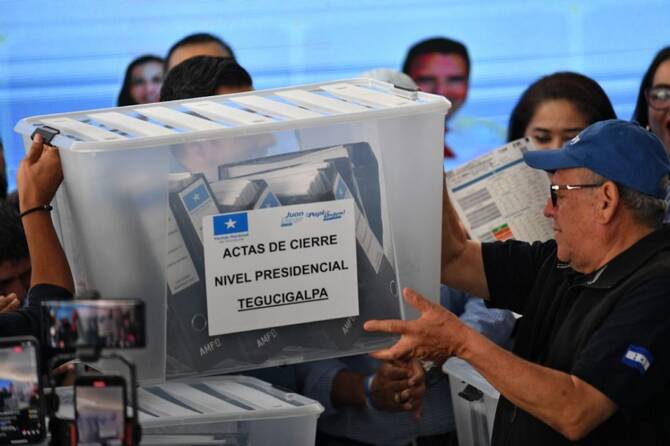
TEGUCIGALPA: A right-wing Honduran presidential candidate backed by Donald Trump reclaimed a narrow lead over his rival Thursday on the fourth day of a plodding vote count.
With over 86 percent of the votes counted, the race was still too early to call.
Trump-backed businessman Nasry Asfura was leading with 40.24 percent compared to 39.41 percent for fellow right-winger and TV personality Salvador Nasralla, according to the National Electoral Council (CNE).
The CNE has come under fire from the US president after announcing Monday that a partial count showed the two men locked in a “technical tie.”
CNE chief Ana Paola Hall said Thursday that the electoral body was entering into the system records that could not be transmitted on election day.
“All of this will complete... the final count to 100 percent,” said Hall, who asked the candidates for patience as the count continues.
“Haste is sometimes the enemy of legitimacy,” she added.
The CNE has vowed that the end result will “scrupulously respect the popular will.”
Trump, who routinely casts doubt on the integrity of elections whose results he disapproves of, accused Honduran authorities of “trying to change” the results, and threatened there would be “hell to pay” if they did.
Late Thursday, US Deputy Secretary of State Christopher Landau amplified Trump’s message, posting on X that “democracy is on trial” in the Honduran election and calling on all parties to “uphold the independence” of the CNE to ensure transparency.
“The world’s eyes, including ours, are on Honduras,” he added.
Honduras is one of Latin America’s most impoverished and violent countries, and many citizens have fled north to the United States to escape those hardships, including minors fearing forced recruitment by gangs.
On Tuesday, the CNE said ballots were still coming in from remote areas — some only accessible by donkey or boat — and the declaration of a winner may still be days away.
The CNE, which has frequently been accused by parties of political favoritism, legally has one month to announce a winner.
Honduran presidential elections are determined in one round, with a simple plurality needed to win.
- ‘Friend of freedom’ -
Trump supports 67-year-old businessman Asfura, whom he has called a “friend of freedom,” while accusing 72-year-old Nasralla of merely “pretending to be an anti-communist.”
Trump has become increasingly vocal in his support for allies in the region, having threatened to cut aid to Argentina and Honduras if his picks did not win.
Argentina’s President Javier Milei, a close Trump ally, was victorious in his country’s midterm elections.
Whatever the outcome in Honduras, Sunday’s vote was a clear defeat for ruling leftists.
Honduras’s swing to the right will likely boost US influence in a country that under the last government had increasingly looked to China.
Trump has also granted a pardon to Juan Orlando Hernandez, a former president from Asfura’s National Party who had been serving a 45-year sentence in the United States for drug trafficking.
The 57-year-old lawyer was released Monday in what was widely perceived as more interference.
Trump favorite reclaims narrow lead in Honduras presidential vote
Rains hamper Sri Lanka cleanup after deadly floods
COLOMBO: Heavy rains lashed Sri Lanka on Friday, hampering a major clean-up operation after severe flooding and landslides last week killed nearly 500 people, officials said.
Authorities reported up to 132 millimeters of rainfall in southern Sri Lanka over a 15-hour period ending Thursday night.
But while the deluge was intense, they said the large-scale flooding seen since last week had begun to subside.
The Disaster Management Center (DMC) said 486 people had been confirmed killed and another 341 were still unaccounted for after Cyclone Ditwah left the island on Saturday.
The number of people in state-run refugee camps has dropped to 170,000 from a peak of 225,000 as floodwaters receded in and around the capital Colombo.
Record rainfall triggered floods and deadly landslides, with President Anura Kumara Dissanayake saying it was the most challenging natural disaster to hit the island in its history.
Residents evacuated from the landslide-prone central hills have been told not to return immediately to their homes, even if they were unaffected by the slides, as the mountainsides remained unstable.
In the central town of Gampola, residents worked to clear the mud and water damage.
“We are getting volunteers from other areas to help with this clean-up,” Muslim cleric Faleeldeen Qadiri told AFP at the Gate Jumma Mosque.
“We have calculated that it takes 10 men a whole day to clean one house,” said a volunteer, who gave his name as Rinas. “No one can do this without help.”
The top official in charge of the recovery, Prabath Chandrakeerthi, Commissioner-General of Essential Services, said authorities were paying 25,000 rupees ($83) to clean a home, with costs of reconstruction as much as $6-7 billion.
A further 2.5 million rupees ($8,300) is being paid to begin rebuilding destroyed homes. More than 50,000 houses had been damaged as of Friday morning, officials said.
Chandrakeerthi’s office said nearly three-quarters of the electricity supply across the country had been restored, but some parts of the worst-affected Central Province were still without power and telephones.
President Dissanayake declared a state of emergency on Saturday and has vowed to rebuild with international support.
Authorities reported up to 132 millimeters of rainfall in southern Sri Lanka over a 15-hour period ending Thursday night.
But while the deluge was intense, they said the large-scale flooding seen since last week had begun to subside.
The Disaster Management Center (DMC) said 486 people had been confirmed killed and another 341 were still unaccounted for after Cyclone Ditwah left the island on Saturday.
The number of people in state-run refugee camps has dropped to 170,000 from a peak of 225,000 as floodwaters receded in and around the capital Colombo.
Record rainfall triggered floods and deadly landslides, with President Anura Kumara Dissanayake saying it was the most challenging natural disaster to hit the island in its history.
Residents evacuated from the landslide-prone central hills have been told not to return immediately to their homes, even if they were unaffected by the slides, as the mountainsides remained unstable.
In the central town of Gampola, residents worked to clear the mud and water damage.
“We are getting volunteers from other areas to help with this clean-up,” Muslim cleric Faleeldeen Qadiri told AFP at the Gate Jumma Mosque.
“We have calculated that it takes 10 men a whole day to clean one house,” said a volunteer, who gave his name as Rinas. “No one can do this without help.”
The top official in charge of the recovery, Prabath Chandrakeerthi, Commissioner-General of Essential Services, said authorities were paying 25,000 rupees ($83) to clean a home, with costs of reconstruction as much as $6-7 billion.
A further 2.5 million rupees ($8,300) is being paid to begin rebuilding destroyed homes. More than 50,000 houses had been damaged as of Friday morning, officials said.
Chandrakeerthi’s office said nearly three-quarters of the electricity supply across the country had been restored, but some parts of the worst-affected Central Province were still without power and telephones.
President Dissanayake declared a state of emergency on Saturday and has vowed to rebuild with international support.
© 2025 SAUDI RESEARCH & PUBLISHING COMPANY, All Rights Reserved And subject to Terms of Use Agreement.


