

US mediator Kushner and Netanyahu discuss phase two of Gaza truce

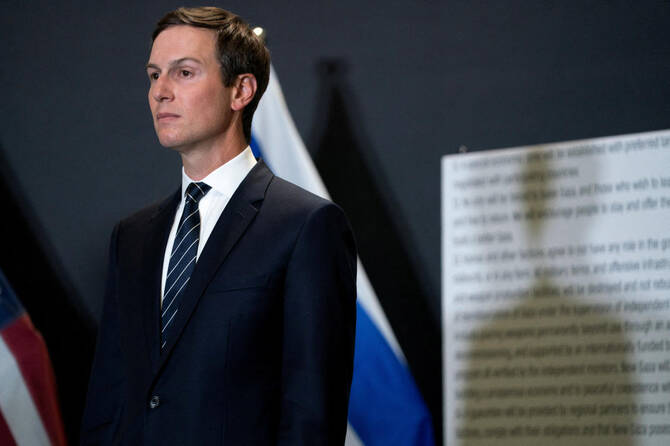
Jared Kushner listens as US Vice President JD Vance speaks during a press conference following a military briefing at the Civilian Military Coordination Center in southern Israel on Tuesday, Oct. 21, 2025. (REUTERS)
Short Url
Updated 10 November 2025
Follow

US mediator Kushner and Netanyahu discuss phase two of Gaza truce

  • The two discussed some of the most sensitive aspects of phase two, Israeli government spokeswoman Shosh Bedrosian said
  • “Phase two also includes the establishment of the international stabilization force and the details of which of course together are being discussed,” she said

JERUSALEM: US mediator Jared Kushner and Israeli Prime Minister Benjamin Netanyahu held talks Monday on the second phase of the Gaza ceasefire, as Washington intensified its efforts to ensure the fragile truce endures.
Netanyahu, meanwhile, said Israel would enforce the ceasefire in Gaza as well as one in Lebanon with an “iron fist.”
The truce in Gaza, in effect for a month now, has largely halted the war that erupted after Hamas’s surprise attack on Israel on October 7, 2023.
During the ongoing first stage, a series of prisoner and hostage exchanges took place over recent weeks.
Kushner, the son-in-law of US President Donald Trump who helped broker the ceasefire, met Netanyahu in Jerusalem on Monday as part of US efforts to stabilize the truce and lay the groundwork for its next phase.
The two discussed some of the most sensitive aspects of phase two, Israeli government spokeswoman Shosh Bedrosian told journalists.
“Together the two discussed phase one, which we are currently still in, to bring our remaining hostages, and the future of phase two of this plan, which includes the disarming of Hamas, demilitarising Gaza and ensuring Hamas will have no role in the future of Gaza ever again,” Bedrosian said.
“Phase two also includes the establishment of the international stabilization force and the details of which of course together are being discussed.”
Hamas has repeatedly insisted that relinquishing its weapons is a red line.

Israel and Hamas continue to accuse each other of violating the ceasefire in Gaza.
Gaza’s health ministry said Israeli forces have killed at least 242 Palestinians in the territory since the ceasefire began on October 10.
On Monday, the Israeli military said it killed two militants who approached the so-called “Yellow Line,” the boundary beyond which Israeli forces hold their positions in Gaza.
Media restrictions in Gaza and difficulties in accessing many areas mean AFP is unable to independently verify details provided by the ministry or the Israeli military.
“Whoever seeks to harm us, we harm them,” Netanyahu said in parliament on Monday.
“We are determined to enforce with an iron fist the ceasefire agreements where they exist against those who seek our destruction, and you can see what happens every day in Lebanon,” he said.
Israel has kept up attacks on Lebanon, where it says it is targeting Hezbollah militants. It agreed a ceasefire to halt a war with the group last November, but has frequently bombed Lebanon since then.
It said on Monday it had killed 15 Hezbollah members this month.
Egypt, Qatar and Turkiye are among the potential participants in the proposed international stabilization force for Gaza, but the United Arab Emirates has indicated it is unlikely to join without a clear operational framework.
“Under such circumstances, the UAE will probably not participate in such a force,” Emirati presidential adviser Anwar Gargash told the Abu Dhabi Strategic Debate Forum on Monday.
Turkiye has been keen to join, but Netanyahu has repeatedly said Israel would not allow it.
“The prime minister said... there will be no Turkish boots on the ground,” Bedrosian said.
Michael Milshtein, who heads the Palestinian studies program at Tel Aviv University, said the decision regarding the stabilization force will ultimately rest with Trump.
“There is a gap between the Israeli opinion and the American opinion but in the end, the only thing that matters is what Trump wants, not what Netanyahu thinks,” Milshtein told AFP.
Turkiye has been one of the most outspoken critics of the war in Gaza, and on Friday it issued arrest warrants accusing Netanyahu and several senior Israeli officials of genocide.

- ‘We still do not feel safe’ -

Since the truce began, Hamas has returned all 20 living hostages and the remains of 24 captives, including 21 Israelis.
Four bodies of hostages killed in the October 2023 attack remain in Gaza.
In exchange, Israel has freed nearly 2,000 prisoners and returned 315 bodies of Palestinian captives.
The latest of those were the remains of 15 Palestinians handed over by Israel on Monday after Hamas a day earlier returned the remains of Lt. Hadar Goldin, killed in the 2014 Gaza war.
Goldin, killed while attempting to destroy Hamas tunnels near Rafah, had been missing for 11 years.
“Time has stood still,” his sister Ayelet Goldin said in a statement on Monday.
Despite the progress in hostage returns, Gazans remain anxious about their future.
“We still do not feel safe. Shooting continues... We try to protect our children from psychological trauma and to help them forget the war,” said Salma Abu Shawish, 40, a resident of Al-Bureij refugee camp in central Gaza.
“Life in Gaza is hard. We still lack food, and many families remain homeless. We only wish this nightmare would stop and never return.”


How a perfect storm of crises pushed Iran into acute, nationwide water scarcity

Updated 10 sec ago
Follow

How a perfect storm of crises pushed Iran into acute, nationwide water scarcity

  • Experts warn Iran faces “water bankruptcy” after decades of drought, heavy overuse, and mismanagement
  • Areas may become uninhabitable, displacing millions and creating cascading social, economic and security pressures

LONDON: During the summer, Israeli Prime Minister Benjamin Netanyahu addressed Iranians directly in a video on social media, promising that Israeli water technology would reach the country “once the regime is deposed.”

The appeal echoed a similar message made during the June 12-day war, drawing a sharp rebuke from Iran’s President Masoud Pezeshkian, who dismissed the offer as “an illusion.”

The unusual appeal nevertheless highlights a stark reality that the Iranian state and its citizens are now struggling to confront: a spiraling water crisis that shows no sign of easing, driven by years of drought, crumbling infrastructure, and chronic mismanagement.

Lake Urmia, once Iran’s largest lake and the Middle East’s biggest saltwater body, has almost completely dried up, with satellite images showing the 4,000-year-old “turquoise jewel” turned into a vast salt plain, fuelling salt storms, ecosystem collapse and serious public health risks.

This picture taken on December 8, 2018 shows a general view of recreational boats along the shore of the salt lake of Urmia and Shahid Kalantari causeway crossing it, in the northwest of Iran which had been shrinking in one of the worst ecological disasters of the past 25 years. (AFP)

Yet the most potent symbol of the emergency is now Tehran, where dam reserves have plunged so low that in early November Pezeshkian warned the capital’s 15 million residents could face rationing and even evacuation if rains failed to arrive by late November.

“Iran has been suffering from a chronic water problem, what we call water bankruptcy, for a number of years, and the symptoms of that have appeared in different parts of the world,” Kaveh Madani, director of the UNU Institute for Water, Environment and Health, told Arab News.

“However, this is the first time the capital and metropolis of more than 15 million people is facing this issue. This is the richest city, the most influential in terms of politics, being impacted. And that shows how serious the problem is.”

Rural areas and farmland have long been on the front line, but amid the worst drought in six decades, exceptionally low rainfall is now hitting cities as well.

Despite 3-4 millimeters of rain in early December, Tehran province remains around 97 percent below normal levels for this time of year.

ERA5 data analysed by Dr. Mojtaba Sadegh of Boise State University shows autumn precipitation this year at just 13.9 millimeters, compared with a historical peak of 257.6 millimeters in 1994, while many major reservoirs have fallen to single-digit capacity.

But today’s crisis is neither a sudden twist of fate nor confined to Tehran; it is the predictable outcome of what experts have long warned is “water bankruptcy” after decades of withdrawing more water than nature can replenish and draining strategic aquifers.

Madani described a “failing state being driven by human decisions, decades of poor management, lack of foresight, and overreliance on engineering solutions that were only seeking increasing water supply, like building more dams or transferring water from one location to another.

“The moment you increase supply, then demand increases would follow because growth is further encouraged, and then the problem keeps coming back. That’s a typical fix that backfires,” he added.

In May, during his visit to Saudi Arabia, US President Donald Trump criticized Iran’s “corrupt water mafia” for engineering droughts and emptying riverbeds — a charge many Iranians saw not as a revelation but an overdue validation of what activists and experts have long warned.

Pezeshkian recently conceded that “past mistakes” have left Iran with shrinking options, while Isa Kalantari, former vice president and head of the Department of Environment, warned that the drought poses “a more dangerous threat to Iran than Israel.”

Independent Iran scholar Alireza Nader told Arab News: “I would describe it as a man-made disaster. Because, yes, Iran is an arid country, and there is drought, but the government in Iran had decades to prepare for this eventuality, which it actually created.”

Nader explained that “as long as you have this closed economic system, where the state makes the decisions and the state exploits Iran’s natural and mineral resources to empower itself, you’re going to have this sort of ‘water mafia’ that relies on construction to make money,” something he described as a dangerous “self-perpetuating system.”

Opaque contracts and weak oversight have fueled the problem.

Since the 1979 revolution, and especially during the reconstruction drive that followed the Iran-Iraq war of 1980-88, the country has built roughly 600 dams of various sizes, up from only about 20-30 modern dams before 1979.

This boom — averaging about 20 new dams a year over several decades — has turned Iran into one of the world’s most aggressive dam‑building states.

Framed as a way to meet rising water demand, it also enriched a small circle of firms and insiders, including Khatam Al‑Anbiya, the construction arm of the Islamic Revolutionary Guard Corps, which critics accuse of siphoning off billions in public funds through dam and inter‑basin transfer projects, deepening what many now call “water corruption.”

Combined with reckless agricultural expansion, these policies have devastated ecosystems, worsened shortages and uprooted communities across Iran, particularly in areas like Balochistan, one of the country’s poorest regions, where 62 percent of the population lacks access to safe drinking water.

Desperate farmers have resorted to over‑pumping groundwater, often illegally, draining aquifers and causing the land to sink, a largely irreversible process known as land subsidence.

“This is an issue of water governance,” said Nader. “This is not a political system that can take care of the people and can take care of the environment, and the last 46 years have shown that it is a system that has caused this problem. Iran is literally sinking because of the water disaster. The ground is subsiding.”

A University of Leeds study has identified 106 subsiding regions spanning 12,120 square miles — around 2 percent of Iran. In Tehran and surrounding areas, where aquifers have been pushed to their limits, the ground is sinking by up to 31 centimeters a year — enough to wreck infrastructure and prompt talk of eventual evacuation.

“If we assume that they’re going to move, where are they going to move?” asked Madani. 

Drinking water can still be provided through tankers and other means, such as redirecting water from resource-intensive activities such as agriculture.

Indeed, agriculture is a key culprit. Iran is one of the Middle East’s leading producers of wheat, pistachios, watermelons and cucumbers, all highly water‑intensive crops. In 2025, the sector accounted for more than 90 percent of all water allocation.

“The country can produce more strategic food with less water and less land area, provided that it can find alternative opportunities for the farmers,” said Madani, himself a former deputy head of Iran’s Department of Environment.

While oil still brings in the most revenue, agriculture is a core economic and strategic sector, employing about 14.8 percent of the workforce.

Yet despite the environmental damage it causes, the government plans to increase agricultural exports by 20-25 percent to prop up an economy strained by international sanctions — measures that have themselves worsened the water crisis.

“Foreign companies and individuals can’t invest in improving Iran’s water governance,” said Nader. “What the sanctions also do is choke off Iran from expertise and technology that is necessary to fix this environmental issue.”

He argued there is no quick fix, but that repairing leaking pipes, especially in Tehran, would be a crucial first step. Citizens, he added, can also act individually and collectively to confront a crisis that is now “existential.”

If large areas become uninhabitable, Nader warned, millions of Iranians could be forced to leave, leading to what he called “the collapse of Iran as a civilization” and, eventually, of the regime itself.

The impact, he added, does not stop at Iran’s borders but affects the “entire Middle East” and could reach “Europe and America much more quickly than we realize.”

Madani, however, sketched a less apocalyptic future. To tackle “water bankruptcy,” he argued, Iran must pursue politically painful reforms, above all decoupling its economy from water by creating jobs for farmers in other sectors — a difficult task while the state remains in “resistance mode” under sanctions.

He noted that although climate stress and migration can fuel tensions and security risks, the link is complex and shaped by many other factors, making precise forecasts speculative.

“We don’t know how wet or dry this year would be, and whether there would be some relief, but whatever it is, it’s not going to address the human-made policy-related problems,” said Madani.

What is certain, he added, is that a “quick evacuation is not possible.” Instead, authorities might rely on temporary measures already used for pollution or power crises — extending weekends, closing schools and offices, and encouraging people to leave the city for short periods to ease pressure on the system.

“If you only have a few days or a few weeks of water left, that’s a practice that can function and can be helpful.”