

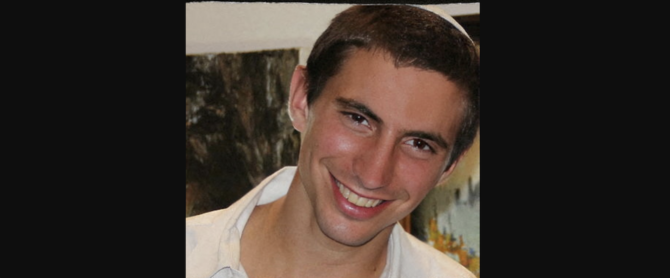

JERUSALEM: Israel said the remains it received on Sunday from Hamas were those of Lt. Hadar Goldin, an Israeli officer killed more than a decade ago in the 2014 Gaza war.
Goldin was the 24th deceased hostage whose remains have been returned by Hamas since the start of the ceasefire on October 10 that has halted the latest war in Gaza, which broke out in October 2023.
Prime Minister Benjamin Netanyahu’s office said forensic experts had confirmed the remains were of Goldin.
“Today, we are united in having finally brought him back to his parents and his family to be laid to rest in Israel,” Netanyahu said in a video statement posted on X, holding a photograph of Goldin.
“It’s a relief. It’s time for this family to finally be able to mourn,” Judith Touati, a resident of Ramla in central Israel told AFP.
“In Israel, no one is forgotten, and we do everything to bring everyone home, even after 11 years.”
The return of the Goldin’s remains in particular marked a deeply symbolic moment for Israel — where the military’s creed of leaving no soldier behind is treated as sacred — closing a painful 11-year chapter that has haunted both his family and the nation.
Several friends of Goldin’s family and his former comrades had gathered at the forensic center where his remains were verified.
Rachel Zinkin, a friend of the family, told AFP that it would now be “a closure for the family and also for the Israeli society.”
Nevertheless, his father, Simcha Goldin, insisted that victory for Israel in Gaza would only come once all the hostages were home.
“What this war has proven is that when we fight for our soldiers, we succeed. Victory means bringing home the hostages and bringing home our soldiers to Israel.”
- Killed in ambush -
Hamas’s armed wing, the Ezzedine Al-Qassam Brigades, handed over the remains earlier on Sunday, saying it had found them in a tunnel in Rafah the day before.
Goldin’s body had been held in Gaza since his death. Until now, Hamas had never acknowledged his death nor possession of his remains.
Israeli media reported on Saturday that Israel had allowed Hamas and Red Cross personnel to search in an area under Israeli control in Rafah to locate Goldin’s remains.
Goldin, 23, was part of an Israeli unit tasked with locating and destroying Hamas tunnels when he was killed on August 1, 2014, just hours after a 72-hour humanitarian ceasefire took effect.
Israeli government spokeswoman Shosh Bedrosian said Goldin had been killed in an ambush.
“The terrorists emerged from a tunnel in Rafah and attacked IDF soldiers,” Bedrosian told journalists on Sunday.
“Hadar was shot and killed during this Hamas attack, with terrorists dragging his body back into the tunnel.”
Parts of his body were found in a tunnel soon after the incident and the family had held his funeral in his hometown Kfar Saba, near Tel Aviv in August 2014.
Previous efforts to retrieve his remains through prisoner swaps had failed.
“The return of his (Goldin’s) body, after an 11-year delay, carries great significance,” said Israeli columnist Amos Harel in the left-leaning Haaretz newspaper.
“It will close a painful chapter and send a message that Israel’s commitment to leaving no soldier behind remains steadfast.”
- ‘We feel like hostages’ -
But Gazan resident Samah Deeb, displaced from northern Gaza to a central part of the territory, remained apprehensive even as Hamas returned hostages.
“We still feel like hostages to the situation,” Deeb, 33, told AFP.
“The next stage of the ceasefire, which involves disarmament of Hamas and administration of the Strip worries us.
“I want my children to have a dignified life, for schools and education to return, and for us to live in a proper home, not a tent or temporary shelter.”
Her views were echoed by Mohammed Zamlout, another displaced Gazan.
“We want Israel’s withdrawal. We want to return to our destroyed homes, begin reconstruction, rebuild infrastructure and schools, and restore life for our children,” he said.
At the start of the truce, Hamas was holding 20 living hostages and the bodies of 28 deceased captives.
It has since released all the living hostages and returned 24 sets of remains of the deceased in line with the ceasefire terms.
In exchange, Israel has released nearly 2,000 Palestinian prisoners that had been in its custody and returned the bodies of hundreds killed in Gaza.
The remains of four hostages are still held in Gaza, three of them Israeli and one Thai, all of whom were seized during Hamas’s October 2023 attack.
That attack resulted in the deaths of 1,221 people on the Israeli side, mostly civilians, according to an AFP tally based on official Israeli figures.
The Israeli military’s retaliatory campaign has since killed 69,176 Palestinians, also mostly civilians, according to Gaza’s health ministry.
The ministry, whose figures are considered reliable by the UN, does not specify the number of fighters killed within this total.


