



DUBAI: Across the Arab world, traditional crafts are finding new life in the hands of modern makers. From Sharjah to Damascus, Beirut to Amman, artisans are reviving techniques once at risk of disappearing — transforming heritage into livelihoods and art into survival.
In Saudi Arabia, 2025 has been declared the Year of Handicrafts — a nationwide initiative led by the Ministry of Culture and the Heritage Commission to highlight traditional crafts and bring them into the modern economy.
Culture Minister Prince Badr bin Abdullah bin Farhan described handicrafts as “a reflection of the creativity of Saudi society through weaving, handmade artifacts and artistic innovations passed down through generations.”

Saudi Arabia's Culture Minister Prince Badr bin Abdullah bin Farhan. (SPA file photo)
The program supports pottery, palm-frond work, leathercraft and Sadu weaving, while training young Saudis to turn inherited know-how into sustainable design businesses.
Among those leading the change is Arwa Al-Ammari, founder of ArAm Designs and a member of the Saudi Fashion Commission.
“When I first launched ArAm, many Saudi designers were still in the early stages of exploring how to express their identity,” she told Arab News. “Heritage was often treated as something to either preserve traditionally or reference subtly.”
Through her label, she reinterprets local embroidery and beadwork in contemporary silhouettes — “capturing Saudi culture’s warmth and storytelling traditions, not just motifs.” Her words echo the wider spirit of Vision 2030: innovation rooted in memory.
In Sharjah, the Irthi Contemporary Crafts Council has become a bridge between Emirati artisans and global designers.
Irthi trains women in traditional crafts such as Talli (hand-braiding), Safeefah (palm weaving), Sadu and embroidery through its Bidwa Social Development Programme, helping them preserve heritage while turning their skills into sustainable livelihoods.

Safeefah, the craft of palm-frond weaving, is one of the traditional heritage being taught at Irthi’s Skill Development Center in the UAE. (Supplied)
Each year, the council selects the crafts it will highlight and opens workshops tailored to different age groups and experience levels.
According to Sherifa Al-Thuhoori, manager of Irthi’s Skill Development Center, the council operates under “a cohesive annual plan that identifies the traditional and contemporary crafts to be highlighted each year.”
She explained that workshops were designed with clear training stages so that “artisans can progress gradually from learners to advanced levels of craftsmanship.” After each session, participants are evaluated to ensure the effectiveness of the training and to track individual growth.
“These crafts reflect our commitment to advancing artisanal expertise and empowering women to turn their craft into a sustainable livelihood,” Al-Thuhoori told Arab News.

Talli is a traditional craft based on intricate thread weaving using the Kajoujah. (Ithri Council photo)
Talli and Safeefah are central to this mission.
Talli is a traditional craft based on intricate thread weaving using the Kajoujah (also known as Kjouja), a metal tool consisting of two opposing cones topped with an oval cushion.
Threads are wound around spools in varying numbers depending on the design, while metallic threads known as Khousah are woven repeatedly and systematically to create beautifully patterned textiles.
“Safeefah, meanwhile, is the craft of palm-frond weaving,” said Al-Thuhoori.
“It begins with collecting, cleaning and drying the fronds, which are then woven either in their natural color or after dyeing. The final stage involves stitching the woven material into mats, baskets, and other functional objects.”
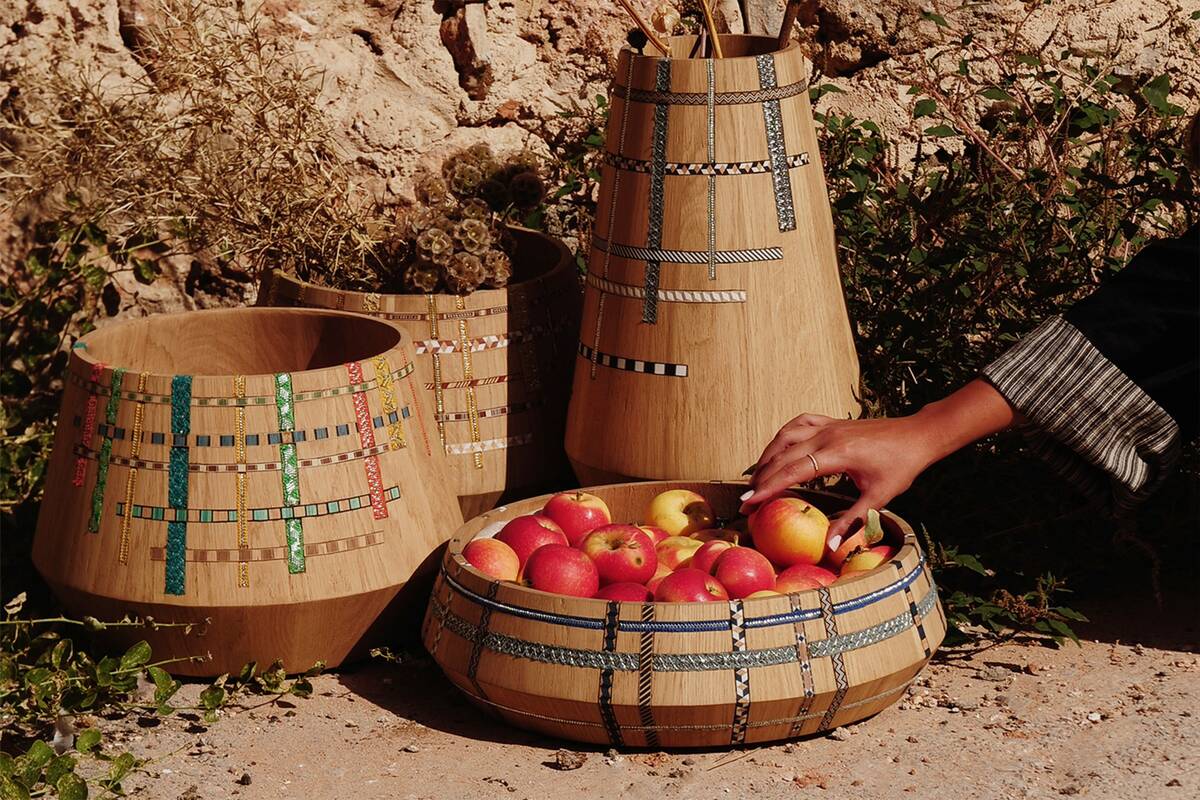
The Zenobie collection, introduced by Irthi and Nada Debs, is an intricately crafted interpretation of the vessels traditionally carried by Bedouin women. (Photo courtesy of Nada Debs)
Through initiatives such as Design Labs and Crafts Dialogue, Irthi artisans also collaborate with local and international designers.
A notable example, Al-Thuhoori said, was the collaboration between Emirati designer Abdullah Al-Mulla and Spanish designer Pepa Riverto, which merged Safeefah and pottery techniques.
The result was a collection of dining chairs and tables crafted from clay that, when assembled, form sculptural columns — a reflection of how traditional crafts can be integrated into contemporary furniture design.
Since its establishment, the council has introduced well-studied strategies to support artisans across social, economic and creative dimensions.
“We now see strong motivation and healthy competition among the women,” Al-Thuhoori said. “They take pride in innovating within their craft and representing their achievements confidently.”

More samples of the work of artisans trained at Irthi’s Skill Development Center. (Instagram: irthicouncil)
One such example is Amna Al-Thanhani, who began as a Talli trainee and has since become a trainer, mentoring a new generation of learners.
Sharjah’s designation as a UNESCO Creative City for Crafts and Folk Art in 2019 has amplified Irthi’s visibility and highlighted its role in preserving and modernizing Emirati crafts.
The recognition, Al-Thuhoori said, has strengthened regional and international partnerships, positioning Sharjah as “a vibrant hub for heritage innovation — where traditional craftsmanship meets contemporary design to build a sustainable creative future.”
The revival of heritage through craft, however, is not unique to the UAE.
In Jordan, hundreds of Palestinian refugee women are preserving another kind of story — stitched into fabric.

At the Social Enterprise Project, embroidery remains a time-honored craft that resists mechanization, with each stitch telling a story. (Supplied)
The Social Enterprise Project, based in Jerash Camp, employs more than 600 embroiderers who produce hand-finished scarves and keffiyehs inspired by traditional Palestinian patterns.
Each artisan signs her piece — a small but radical act of authorship.
According to SEP’s founders, embroidery remains “a time-honored craft that resists mechanization; each stitch tells a story.”
Their work has found new resonance through collaborations with regional designers such as Dana Odeh, founder and managing director of Rock n’ Shine.
She said the partnership with SEP began only months after launching her brand in 2018 while she was living in Russia.

At the Jerash Camp in Jordan, the Social Enterprise Project employs more than 600 embroiderers who produce hand-finished scarves and keffiyehs inspired by traditional Palestinian patterns. (Supplied)
Eager to stay connected to Middle Eastern craftsmanship, she was drawn to SEP’s mission and the women behind it.
“As a Palestinian, when I came across SEP and learned about their work empowering women artisans in Jerash Refugee Camp, something truly moved inside me,” Odeh told Arab News.
“Their story and the beauty of their hand-embroidered creations made me feel deeply connected to my roots and to the strength of my people. I instantly knew that if I were to represent a brand, it should be this one.”
Odeh focuses on keeping heritage intact while giving it modern relevance. She said each design choice began with meaning — motifs that carry emotion or memory — and she aimed to present them “in a way that feels modern and easy to wear.”
Her goal, she said, was to let the craftsmanship shine without making it feel old-fashioned, allowing the artistry of Palestinian embroidery to speak to contemporary audiences.

The embroidery created by SEP’s artists embodies generations of history and identity, according to Dana Odeh, founder and managing director of Rock n’ Shine. (Supplied)
“Since I represent SEP, I always try to stay true to their trademark patterns and authentic designs,” she said.
“These motifs already carry so much meaning and history, and I feel it’s important to preserve that. I might play a little with the colors or the way the embroidery is placed to make it more wearable today, but the heart of it, the traditional stitching and its story, always stays the same.”
Odeh sees her role as a bridge between authenticity and modern appeal.
The embroidery created by SEP’s artists, she said, embodies generations of history and identity, and she works to frame that heritage through current silhouettes and styling so that “the story stays the same, but the way we tell it speaks to more people.”
She said Rock n’ Shine began as a small handmade jewelry project in Moscow, but her discovery of SEP gave it deeper purpose, evolving the brand into a space that celebrates ethical craftsmanship and meaningful design.
“We now work not only with SEP but also with MADE51, a UN initiative supporting refugee artisans around the world. For me, it’s about helping the underprivileged, giving talented artisans the chance to earn, sustain their families, and feel proud of their work — using fashion to create opportunity, dignity and hope,” she said.

At the social Enterprise Project, each artisan signs her piece — a small but radical act of authorship. (Supplied)
At its heart, she added, the brand was about giving meaning to what people wear — pieces that connect beauty with purpose.
In Lebanon, design itself has become a language of resilience.
In May 2024, We Design Beirut transformed the city’s industrial landmarks — Villa Audi, PS Lab, and the Abroyan Factory — into living galleries.
The four-day event, founded by Mariana Wehbe alongside Samer Al-Ameen, brought together furniture-makers, metal artisans, and textile designers to highlight Beirut’s creative pulse.
“Our mandate for We Design Beirut was to ensure the exposure and sustainability of the different segments of the design scene in Lebanon,” Wehbe told Entrepreneur Middle East.
In another interview she added: “Creativity is the heartbeat of Beirut, and it is our intention to make sure it is brought back to life once again.”
Farther east, in Damascus, that conversation continues quietly through Aghabani embroidery — the fine silk-and-gold stitching once prized in Levantine homes. Small ateliers still produce table linens and garments bearing patterns unchanged for a century, even as many artisans have left the country.

Stitch design for Aghabani. (Photo courtesy: Rania Kataf / Syrian heritage Archive)
Their survival is less about commerce than continuity. To them, every finished piece is proof that war has not silenced Syria’s artisans.
Across these landscapes, from government initiatives and design councils to refugee collectives and family workshops, one thing is clear. Handmade traditions are not fading. They are changing, they are being rewoven into new economies, new identities, and new forms of beauty.
In every pattern and stitch, the region’s heritage continues to find its place in the present.


