

In Sudan, satellite images uncover atrocities in El-Fasher

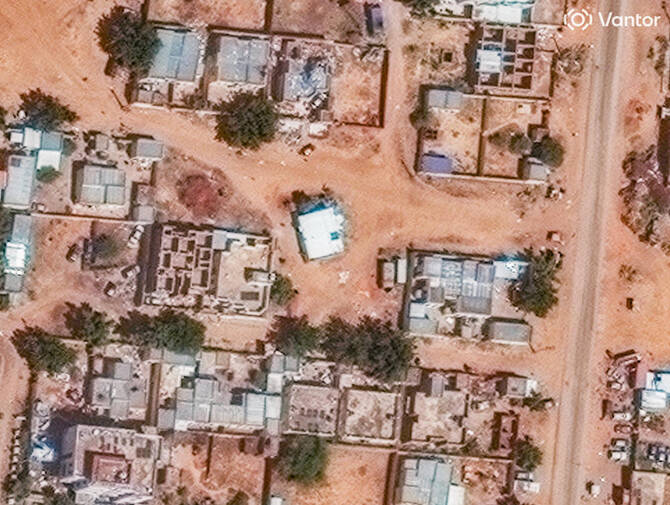
This satellite image from Vantor shows what experts suspect is a mass grave being dug near a mosque north of Saudi hospital in El-Fasher on Nov. 1 (Vantor via AP)
Short Url
Updated 05 November 2025
Follow

In Sudan, satellite images uncover atrocities in El-Fasher

  • Yale University’s Humanitarian Research Lab says the images are the only way to monitor the crisis in North Darfur's capital
  • Close-up aerial shots show evidence of door-to-door killings and mass graves

CAIRO: Satellite images from Sudan have played a crucial role in uncovering the atrocities committed during paramilitaries’ takeover of the last army stronghold in the western Darfur region.
In an interview with AFP, Nathaniel Raymond of Yale University’s Humanitarian Research Lab (HRL) said the aerial images were the only way to monitor the crisis unfolding on the ground in the city of El-Fasher, the capital of North Darfur.
On October 26, the paramilitary Rapid Support Forces (RSF), which have been fighting a brutal war with Sudan’s army for more than two years, claimed full control of the city they had besieged for nearly 18 months.
Close-up satellite images have emerged showing evidence of door-to-door killings, mass graves, red patches and bodies visible along an earthen berm — findings consistent with eyewitness accounts.

On October 28, HRL published footage from El-Fasher’s maternity hospital showing “piles of white objects” that were not present before and measured between “1.1 to 1.9 meters” (3.6 to 6.2 feet) — roughly the size of human bodies lying down or with limbs bent.
It said there were “reddish earth discolorations” on the ground nearby that could have been blood.
The following day, the World Health Organization announced the “tragic killing of more than 460 patients and medical staff” at the hospital.
The images released by HRL, which had been tracking the situation in El-Fasher throughout the siege, became “a spark plug for public outrage,” said Raymond.

‘Highest volume’

Since the start of the siege, HRL has been alerting the United Nations and the United States to developments on the ground, with its reports becoming a reference point for tracking territorial advances in the area.
Population movements, attacks, drone strikes and mass killings have been closely monitored in the city, where access remains blocked despite repeated calls to open humanitarian corridors.
Satellite imagery has become an indispensable tool for non-governmental organizations and journalists in regions where access is difficult or impossible — including Gaza, Ukraine and Sudan.
Several companies specializing in satellite imaging scan the globe daily, hindered only by weather conditions. Depending on the sensors onboard, satellites can clearly distinguish buildings, vehicles and even crowds.
HRL then cross-references the images with other material including online footage, social media and local news reports, according to Yale’s published methodology.
Raymond said that after El-Fasher’s fall paramilitaries “started posting videos of themselves killing people at the highest volume they ever had,” providing more material for analysis.
The team cross-checked these videos with the limited available information to identify, date and geolocate acts of violence using satellite imagery.
Raymond said the lab’s mission is to raise the alarm about the atrocities and collect evidence to ensure the perpetrators of war crimes do not escape justice.
He referenced similar aerial images taken after the 1995 Srebrenica massacre, which eventually helped bring charges against former Bosnian Serb military leader Ratko Mladic.
An international tribunal sentenced him to life imprisonment for war crimes and genocide.

Grim task ahead

The images from El-Fasher have triggered international outcry.
The prosecutor’s office at the International Criminal Court said on Monday that the atrocities there could amount to crimes against humanity and war crimes.
The public outrage was followed by a significant reduction in the amount of footage posted by paramilitaries on the ground, according to the HRL.
Of the videos still being shared, “very few, if any, have metadata in them,” said Raymond, who noted that the researchers had to count the bodies themselves.
He said they were not counting individual remains but tagging piles of bodies and measuring them as they get bigger.
He added, however, that the researchers’ workload has not decreased with the reduction in videos. Instead, they are now focusing on the grim task of tracing “the perpetrator’s transition from killing phase to disposal.”
“Are they going to do trenches? Are they going to light them on fire? Are they going to try to put them in the water?“


Washington presses Syria to shift from Chinese telecom systems

Updated 26 February 2026
Follow

Washington presses Syria to shift from Chinese telecom systems

  • Syria is exploring the possibility of procuring Chinese technology
  • It was unclear whether the United States ⁠pledged financial or logistical support to Syria to do so

DAMASCUS: The United States has warned Syria against relying on Chinese technology in its telecommunications sector, arguing it conflicts with US interests and threatens US national security, according to three sources familiar with the matter.
The message was conveyed during an unreported meeting between a US State Department team and Syrian Communications Minister Abdulsalam Haykal in San Francisco on Tuesday. Washington has been coordinating closely with Damascus since 2024, when Syria’s now President Ahmed Al-Sharaa ousted longtime leader Bashar Assad, who had a strategic partnership with China.
Syria is exploring the possibility of procuring Chinese technology to support its telecommunications towers and the infrastructure of local Internet service providers, according to a Syrian businessman involved in the procurement talks.
“The US side asked for clarity on the ministry’s plans regarding Chinese telecom equipment,” said ⁠another source briefed on ⁠the talks.
But Syrian officials said infrastructure development projects were time-critical and that Damascus was seeking greater vendor diversity, the source added.
SYRIAN OFFICIALS CITE US EXPORT CONTROLS AS TELECOMS BARRIER
Syria is open to partnering with US firms but the matter was urgent and export controls and “over-compliance” remained an issue, according to person familiar with the meeting in San Francisco.
A US diplomat familiar with the discussions told Reuters that the US State Department “clearly urged Syrians to use American technology or technology from allied countries in the telecoms sector.”
It was unclear whether the United States ⁠pledged financial or logistical support to Syria to do so.
Responding to Reuters questions, a US State Department spokesperson said: “We urge countries to prioritize national security and privacy over lower-priced equipment and services in all critical infrastructure procurement. If it seems too good to be true, it probably is.”
The spokesperson added that Chinese intelligence and security services “can legally compel Chinese citizens and companies to share sensitive data or grant unauthorized access to their customers’ systems” and promises by Chinese companies to protect customers’ privacy were “entirely inconsistent with China’s own laws and well-established practices.”
China has repeatedly rejected allegations of it using technology for spying purposes.
The Syrian Ministry of telecommunications told Reuters any decisions related to equipment and infrastructure are made “in accordance with national technical and security standards, ensuring data protection and service continuity.”
The ministry said it is also prioritizing the diversification of partnerships and technology sources to ⁠serve the national interest.
Syria’s telecom ⁠infrastructure has relied heavily on Chinese technology due to US sanctions imposed on successive Assad governments over the civil war that grew from a crackdown on anti-government protests in 2011.
Huawei technology accounts for more than 50 percent of the infrastructure of Syriatel and MTN, the country’s only telecom operators, according to a senior source at one of the companies and documents reviewed by Reuters. Huawei did not immediately respond to a request for comment.
Syria is seeking to develop its private telecommunications sector, devastated by 14 years of war, by attracting foreign investment.
In early February, Saudi Arabia’s largest telecom operator, STC, announced it would invest $800 million to “strengthen telecommunications infrastructure and connect Syria regionally and internationally through a fiber-optic network extending over 4,500 kilometers.”
The ministry of telecommunications says that US restrictions “hinder the availability of many American technologies and services in the Syrian market,” emphasizing that it welcomes expanding cooperation with US companies when these restrictions are lifted.
Syria has inadequate telecommunications infrastructure, with network coverage weak outside city centers and connection speeds in many areas barely exceeding a few kilobits per second.