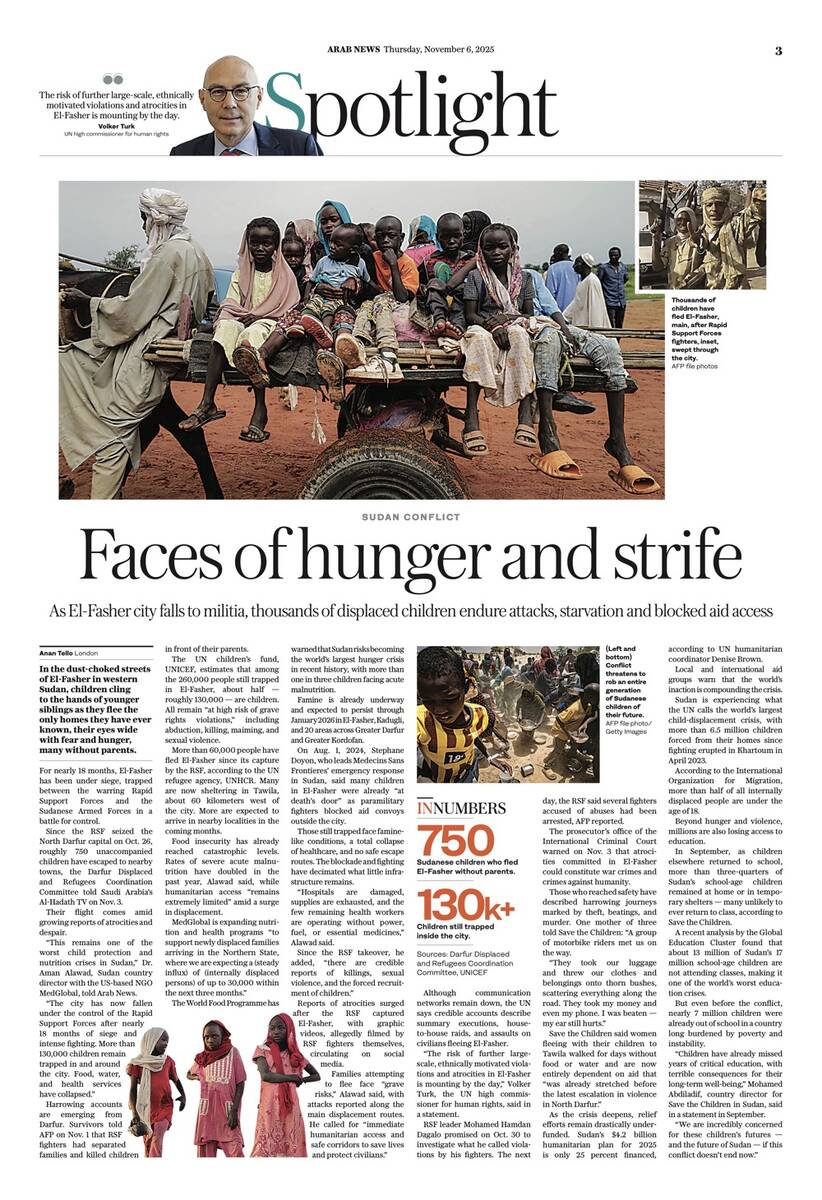
LONDON: In the dust-choked streets of El-Fasher in western Sudan, children cling to the hands of younger siblings as they flee the only homes they have ever known, their eyes wide with fear and hunger, many without parents.
For nearly 18 months, El-Fasher has been under siege, trapped between the warring Rapid Support Forces and the Sudanese Armed Forces in a battle for control.
Since the RSF seized the North Darfur capital on Oct. 26, roughly 750 unaccompanied children have escaped to nearby towns, the Darfur Displaced and Refugees Coordination Committee told Saudi Arabia’s Al-Hadath TV on Nov. 3.
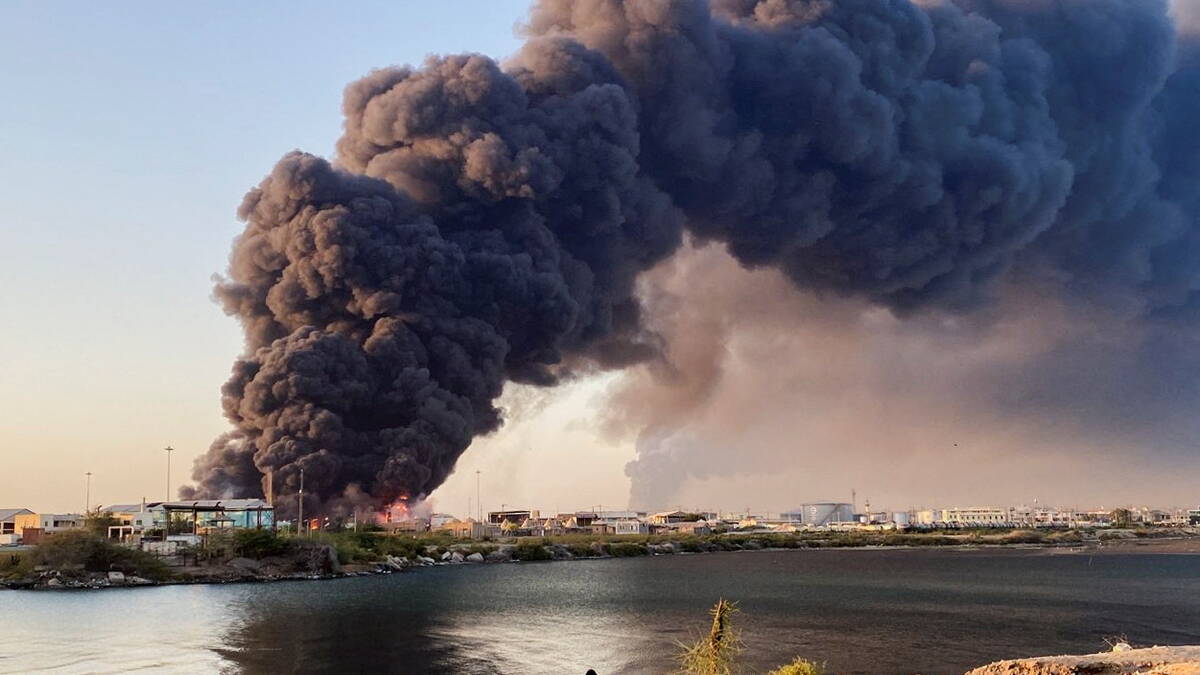
A view shows a large plume of smoke rising from fuel depot in Port Sudan, Sudan. (Reuters/File)
Their flight comes amid growing reports of atrocities and despair.
“This remains one of the worst child protection and nutrition crises in Sudan,” Dr. Aman Alawad, Sudan country director with the US-based NGO MedGlobal, told Arab News.
“The city has now fallen under the control of the Rapid Support Forces after nearly 18 months of siege and intense fighting. More than 130,000 children remain trapped in and around the city. Food, water, and health services have collapsed.”
Harrowing accounts are emerging from Darfur. Survivors told AFP on Nov. 1 that RSF fighters had separated families and killed children in front of their parents.
The UN children’s fund, UNICEF, estimates that among the 260,000 people still trapped in El-Fasher, about half — roughly 130,000 — are children. All remain “at high risk of grave rights violations,” including abduction, killing, maiming, and sexual violence.
More than 60,000 people have fled El-Fasher since its capture by the RSF, according to the UN refugee agency, UNHCR. Many are now sheltering in Tawila, about 60 kilometers west of the city. More are expected to arrive in nearby localities in the coming months.
Food insecurity has already reached catastrophic levels. Rates of severe acute malnutrition have doubled in the past year, Alawad said, while humanitarian access “remains extremely limited” amid a surge in displacement.
MedGlobal is expanding nutrition and health programs “to support newly displaced families arriving in the Northern State, where we are expecting a (steady influx) of (internally displaced persons) of up to 30,000 within the next three months.”

A man watches as smoke billows after a drone strike on the port of Port Sudan. (AFP/File)
“We are also expanding health, water, and sanitation activities in affected localities, as we anticipate a significant rise in general acute malnutrition including both severe and moderate cases among children,” Alawad added.
The World Food Programme has warned that Sudan risks becoming the world’s largest hunger crisis in recent history, with more than one in three children facing acute malnutrition — well above the 20 percent threshold for famine.
On Nov. 3, the Integrated Food Security Phase Classification reported that more than 21 million people in Sudan were suffering from high levels of acute food insecurity as of September 2025.
Famine is already underway and expected to persist through January 2026 in El-Fasher, Kadugli, and 20 areas across Greater Darfur and Greater Kordofan.
It was first declared in El-Fasher’s Zamzam displacement camp in August 2024, one of the world’s most severe hunger emergencies. But even before the city fell to the RSF, aid groups had sounded the alarm.
On Aug. 1, 2024, Stephane Doyon, who leads Medecins Sans Frontieres’ emergency response in Sudan, said many children in El-Fasher were already “at death’s door” as paramilitary fighters blocked aid convoys outside the city.
Those still trapped face famine-like conditions, a total collapse of healthcare, and no safe escape routes. The blockade and fighting have decimated what little infrastructure remains.
“Hospitals are damaged, supplies are exhausted, and the few remaining health workers are operating without power, fuel, or essential medicines,” Alawad said.
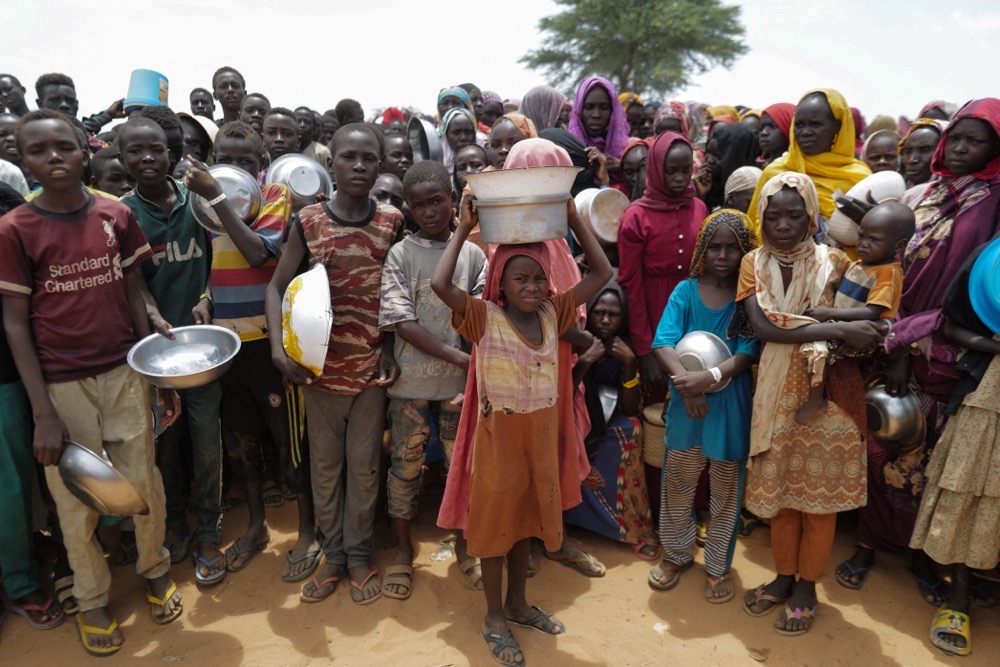
Sudanese children, who fled the conflict in Geneina in Sudan's Darfur region, line up to receive rice portions from Red Cross volunteers in Ourang on the outskirts of Adre, Chad. (Reuters/File)
Since the RSF takeover, he added, “there are credible reports of killings, sexual violence, and the forced recruitment of children.”
Medical services have been decimated. On Oct. 28, RSF fighters reportedly stormed the Saudi Maternity Hospital, killing more than 460 patients and companions.
Tedros Adhanom Ghebreyesus, director-general of the World Health Organization, said that before the attack, the WHO had already verified 185 assaults on health facilities since the start of the war, resulting in 1,204 deaths.
Reports of atrocities surged after the RSF captured El-Fasher, with graphic videos, allegedly filmed by RSF fighters themselves, circulating on social media.
Families attempting to flee face “grave risks,” Alawad said, with attacks reported along the main displacement routes. He called for “immediate humanitarian access and safe corridors to save lives and protect civilians.”
Although communication networks remain down, the UN says credible accounts describe summary executions, house-to-house raids, and assaults on civilians fleeing El-Fasher.
The UN human rights office said it received “distressing videos” showing dozens of unarmed men shot dead or surrounded by RSF fighters accusing them of being government soldiers. Hundreds of people have reportedly been detained while trying to flee, including a journalist.

Footage released on Sudan's paramilitary Rapid Support Forces (RSF) Telegram account. (RSF on Telegram)
“The risk of further large-scale, ethnically motivated violations and atrocities in El-Fasher is mounting by the day,” Volker Turk, the UN high commissioner for human rights, said in a statement, calling for “urgent and concrete action” to protect civilians.
RSF leader Mohamed Hamdan Dagalo promised on Oct. 30 to investigate what he called violations by his fighters. The next day, the RSF said several fighters accused of abuses had been arrested, AFP reported.
The prosecutor’s office of the International Criminal Court warned on Nov. 3 that atrocities committed in El-Fasher could constitute war crimes and crimes against humanity.
Those who reached safety have described harrowing journeys marked by theft, beatings, and murder. One mother of three told Save the Children: “We’ve been walking for the past four days from El-Fasher.
“A group of motorbike riders met us on the way. They took our luggage and threw our clothes and belongings onto thorn bushes, scattering everything along the road. They took my money and even my phone. I was beaten — my ear still hurts.”
She added: “They beat some people and battered them in front of us. They killed people and insulted us a lot.”

A woman holds a baby at the Zamzam displacement camp, close to El Fasher in North Darfur. (Reuters)
Another mother of six described how her family survived the siege. “We hid the children in trenches, and we ran into abandoned buildings during the attacks,” she said. “After that, we just ate umbaz (animal feed).”
Save the Children said women fleeing with their children to Tawila walked for days without food or water and are now entirely dependent on aid that “was already stretched before the latest escalation in violence in North Darfur.”
As the crisis deepens, relief efforts remain drastically underfunded. Sudan’s $4.2 billion humanitarian plan for 2025 is only 25 percent financed, according to UN humanitarian coordinator Denise Brown.
Local and international aid groups warn that the world’s inaction is compounding the crisis.
Sudan is experiencing what the UN calls the world’s largest child-displacement crisis, with more than 6.5 million children forced from their homes since fighting erupted in Khartoum in April 2023.
According to the International Organization for Migration, more than half of all internally displaced people are under the age of 18. Displacement has left them vulnerable to attack.
A UNICEF report released in March found that hundreds of children have been raped and sexually assaulted by armed men.
INNUMBER
• 750 Sudanese children who fled El-Fasher without parents.
• 130k+ Children still trapped inside the city.
(Sources: Darfur Displaced and Refugees Coordination Committee, UNICEF)
Since the beginning of last year, 221 child rape cases have been recorded across nine Sudanese states, including 16 children under 5, and four infants just a year old.
Beyond hunger and violence, millions are also losing access to education.
In September, as children elsewhere returned to school, more than three-quarters of Sudan’s school-age children remained at home or in temporary shelters — many unlikely to ever return to class, according to Save the Children.
A recent analysis by the Global Education Cluster found that about 13 million of Sudan’s 17 million school-age children are not attending classes, making it one of the world’s worst education crises.
That figure includes 7 million enrolled students unable to attend due to conflict or displacement, and 6 million who were never enrolled and risk losing the chance to learn altogether.
All 13 million have been out of school since at least April 2023, with more than two years of education lost to war.
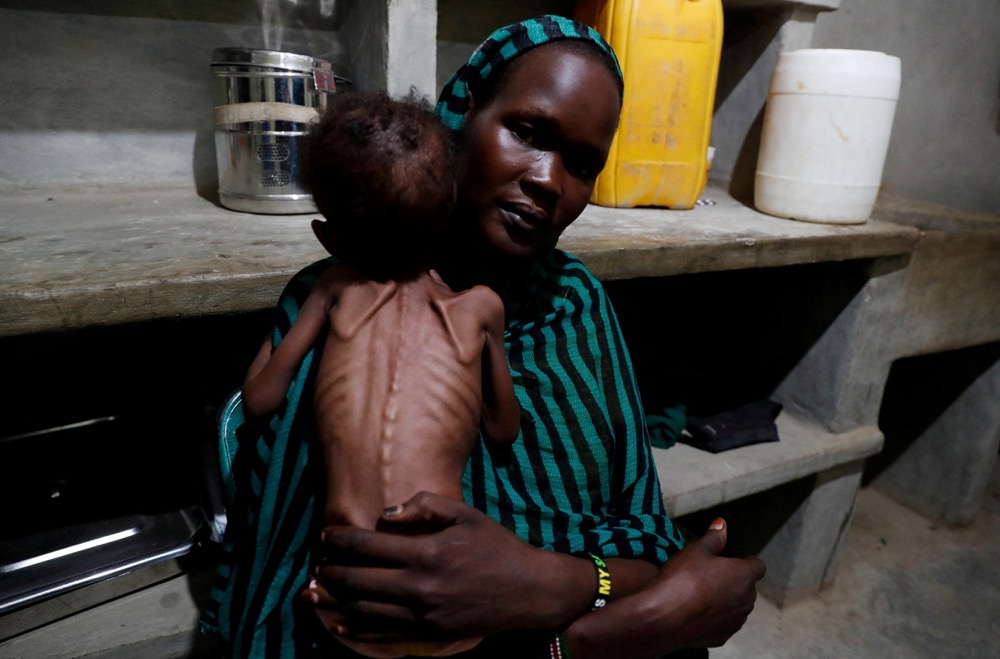
Holds her severely malnourished child at the paediatric ward of the Mother of Mercy Hospital in Gidel, South Kordofan. (Reuters)
But even before the conflict, nearly 7 million children were already out of school in a country long burdened by poverty and instability.
“Children have already missed years of critical education, with terrible consequences for their long-term well-being,” Mohamed Abdiladif, country director for Save the Children in Sudan, said in a statement in September.
“We are incredibly concerned for these children’s futures — and the future of Sudan — if this conflict doesn’t end now.”