No one could stop it: Sudanese describe mass rapes while fleeing El-Fasher

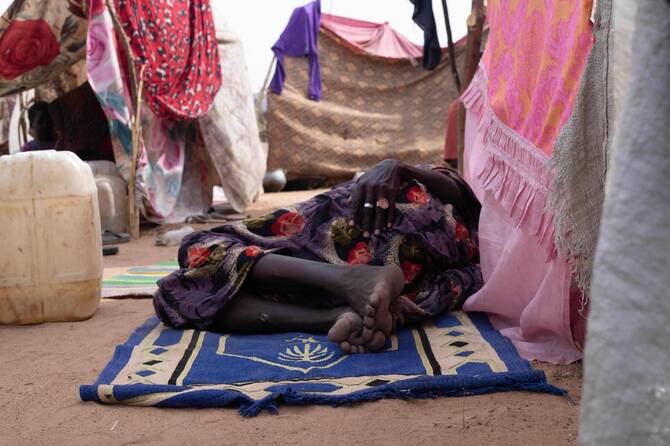
A displaced Sudanese who fled El-Fasher after the city fell to the Rapid Support Forces (RSF), rest on a mat in the camp of Um Yanqur, located on the southwestern edge of Tawila, in western Darfur region. (AFP)
Short Url
Updated 05 November 2025
Follow

No one could stop it: Sudanese describe mass rapes while fleeing El-Fasher

  • Reports have emerged of mass killings, sexual violence, attacks on aid workers, looting and abductions in a city where communications have largely been cut off

TAWILA: Sudanese mother Amira wakes up every day trembling, haunted by scenes of mass rapes she saw while fleeing the western city of El-Fasher after it was overrun by paramilitaries.
Following an 18-month siege marked by starvation and bombardment, El-Fasher — the last army stronghold in the western Darfur region — fell on October 26 to the paramilitary Rapid Support Forces (RSF), which have been at war with the military since April 2023.
Reports have since emerged of mass killings, sexual violence, attacks on aid workers, looting and abductions in a city where communications have largely been cut off.
“The rapes were gang rapes. Mass rape in public, rape in front of everyone and no one could stop it,” Amira said from a makeshift shelter in Tawila, some 70 kilometers (43 miles) west of El-Fasher.
The mother of four spoke during a webinar organized by campaign group Avaaz with several survivors of the recent violence.
Avaaz gave the survivors who participated in the webinar pseudonyms for their safety.
Doctors Without Borders (MSF) said more than 300 survivors of sexual violence had sought care from its teams in Tawila after a previous RSF assault on the nearby Zamzam camp, which displaced more than 380,000 people last spring.
“The RSF have carried out widespread sexual violence across towns and villages in Sudan to humiliate, assert control and to forcefully displace families and communities from their homes,” Amnesty International warned in April.
The rights group has documented conflict-related sexual violence by both the army and RSF — particularly in the capital Khartoum and Darfur — and denounced “over two decades of impunity for such crimes, particularly by the RSF.”

Nighttime assaults

In Korma, a village about 40 kilometers northwest of El-Fasher, Amira said she was detained for two days because she could not pay RSF fighters for safe passage.
Those unable to pay, she said, were denied food, water and the ability to leave, and mass assaults took place at night.
“You’d be asleep and they’d come and rape you,” she said.
“I saw with my own eyes people who couldn’t afford to pay and the fighters took their daughters instead.
“They said, ‘Since you can’t pay, we’ll take the girls.’ If you had daughters of a young age, they would take them immediately.”
Sudan’s state minister for social welfare, Sulimah Ishaq, told AFP that 300 women were killed on the day El-Fasher fell, “some after being sexually assaulted.”
The General Coordination for Displaced People and Refugees in Darfur, an independent humanitarian group, had documented 150 cases of sexual violence since the fall of El-Fasher until November 1.
“Some incidents occurred in El-Fasher and others during the journey to Tawila,” Adam Rojal, the organization’s spokesman, told AFP.

Raped at gunpoint

Last week, the UN confirmed alarming reports that at least 25 women were gang-raped when RSF forces entered a shelter for displaced people near El-Fasher University in the city’s west.
“Witnesses confirmed that RSF personnel selected women and girls and raped them at gunpoint,” Seif Magango, spokesperson for the UN human rights office, said in Geneva.
Mohamed, another survivor who joined the Avaaz webinar from Tawila, described how women and girls of all ages were searched and humiliated in Garni, a town between El-Fasher and Tawila.
“If they found nothing on you, they beat you. They searched the girls, even tearing apart their (sanitary) pads,” he said.
In Garni, before reaching Korma, Amira said that RSF leaders would “greet people,” but as soon as they left, the fighters who stayed behind began torturing them.
“They start categorising you: ‘You were married to a soldier.’ ‘You were affiliated with the army,’” she said.
She also described seeing men slaughtered with knives by RSF fighters. “My 12-year-old son saw it himself, and he is now in a bad psychological state,” she said.
“We wake up shivering from fear, images of slaughter haunt us.”
More than 65,000 people have fled El-Fasher since its fall, including more than 5,000 who are now sheltering in Tawila, which was already hosting more than 650,000 displaced people, according to the UN.
In Tawila, hundreds of people have huddled together in makeshift tents in a vast desert expanse, scrounging together what they can to prepare food for their families, AFP video shows.
Rojal of the General Coordination for Displaced People and Refugees in Darfur warned that the situation “needs immediate intervention.”
“People need food, water, medicine, shelter and psychological support,” he said.

After wins abroad, Syria leader must gain trust at home

Updated 2 sec ago
Follow

After wins abroad, Syria leader must gain trust at home

BEIRUT: One year after ousting Bashar Assad, Ahmed Al-Sharaa has restored Syria’s international standing and won sanctions relief.
But analysts warn the former jihadist still needs to secure trust on the home front.
Sectarian bloodshed in the country’s Alawite and Druze minority heartlands — alongside ongoing Israeli military operations — have shaken Syria as President Sharaa tries to lead the country out of 14 years of war.
“Syria has opened a new chapter that many once thought impossible,” said Nanar Hawach, senior Syria analyst at the International Crisis Group, citing relaunched diplomatic ties and foreign investment.
But he added: “International rehabilitation means little if all Syrians don’t feel safe walking their own streets.”
US President Donald Trump has taken a particular shining to the 43-year-old, a surprise political victory for a former militant who once had a US bounty on his head due to his ties to Al-Qaeda.
Sharaa has toured capitals from the Gulf to Europe to Washington since his Islamist alliance toppled Assad on December 8 last year, ending more than half a century of the family’s iron-fisted rule.
Washington and the UN Security Council have removed him from their respective “terrorism” and sanctions lists, and a delegation from the world body visited Damascus for the first time this week.
The United States, the European Union and Britain have lifted major economic sanctions on Syria, and Damascus has announced investment deals for infrastructure, transport and energy.
Sharaa has even visited Russia, whose military pounded his forces during the war and which is now home to an exiled Assad.
“Sharaa won abroad, but the real verdict comes at home,” Hawach said.

- ‘Real accountability’ -

Critics say Syria’s temporary constitution fails to reflect the country’s ethnic and religious diversity and concentrates power in the hands of a president appointed for a five-year transition.
The new authorities have disbanded armed factions, including Islamist and militant fighters, but absorbed most into the new-look army and security forces, including some foreign fighters.
And some government forces or their allies have been implicated in outbreaks of sectarian violence.
The Alawite community massacres in March, killed more than 1,700 people, according to the Syrian Observatory for Human Rights.
And clashes in July in south Syria’s Druze-majority Sweida province left more than 2,000 dead, including hundreds of Druze civilians.
Authorities have announced investigations into the bloodshed and have arrested and put some suspects on trial.
Nicholas Heras, from the New Lines Institute, said Sharaa “has twice failed as a leader of national reconciliation” — during the violence against the Alawites and the Druze.
Heras told AFP questions remain over “the extent to which he personally wants to rein in the militant Islamist militias that played the strongest role in bringing him to power in Damascus.”
Sharaa’s position, he said, remains precarious “because he does not command a unified security apparatus that can enforce the rules made by his government.”

- ‘Terrifying’ -

Gamal Mansour, a researcher at the University of Toronto, said “factional leaders who are essentially warlords” have taken up official roles, contributing to a “crisis of trust” among minorities.
However, “most Syrians believe Sharaa is the only option that provides guarantees,” he said, calling the prospect of a power vacuum “terrifying.”
Just keeping the country together is a major task, with some on the coast and in Sweida urging succession and the Kurds seeking decentralization, which Damascus has rejected.
A Kurdish administration in the northeast has agreed to integrate its institutions into the central government by year-end but progress has stalled.
Adding to pressures is neighboring Israel, which has repeatedly bombed Syria and wants to impose a demilitarised zone in the south.
Israel’s forces remain in a UN-patrolled buffer zone on the occupied Golan Heights and conduct regular incursions deeper into Syria despite the two sides holding direct talks.
On Monday, Trump told Israel to avoid destabilising Syria and its new leadership.
In October, committees selected new members of parliament, but the process excluded areas outside government control and Sharaa is still to appoint 70 of the 210 representatives.
lar/lg/dc