

Pakistani stock market gains over 3,000 points after ceasefire extension with Afghanistan

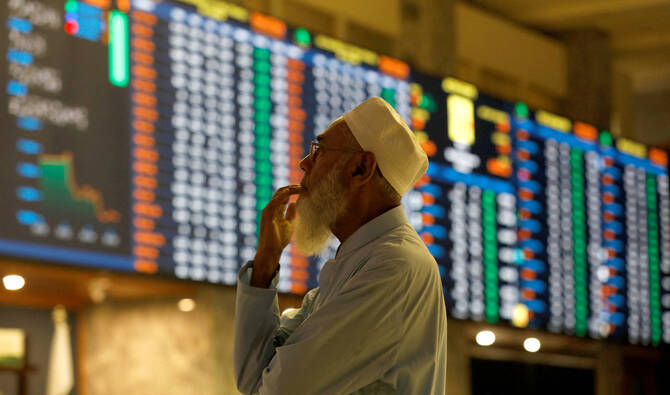
A stock broker reacts while monitoring the market on the electronic board displaying share prices during trading session at the Pakistan Stock Exchange, in Karachi, Pakistan July 3, 2023. (REUTERS/File)
Short Url
Updated 31 October 2025
Follow

Pakistani stock market gains over 3,000 points after ceasefire extension with Afghanistan

  • KSE-100 index gained 3,319.21 points or 2.12 percent to be suspended at 160,052.08 by noon
  • Pakistan and Afghanistan saw the worst clashes between them this month that killed dozens

ISLAMABAD: The Pakistan Stock Exchange (PSX) gained more than 3,000 points during intra-day trading on Friday, with an analyst attributing the jump to an extended ceasefire between Pakistan and Afghanistan.

The benchmark KSE-100 index gained 3,319.21 points, or 2.12 percent, to be suspended at 160,052.08 points by noon on Friday.

The development came a day after Pakistan and Afghanistan agreed in Istanbul to extend a ceasefire, following the worst border clashes between the two countries in years.

Ahsan Mehanti, chief executive officer at Arif Habib Commodities, said speculation in the earnings seasons played a catalyst role in bullish activity after the ceasefire.

“Bullish activity witnessed after reports of Pakistan, Afghanistan agreeing to maintain ceasefire in the cross-border conflict,” he told Arab News.

The two neighbors have agreed to extend the ceasefire, reached in Doha on Oct. 19, until the next round of talks scheduled for Nov. 6 in Istanbul, and to establish a monitoring and verification mechanism to ensure peace and penalize either country for any violations. The talks have been mediated by Turkiye and Qatar.

Pakistan has warned that the ceasefire is conditional, saying it will treat Afghanistan’s failure to act against Pakistani Taliban (TTP) hideouts as a breach of the extended truce.

The PSX reported losses during the conflict. On Thursday, it extended shed 1,732.19 points, or 1.09 percent, to close at 156,732.87 points.


Pakistan slashes power tariff for industries by Rs4.4 per unit to spur growth

Updated 12 min 40 sec ago
Follow

Pakistan slashes power tariff for industries by Rs4.4 per unit to spur growth

  • The development comes as Pakistan seeks to boost exports to ensure economic recovery under a $7 billion IMF program
  • PM Sharif also announces lowering export refinance rate from 7.5 percent to 4.5 percent, and electricity wheeling charges to Rs9 per unit

ISLAMABAD: Prime Minister Shehbaz Sharif on Friday announced a Rs4.4 ($0.014) cut in electricity tariffs for industrial consumers, saying the move is aimed at lowering production costs and spurring economic activity in Pakistan.

Manufacturers in Pakistan have long complained of high electricity price, i.e. Rs22.98 per unit, for industrial consumers, arguing that it has dampened industrial growth and made local products less competitive globally.

The reduction in power tariffs for industries is expected to lower production costs that will allow exporters to offer more competitive prices in international markets and increase profit margins through higher capacity utilization.

Addressing businessmen and exporters at a ceremony in Islamabad, Sharif said there was no alternative to export-driven economic growth and his government will devise all future economic policies in consultation with them.

“Four rupees and four paisas per unit are being reduced in electricity tariffs for industry,” the prime minister announced at the ceremony. “If it were up to me, I would reduce it by another 10 rupees, but my hands are tied.”

The development comes as Pakistan, which has long struggled with boom-bust cycles, seeks to boost foreign investment and increase exports as it navigates a long path to economic recovery under a $7 billion International Monetary Fund (IMF) program.

The prime minister said they have reduced the export refinance rate from 7.5 percent to 4.5 percent.

“I believe this is a very significant facility being extended to you,” he said. “God willing, it will help Pakistan’s exports rebound and it will certainly be of immense benefit, especially to those who need financing.”

During his address, Sharif also announced lowering wheeling charges for industries by Rs9 ($0.032) per unit, noting the country’s economy had stabilized, inflation had come down to single digits and the policy rate stood at 10.5 percent.

In Pakistan, wheeling charges refer to fees paid by electricity consumers and generators to use the national grid’s transmission and distribution network to move electricity from suppliers to end-users under the Competitive Trading Bilateral Contracts Market (CTBCM).

“I think this should help you sell your power to neighboring industries,” he told businesspersons at the event.