

Pakistan slashes power tariff for industries by Rs4 per unit to spur growth

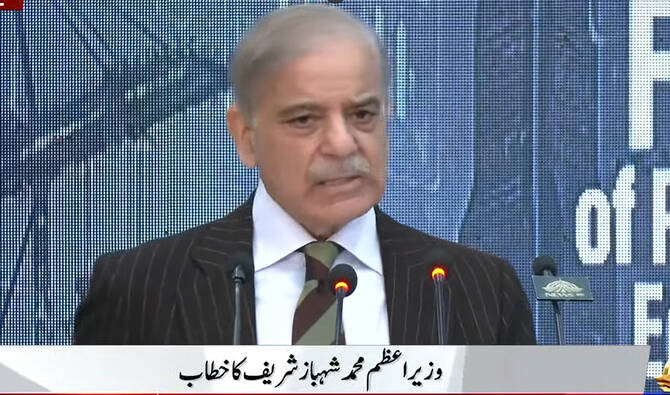
Prime Minister Shehbaz Sharif addresses the country’s major exporters and business figures at a ceremony in Islamabad, Pakistan, on January 30, 2026. (Screenshot/PTVNews/YouTube)
Short Url
Updated 30 January 2026
Follow

Pakistan slashes power tariff for industries by Rs4 per unit to spur growth

  • The development comes as Pakistan seeks to boost exports to ensure economic recovery under a $7 billion IMF program
  • PM Sharif also announces lowering export refinance rate from 7.5 percent to 4.5 percent, and electricity wheeling charges to Rs9 per unit

ISLAMABAD: Prime Minister Shehbaz Sharif on Friday announced a Rs4.04 ($0.014) cut in electricity tariffs for industrial consumers, saying the move is aimed at lowering production costs and spurring economic activity in Pakistan.

Manufacturers in Pakistan have long complained of high electricity price, i.e. Rs22.98 per unit, for industrial consumers, arguing that it has dampened industrial growth and made local products less competitive globally.

The reduction in power tariffs for industries is expected to lower production costs that will allow exporters to offer more competitive prices in international markets and increase profit margins through higher capacity utilization.

Addressing businessmen and exporters at a ceremony in Islamabad, Sharif said there was no alternative to export-driven economic growth and his government will devise all future economic policies in consultation with them.

“Four rupees and four paisas per unit are being reduced in electricity tariffs for industry,” the prime minister announced at the ceremony. “If it were up to me, I would reduce it by another 10 rupees, but my hands are tied.”

The development comes as Pakistan, which has long struggled with boom-bust cycles, seeks to boost foreign investment and increase exports as it navigates a long path to economic recovery under a $7 billion International Monetary Fund (IMF) program.

The prime minister said they have reduced the export refinance rate from 7.5 percent to 4.5 percent.

“I believe this is a very significant facility being extended to you,” he said. “God willing, it will help Pakistan’s exports rebound and it will certainly be of immense benefit, especially to those who need financing.”

During his address, Sharif also announced lowering wheeling charges for industries by Rs9 ($0.032) per unit, noting the country’s economy had stabilized, inflation had come down to single digits and the policy rate stood at 10.5 percent.

In Pakistan, wheeling charges refer to fees paid by electricity consumers and generators to use the national grid’s transmission and distribution network to move electricity from suppliers to end-users under the Competitive Trading Bilateral Contracts Market (CTBCM).

“I think this should help you sell your power to neighboring industries,” he told businesspersons at the event.


Sindh assembly passes resolution rejecting move to separate Karachi

Updated 21 February 2026
Follow

Sindh assembly passes resolution rejecting move to separate Karachi

  • Chief Minister Shah cites constitutional safeguards against altering provincial boundaries
  • Calls to separate Karachi intensified amid governance concerns after a mall fire last month

ISLAMABAD: The provincial assembly of Pakistan’s southern Sindh province on Saturday passed a resolution rejecting any move to separate Karachi, declaring its territorial integrity “non-negotiable” amid political calls to carve the city out as a separate administrative unit.

The resolution comes after fresh demands by the Muttahida Qaumi Movement (MQM) and other voices to grant Karachi provincial or federal status following governance challenges highlighted by the deadly Gul Plaza fire earlier this year that killed 80 people.

Karachi, Pakistan’s largest and most densely populated city, is the country’s main commercial hub and contributes a significant share to the national economy.

Chief Minister Syed Murad Ali Shah tabled the resolution in the assembly, condemning what he described as “divisive statements” about breaking up Sindh or detaching Karachi.

“The province that played a foundational role in the creation of Pakistan cannot allow the fragmentation of its own historic homeland,” Shah told lawmakers, adding that any attempt to divide Sindh or separate Karachi was contrary to the constitution and democratic norms.

Citing Article 239 of Pakistan’s 1973 Constitution, which requires the consent of not less than two-thirds of a provincial assembly to alter provincial boundaries, Shah said any such move could not proceed without the assembly’s approval.

“If any such move is attempted, it is this Assembly — by a two-thirds majority — that will decide,” he said.

The resolution reaffirmed that Karachi would “forever remain” an integral part of Sindh and directed the provincial government to forward the motion to the president, prime minister and parliamentary leadership for record.

Shah said the resolution was not aimed at anyone but referred to the shifting stance of MQM in the debate while warning that opposing the resolution would amount to supporting the division of Sindh.

The party has been a major political force in Karachi with a significant vote bank in the city and has frequently criticized Shah’s provincial administration over its governance of Pakistan’s largest metropolis.

Taha Ahmed Khan, a senior MQM leader, acknowledged that his party had “presented its demand openly on television channels with clear and logical arguments” to separate Karachi from Sindh.

“It is a purely constitutional debate,” he told Arab News by phone. “We are aware that the Pakistan Peoples Party, which rules the province, holds a two-thirds majority and that a new province cannot be created at this stage. But that does not mean new provinces can never be formed.”

Calls to alter Karachi’s status have periodically surfaced amid longstanding complaints over governance, infrastructure and administrative control in the megacity, though no formal proposal to redraw provincial boundaries has been introduced at the federal level.