FII9: Standard Chartered ‘very optimistic’ about Saudi Arabia amid investment boom — CEO

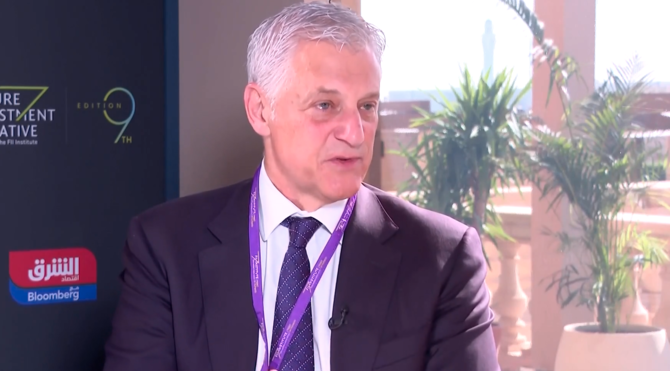
Standard Chartered CEO Bill Winters. Screenshot
Short Url
Updated 29 October 2025
Follow

FII9: Standard Chartered ‘very optimistic’ about Saudi Arabia amid investment boom — CEO

RIYADH: London-based Standard Chartered bank is ramping up operations in Saudi Arabia as it seeks to capture opportunities from the Kingdom’s rapid economic transformation, according to Group CEO Bill Winters. 

Speaking to Asharq Bloomberg on the sidelines of the Future Investment Initiative in Riyadh, Winters said the lender believes Saudi Arabia is going through a “fundamental investment boom” amid rapid economic change.

Winters’ comments underscore the key role international banks are playing in Saudi Arabia’s Vision 2030, a strategic framework to diversify the economy away from oil dependence. 

“We’re very optimistic about Saudi,” Winters said. “We opened up a full bank ... have a full banking license in Saudi going back about five years, which we’re fully ramping up as we speak — building quite substantially in the Kingdom,” he said. 

The CEO added: “We’re quite fortunate in terms of timing that we were granted this license at a time when Saudi is going through such a fundamental investment boom and transformation.” 

Winters emphasized that the bank aims to act as a bridge between international investors and Saudi companies expanding abroad, while also supporting the country’s evolving capital markets. 

“We’re in a position to bring international investors to Saudi to represent and to finance and provide services to Saudi companies going abroad, supporting trade flows in the region,” he said. 

Winters added: “We’re a leading issuer in the debt capital markets across the region and within the Kingdom, absolutely. The Kingdom has reformed tremendously. The financial markets are evolving quickly.” 

The executive noted that the key challenge now is ensuring that sufficient funding — domestic and foreign — reaches Saudi Arabia’s ambitious development pipeline. 

“The key now is to make sure that there’s enough money, either in the Kingdom, or coming from outside,” Winters said. “We have our own balance sheet, which we bring to bear in the Kingdom. We have very substantial exposures in the Kingdom.” 

A key part of their strategy involves originating credit for major infrastructure projects, which are then channeled to non-bank investors such as private credit funds, insurance companies, and pension funds. 

Winters concluded by stressing that Saudi Arabia’s growth ambitions can be met if the right capital connections continue to form. 

“There’s enough money in the world to fund the growth aspirations of Saudi,” he said. “What we need to do is connect it with the project, which is happening — but there’s no fast-growing major economy in the world that relies extraordinarily on banks.” 


Saudi investment pipeline active as reforms advance, says Pakistan minister

Updated 08 February 2026
Follow

Saudi investment pipeline active as reforms advance, says Pakistan minister

ALULA: Pakistan’s Finance Minister Mohammed Aurangzeb described Saudi Arabia as a “longstanding partner” and emphasized the importance of sustainable, mutually beneficial cooperation, particularly in key economic sectors.

Speaking to Arab News on the sidelines of the AlUla Conference for Emerging Market Economies, Aurangzeb said the relationship between Pakistan and Saudi Arabia remains resilient despite global geopolitical tensions.

“The Kingdom has been a longstanding partner of Pakistan for the longest time, and we are very grateful for how we have been supported through thick and thin, through rough patches and, even now that we have achieved macroeconomic stability, I think we are now well positioned for growth.”

Aurangzeb said the partnership has facilitated investment across several sectors, including minerals and mining, information technology, agriculture, and tourism. He cited an active pipeline of Saudi investments, including Wafi’s entry into Pakistan’s downstream oil and gas sector.

“The Kingdom has been very public about their appetite for the country, and the sectors are minerals and mining, IT, agriculture, tourism; and there are already investments which have come in. For example, Wafi came in (in terms of downstream oil and gas stations). There’s a very active pipeline.”

He said private sector activity is driving growth in these areas, while government-to-government cooperation is focused mainly on infrastructure development.

Acknowledging longstanding investor concerns related to bureaucracy and delays, Aurangzeb said Pakistan has made progress over the past two years through structural reforms and fiscal discipline, alongside efforts to improve the business environment.

“The last two years we have worked very hard in terms of structural reforms, in terms of what I call getting the basic hygiene right, in terms of the fiscal situation, the current economic situation (…) in terms of all those areas of getting the basic hygiene in a good place.”

Aurangzeb highlighted mining and refining as key areas of engagement, including discussions around the Reko Diq project, while stressing that talks with Saudi investors extend beyond individual ventures.

“From my perspective, it’s not just about one mine, the discussions will continue with the Saudi investors on a number of these areas.”

He also pointed to growing cooperation in the IT sector, particularly in artificial intelligence, noting that several Pakistani tech firms are already in discussions with Saudi counterparts or have established offices in the Kingdom.

Referring to recent talks with Saudi Minister of Economy and Planning Faisal Alibrahim, Aurangzeb said Pakistan’s large freelance workforce presents opportunities for deeper collaboration, provided skills development keeps pace with demand.

“I was just with (Saudi) minister of economy and planning, and he was specifically referring to the Pakistani tech talent, and he is absolutely right. We have the third-largest freelancer population in the world, and what we need to do is to ensure that we upscale, rescale, upgrade them.”

Aurangzeb also cited opportunities to benefit from Saudi Arabia’s experience in the energy sector and noted continued cooperation in defense production.

Looking ahead, he said Pakistan aims to recalibrate its relationship with Saudi Arabia toward trade and investment rather than reliance on aid.

“Our prime minister has been very clear that we want to move this entire discussion as we go forward from aid and support to trade and investment.”