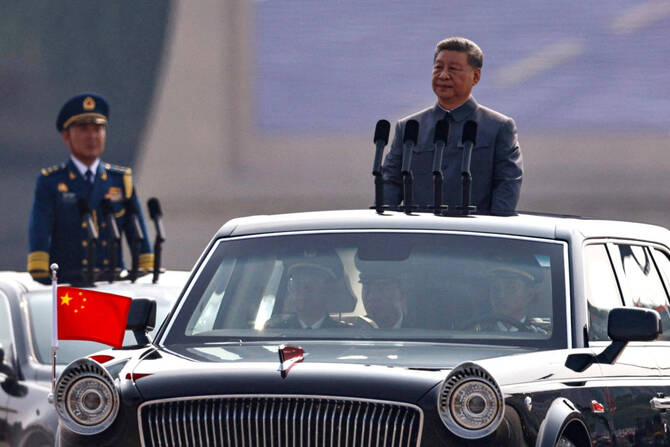
WASHINGTON: US President Donald Trump has said he will host Chinese leader Xi Jinping at the White House late this year, as the world’s top two economies look to reset ties marred by a roiling trade war.
Trump made the comment in an interview with NBC News taped Wednesday — the same day he and Xi had a wide-ranging conversation about trade, Taiwan, Russia’s war in Ukraine, and the situation in Iran.
Trump is expected to go to China in April, before Xi would then visit the United States.
“He’s coming to the White House, yeah — toward the end of the year,” Trump said in the interview, parts of which aired Sunday.
“These are the two most powerful countries in the world and we have a very good relationship.”
Since Trump returned to the White House a year ago, he has been a prolific purveyor of tariffs, unveiling sector-specific levies on steel, autos and other items as well as broader measures to achieve a variety of policy objectives.
The White House has jousted with Beijing on trade but reached a broad truce with China after a major escalation last spring.
Despite moves from the United States intended to lessen its dependence on Chinese manufacturing, the two countries remain deeply entwined economically.
Xi, who last visited the United States in 2023, on Wednesday warned Trump to proceed with “caution” on selling arms to self-ruled Taiwan, which China claims as part of its territory.
The Chinese leader also voiced hope that bilateral issues including trade could be resolved amicably between Beijing and Washington.
“By tackling issues one by one and continuously building mutual trust, we can forge a right way for the two countries to get along,” Xi said, according to state broadcaster CCTV.
Trump meanwhile said the conversation with Xi was “excellent” and that “we both realize how important it is to keep it that way.”
On Friday, the United States urged three-way talks with Russia and China to set new limits on nuclear weapons, but Beijing so far has rejected joining disarmament negotiations “at this stage.”


![]()


Trump says China’s Xi to visit US ‘toward the end of the year’
Short Url
https://arab.news/8yfrf
Trump says China’s Xi to visit US ‘toward the end of the year’
- Trump is expected to go to China in April, before Xi would then visit the United States.
- Despite US moves intended to lessen its dependence on Chinese manufacturing, the two countries remain deeply entwined economically


Militants kill 6 officers and a civilian in ambushes on police vehicles in northwest Pakistan
- Assailants ambushed a police vehicle and killed one officer in Kohat — When police reinforcements arrived minutes later, they launched another attack and killed five more officers and a civilian
- No group claimed responsibility for this week’s attacks, but suspicion may fall on the Pakistani Taliban, also known as Tehrik-e-Taliban Pakistan, or the TTP
PESHAWAR, Pakistan: A pair of attacks on police vehicles by suspected militants killed at least six police officers and a civilian in northwest Pakistan on Tuesday, authorities said.
The assailants ambushed a police vehicle and killed one officer in Kohat, a district in Khyber Pakhtunkhwa province. When police reinforcements arrived minutes later, they launched another attack and killed five more officers and a civilian, police official Kamran Khan said.
Separately on Tuesday, a suicide bomber detonated explosives at a police post in Bukkur, a district in eastern Punjab province, killing two officers and wounding four others, police official Shahzad Rafiq said.
He provided no further details and only said officers were still investigating.
No group immediately claimed responsibility for the attacks, which have increased across the country in recent months.
President Asif Ali Zardari condemned the attacks in Kohat and Bukkur and offered condolences to the victims’ families.
The latest violence followed an attack on a paramilitary post in Karak on Monday, when a drone loaded with explosives wounded several officers. The attackers later ambushed two ambulances transporting the wounded, killing three officers and burning their bodies before fleeing. The driver of the second ambulance transported several wounded officers despite suffering burn injuries and authorities recovered the remains of the three officers.
No group claimed responsibility for this week’s attacks, but suspicion may fall on the Pakistani Taliban, also known as Tehrik-e-Taliban Pakistan, or the TTP. The TTP is separate from, but closely allied with, Afghanistan’s Taliban. Islamabad has accused the group of operating from inside Afghanistan, a claim the TTP and Kabul deny.
Pakistan’s military said it killed at least 70 militants on Sunday in strikes along the Afghan border, targeting hideouts of Pakistani militants blamed for recent attacks inside the country.
The assailants ambushed a police vehicle and killed one officer in Kohat, a district in Khyber Pakhtunkhwa province. When police reinforcements arrived minutes later, they launched another attack and killed five more officers and a civilian, police official Kamran Khan said.
Separately on Tuesday, a suicide bomber detonated explosives at a police post in Bukkur, a district in eastern Punjab province, killing two officers and wounding four others, police official Shahzad Rafiq said.
He provided no further details and only said officers were still investigating.
No group immediately claimed responsibility for the attacks, which have increased across the country in recent months.
President Asif Ali Zardari condemned the attacks in Kohat and Bukkur and offered condolences to the victims’ families.
The latest violence followed an attack on a paramilitary post in Karak on Monday, when a drone loaded with explosives wounded several officers. The attackers later ambushed two ambulances transporting the wounded, killing three officers and burning their bodies before fleeing. The driver of the second ambulance transported several wounded officers despite suffering burn injuries and authorities recovered the remains of the three officers.
No group claimed responsibility for this week’s attacks, but suspicion may fall on the Pakistani Taliban, also known as Tehrik-e-Taliban Pakistan, or the TTP. The TTP is separate from, but closely allied with, Afghanistan’s Taliban. Islamabad has accused the group of operating from inside Afghanistan, a claim the TTP and Kabul deny.
Pakistan’s military said it killed at least 70 militants on Sunday in strikes along the Afghan border, targeting hideouts of Pakistani militants blamed for recent attacks inside the country.
Latest updates


© 2026 SAUDI RESEARCH & PUBLISHING COMPANY, All Rights Reserved And subject to Terms of Use Agreement.