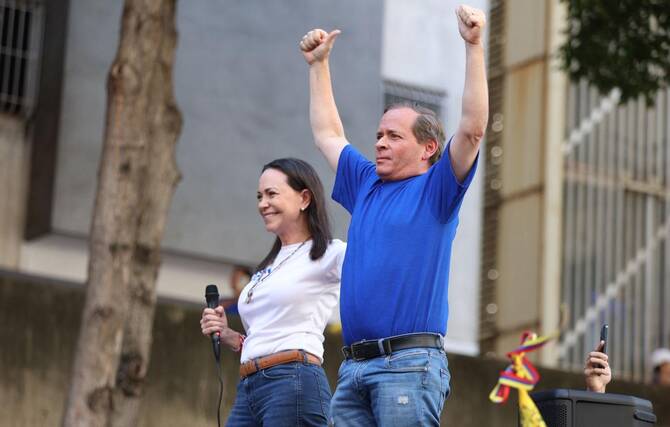
CARACAS: Venezuelan opposition leader Juan Pablo Guanipa on Sunday was released after more than eight months in prison for what are widely considered to be politically motivated accusations.
Guanipa, one of the closest allies of opposition powerhouse María Corina Machado, had been held at a detention facility in the capital, Caracas. His release comes as the government of acting President Delcy Rodríguez faces mounting pressure to free hundreds of people whose detentions months or years ago have been linked to their political beliefs.
“Today, we are being released,” Guanipa, standing with an armored vehicle and officers behind him, said in a video posted on X. “Much to discuss about the present and future of Venezuela, always with the truth at the forefront.”
Venezuelan-based prisoners’ rights group Foro Penal confirmed the release of at least 18 people on Sunday.
In addition to Guanipa, Machado’s political organization said some of its local political organizers as well as her attorney, Perkins Rocha, were among those freed.
“Let’s go for the freedom of Venezuela!” she posted on X.
Guanipa was detained in late May and accused by Interior Minister Diosdado Cabello of participating in an alleged “terrorist group” plotting to boycott that month’s legislative election. Guanipa’s brother Tomás rejected the accusation, and said that the arrest was meant to crack down on dissent.
“Thinking differently cannot be criminalized in Venezuela, and today, Juan Pablo Guanipa is a prisoner of conscience of this regime,” Tomás Guanipa said after the arrest. “He has the right to think as he thinks, the right to defend his ideas, and the right to be treated under a constitution that is not being enforced today.”
Rodríguez was sworn in as Venezuela’s acting president after the capture in Caracas of then-President Nicolás Maduro by the US military last month.
Her government announced on Jan. 8 it would free a significant number of prisoners — a central demand of the country’s opposition and human rights organizations with backing from the United States — but families and rights watchdogs have criticized authorities for the slow pace of the releases.
The ruling party-controlled National Assembly this week began debating an amnesty bill that could lead to the release of hundreds of prisoners. The opposition and nongovernmental organizations have reacted with cautious optimism as well as with suggestions and demands for more information on the contents of the proposal.
National Assembly President Jorge Rodríguez on Friday posted a video on Instagram showing him outside a detention center in Caracas and saying that “everyone” would be released no later than next week, once the amnesty bill is approved.


![]()

Venezuelan opposition leader Juan Pablo Guanipa freed after 8 months in prison
Short Url
https://arab.news/9padp
Venezuelan opposition leader Juan Pablo Guanipa freed after 8 months in prison
- Guanipa is one of the closest allies of opposition powerhouse María Corina Machado
- Venezuelan government faces mounting pressure to free hundreds of people detained over political beliefs


Latest updates


© 2026 SAUDI RESEARCH & PUBLISHING COMPANY, All Rights Reserved And subject to Terms of Use Agreement.